





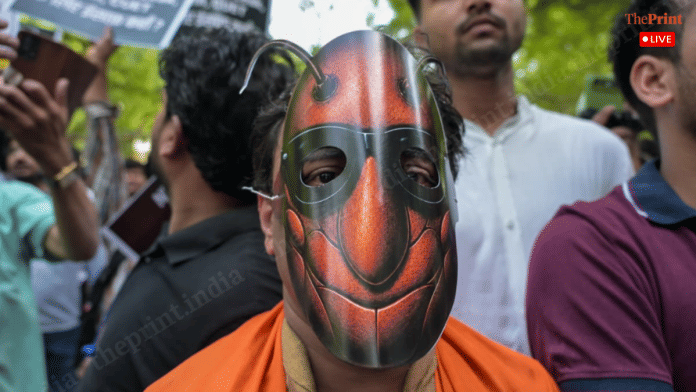


A month ago, the Chief Justice of India remarked, in passing, that jobless young Indians who turn to activism behave like cockroaches. He clarified soon enough that he had meant only those who enter professions on fake degrees. But the word had already skittered out of reach. Frustrated young Indians picked it up, wore it, and turned the insult into a banner. On the evening of 6 June, hundreds swarmed New Delhi’s Jantar Mantar with national flags for the first rally of the new Cockroach Janta Party. The protests have since reached Maharashtra.
That a protest of this scale was permitted at all is reassuring. Though a democracy permitting its citizens’ dissent is fulfilling a duty, not doing them a favour. When the State forgets that duty, the citizen’s recourse is a court of law. Now, the Cockroach Janta Party got its permission. Many protesters never do, and many more are dragged into court by someone bent on shutting them down. That leaves a narrower question than the week’s politics, and a more durable one: when a protest matter reaches a High Court, how does the Indian judicial system actually treat it?
From TheProfesseer’s dataset, we sampled 136 matters before the Bombay and Delhi High Courts between 2021 and 2026, in which the court ruled on a protest: its permission, its policing, its removal, or its punishment.
Who are India’s cockroaches?
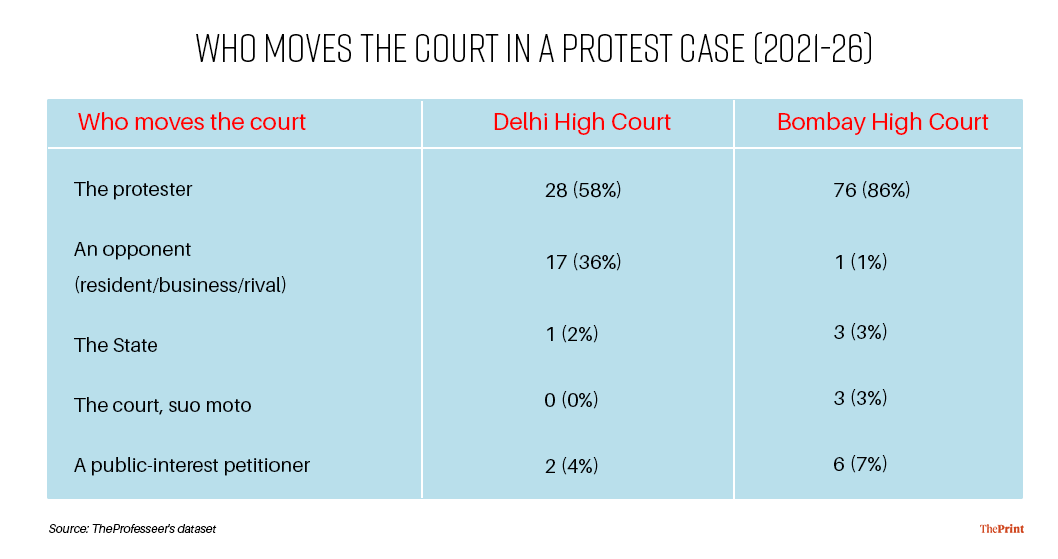
Mostly, India’s protesters are singular individuals who file their own cases. Across jurisdictions, they move the court in 76 per cent of the matters. They mostly ask for a venue, for protection, or for an FIR to be quashed.
While this is unsurprising, who makes up the rest usually goes unnoticed. In Delhi, more than a third of protest cases are filed not by a protester but by someone determined to shut one down: a resident’s association, a school, liquor stores ensconced in glass, and occasionally, a political outfit disguised in NGO clothing asking the court to clear the streets. The heckler’s veto is less a clash of citizens than a trade remedy; average Kumars trying to get to work.
What cockroaches want
Our protesters, in court at least, are not as ambitious as one would imagine. Their aims are not the caricature painted of them—some overzealous pursuit to topple a regime or to sweep an election at home. Their requests are smaller, nationally-rooted, and far more, if you will, human.
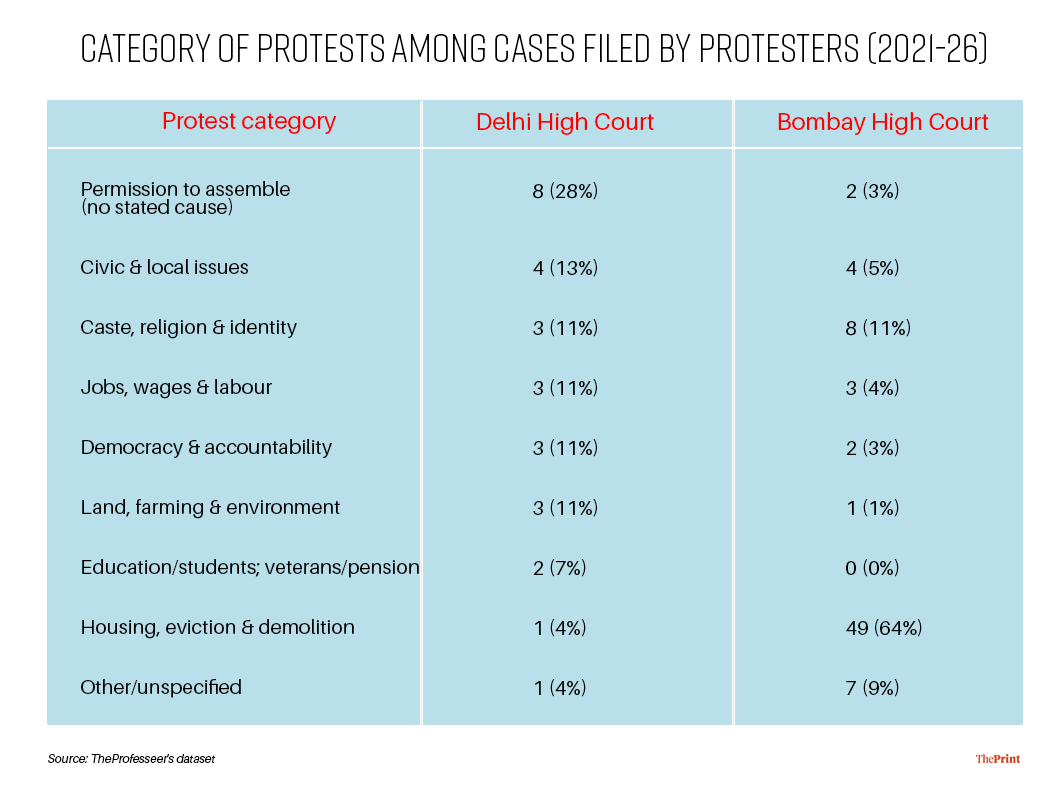
In Delhi, the case-titles read like a roll-call of the decade’s causes: Himalayan statehood, a farmers’ revolt over crop prices and poor water supply, bonded labour, and soldiers seeking their pension.
In Bombay High Court, Shiv Sena (UBT) had to sue the city to hold its Dussehra rally at Shivaji Park, and the court found the municipality had “misused its powers“. Months later, when the CPI(M) asked to march against the war in Gaza, the same court first told it to “be patriots” and take up Indian causes, before the police granted permission anyway. On aggregate, these fights are outliers. Two-thirds of Mumbai’s protest cases deal with property, largely from an anti-encroachment drive in Pimpri-Chinchwad’s Kudalwadi, where owners of unauthorised scrap godowns blockaded bulldozers and went to court to stop the demolition.
Also read: The case for an intelligent one-way attack drone
What awaits the cockroaches in courts?
In most of these cases, by the time a matter approaches the court as dispute, either a protest has elapsed and someone has had a grievance about the way it was conducted, or, alternatively, a protest was denied permission by the police and the rejection is contended. We only ever meet the cockroaches caught in the light. The ones that scurried off unbothered never trouble a cause-list. Therefore, the inherent selection of cases that reach courts that makes it a poor proxy for the general protest-friendliness of the Indian state.
Furthermore, to side with a protester, a court must also take an affirmative stance for the demonstration—an awkward position for a bench to occupy. And yet, it often does, especially if the protester is the first mover. Challenge a wrongful FIR, an externment, or a refused permission, and the protester wins about seven times in 10. At the same time, should a third party or the State bring a matter against an ongoing protest—claiming that it is irregular or unlawful, the petitioners win 19 out of 20 times. In other words, the judicial prior tilts in favour of the first mover within our sample. This reveals less about judicial trends and owes more to the invisible factors at play. Who ends up becoming the first mover of a court is multicausal and impossible to triangulate with just court orders.
However, at their best, Indian courts encourage legitimate protests with enviable conviction. In a suo motu matter before the Nagpur bench of the Bombay High Court, the judges held with no ambiguity that peaceful protests are a crucial component of fundamental rights under Article 19 and directed the State to arrange shelter and welfare for the people gathered to exercise it. In the same spirit, in Sharad Ramdas Mali v. State of Maharashtra, the Aurangabad bench quashed an FIR registered against a protester simply for taking part in an agitation. Better still, in Vijayabai Vyankat Suryawanshi v. State of Maharashtra, the court directed an FIR against the police officers alleged to be responsible for the custodial death of a peaceful protester—the petitioner’s son. The Bombay High Court does not shy from admonishing the civic authorities when they overstep either. In Shiv Sena v. Municipal Corporation of Greater Mumbai, it found the Corporation had misused its powers in refusing permission for a rally. It has shown no hesitation, at times, in striking down police notices that deny permission to demonstrate outright, as it did across a string of matters from Parbhani (Sawrate v. the District Magistrate).
But for every such defence of the right to protest, there are several instances the other way. In the Kudalwadi encroachment cases—where traders, mostly migrant and Muslim, had worked for decades and received no prior warning before the demolition drive—the Bombay High Court refused the protesters’ pleadings in a breath. Illegal construction, it held, cannot be protected by gathering a crowd. In East Delhi Municipal Corporation v. Commissioner of Police, the Delhi High Court described striking sanitation workers as “mischievous and unruly persons who take the law into their hands” and who “do not deserve leniency”. The court may well have had reason, given that the workers had reportedly strewn garbage in public spaces and stopped their non-striking colleagues from working. However, harsh language that extends to the description of safai karamcharis as “unruly persons” is concerning.
That our window of study opens only in 2021 implies that it necessarily misses the protests that still haunt this decade’s courtrooms. Prosecutions initiated at the sit-in at Shaheen Bagh, the accused of Bhima Koregaon, and several other matters that grind on as undertrials long after the placards came down, lie outside the scope of our examination. At least one side of the Indian public does believe that the courts could have done far more for the liberties of the protesters than for the protests themselves.
Whatever one makes of the politics, one may still ask whether the full might of the State needed to fall on an octogenarian priest who died awaiting bail, or on a pregnant woman held under an anti-terror law. For all the nuclear fallouts that they are famed to survive, cockroaches are not immune to the State’s indiscriminate extermination. The court’s liberalism and generosity are the only hope for well-meaning civilians to prevail. As testament to their resilience, right across the street in Nepal, we see stifled youth movements erupting doubly strong, replacing the very powers that once swept them under the carpet. As ancient wisdom goes, a republic that treats its peaceful, lawful protest as integral rather than incidental, belittles none and hears all; and a judiciary willing to say as much, out loud, keeps its arthropods happy.
Srikanth Rajkumar is a Developer and Data Scientist at TheProfesseer. He tweets @SonOfRajkumar. Gokul Sunoj is a Legal Associate at TheProfesseer. He tweets @GokulSunoj. Views are personal.
(Edited by Prasanna Bachchhav)