









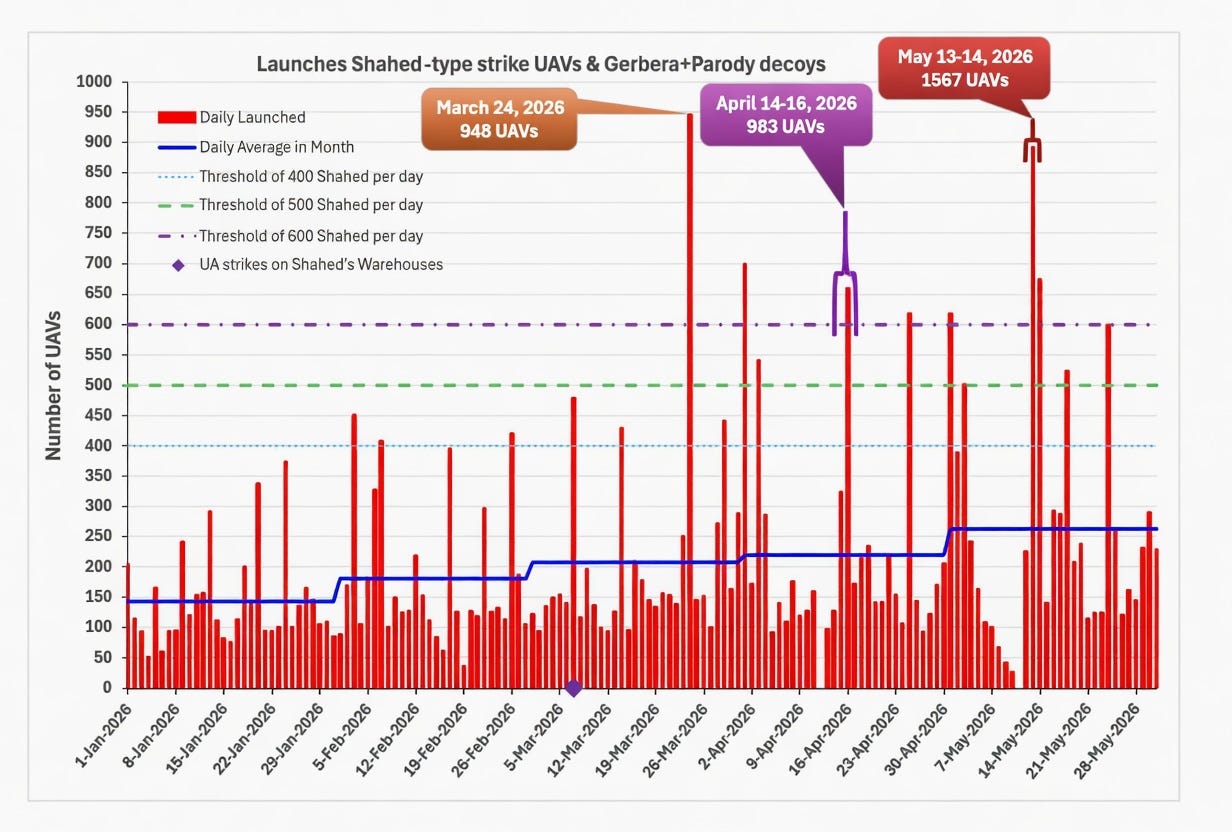
In May 2026, Russia launched 8,161 Geran type, Shahed-derived, drones against Ukraine. Ukrainian air defences brought down 7,476 — an interception rate of roughly 91.6%, consistent with the ~91% figure Ukrainian sources reported across the month. The campaign peaked over 13–14 May, when Russia put more than 1,500 drones into the air in barely 36 hours, flying many of them in tight formations along the Belarusian border at very low altitude to compress warning and force Ukraine onto its mobile fire groups and short-range guns. The drones that leaked through were disproportionately the high-end Gerans — faster jet-powered variants flying unorthodox, terrain-hugging profiles, hardened against electronic warfare and fitted with onboard cameras for terminal guidance — the same pressure that pushed Russia to field the newer Geran-4 specifically to defeat Ukraine’s cheap interceptor drones. Most of those leakers found their targets.
Every fighter pilot of my generation was raised on a single article of faith — quality beats quantity. A good aircraft with a good pilot beats three older ones. A modern surface-to-air battery punches far above its weight. We built our doctrines, our budgets, and our self-image on the exquisite platform — the expensive, beautiful, war-winning machine.
The last four years took that faith out and shot it down. Not because quality stopped mattering — it matters more than ever — but because the cost curve inverted beneath our feet. When a strike aircraft costs a hundred million dollars and the thing burning your refinery to the ground costs fifty thousand, the contest is no longer platform against platform. It is arithmetic against arithmetic. And arithmetic cares nothing for heritage, squadron crests, or unit price.
For a century we were the gunslinger who practised his draw until no one on earth could beat him to it — and then someone wheeled a Maxim gun onto the field and made the fastest draw in the world irrelevant. It was never about being outshot. It was about being out-counted.
That is the grammar of saturation warfare, and it has rewritten every major air campaign since 2022 — Russia and Ukraine, the Middle East, the Houthis against the US Navy, Pakistan against India. Now let me argue something that will sound perverse to anyone who has watched Shahed drones swarm a city on a phone screen: the cheap-mass moment has already passed its peak. The crude, mass-produced drone that overwhelmed everyone for three years is being quietly demoted — from the weapon that gets through to the one that merely distracts. What comes next flies faster, strikes harder, and is far tougher to stop. It is the intelligent one way effector (OWE) drone. And we are not ready for it.
A note on language: I use “drone” and “one-way effector (OWE)” interchangeably throughout. Strictly they aren’t identical — not every drone is expendable and not every OWE is a drone — but in the saturation context of this essay, the distinction doesn’t matter, and I switch between the terms as the prose demands.
Saturation is a rate, not a number
Strip away the jargon and a saturation attack reduces to five numbers. I have spent enough time on both sides of an air-defence problem — flying against it, and now building the machines meant to break it — to believe those five numbers decide more than any platform does.
Fire channels. Every defensive system can fight only so many targets at once. Radar track capacity, illuminators, datalinks, launchers — all finite. A battery that can guide a dozen interceptors simultaneously is a twelve-channel problem, no matter how clever its missiles. Stack a whole national network and you still arrive at a finite number of engagements per sector, per minute.
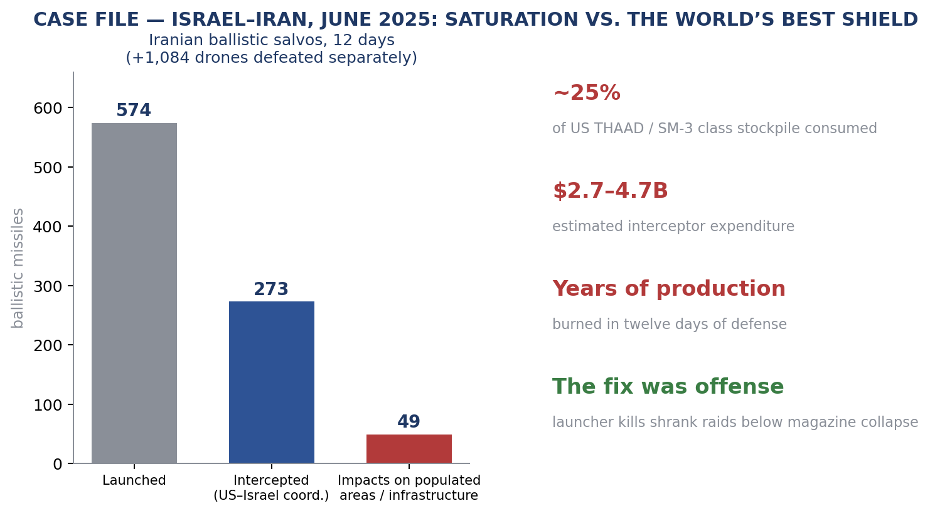
Magazine depth. Channels are useless without rounds. A launcher empties its ready missiles in minutes; reloading takes tens of minutes, during which it is a spectator. The June 2025 Israel-Iran war made this brutally concrete: defending against roughly 500 ballistic missiles consumed about a quarter of the inventory — and several years of production — of two of America’s most sophisticated interceptor families, at an estimated 2.7 to 4.7 billion dollars in twelve days. The 2026 Middle East conflict is no better. No magazine on earth survives that exchange for a quarter.
Leaker rate. No defence is perfect. Intercept ninety per cent of a raid — a superb night’s work — and a ten-drone raid leaks one while a five-hundred-drone raid leaks fifty. The interception percentage is a vanity metric. The attacker plans around the absolute number of leakers he needs. Of 574 ballistic missiles Iran fired at Israel in June 2025, forty-nine reached populated areas and infrastructure despite a defence that stopped the overwhelming majority. Forty-nine was enough to message.
Cost-per-effect. The attacker’s real metric is not what each drone costs but the total spend — every decoy, every airframe shot down — divided by the damage done. The defender’s mirror is cost-per-negation. In the Red Sea the US Navy fired Standard Missiles costing between 2.5 and 2.8 million dollars apiece at Houthi weapons costing a fraction of that. The Navy won every single engagement and lost the exchange.
Time. This is the one most people miss. Saturation is a rate, not a quantity. A thousand drones spread over a month is a nuisance you service one at a time. Two hundred arriving in eight minutes from five bearings is a network collapse. The attacker’s entire art is compressing the arrival window; the defender’s entire art is buying that decision time back. Iran understood this perfectly in Feb 2026 — it coordinated launches across dispersed sites, varying trajectories to deny Israel and the Gulf States the reload window, and chose fast ballistic missiles and slow drones to saturate the targets within a compressed timeline.
The arithmetic of the raid. Saturation occurs the moment threats-per-minute cross the defender’s engagements-per-minute — the same two hundred airframes are a nuisance over a month, and a collapse over eight minutes. The funnel shows where two hundred inbound become twenty leakers.
Everything that follows in this article is commentary on those five numbers.
A stream is not a swarm
The commonest amateur mistake is to confuse mass with saturation. A hundred drones flying the near same track at the same height is not a swarm. It is a queue. The defender services it like a procession — one channel, sequential kills, a gunnery exercise that ends when the magazine does, but ends in his favour.
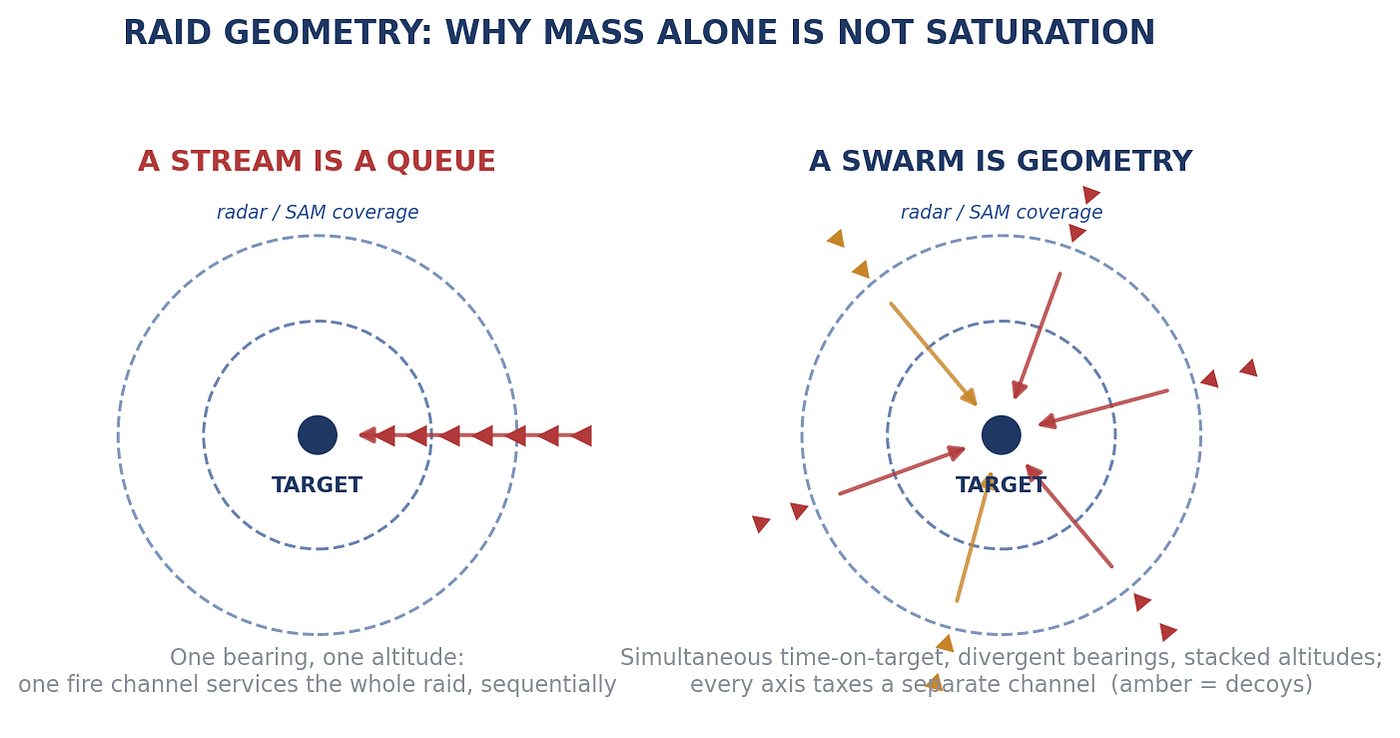
Saturation begins with geometry. The competent raid arrives as a simultaneous time-on-target (TOT) problem from divergent bearings and stacked altitudes — terrain-hugging elements below the radar horizon where the curvature of the earth shrinks your warning to seconds, high or fast elements that demand your premier interceptors, and everything in between forcing your medium-range systems to commit. Each axis taxes a different sensor. The geometry alone multiplies the effective size of the raid before a single warhead does its work.
A single-axis stream is serviced one platform at a time; a multi-axis, multi-altitude arrival taxes every fire channel at once.
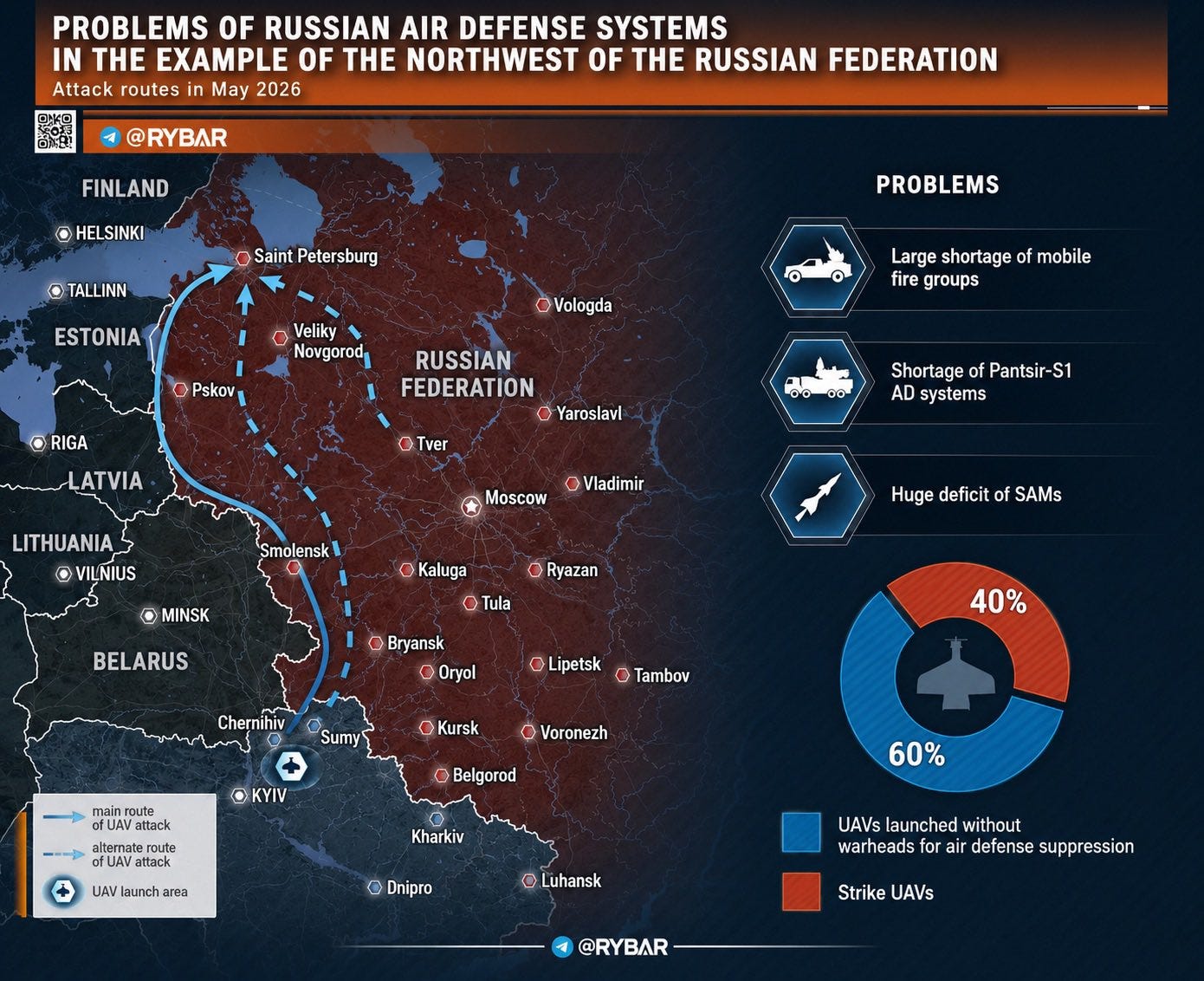
Ukraine’s deep-strike packages into Russia evolved into exactly this. Early raids were streams and died as streams. By 2025–26 they doglegged through mapped radar gaps, split and re-merged, arrived from the unexpected azimuth, and came mixed with decoys and anti-radiation elements sequenced so that the defence’s own reactions became the targeting data for the next wave. The Houthis showed the cheapest version of the same truth — a single slow drone, arriving on an unwatched bearing at the right height, defeated layered defences over Eilat in September 2025 — detected late, engaged twice, missed twice. Geometry and timing forgave every other deficiency.
Also Read:Drones no longer enablers, they’re replacing manned aircraft roles—CISC Air Marshal Ashutosh Dixit
The maths of the turn
Let me make this concrete, because the effect of a manoeuvring drone on a layered defence is not intuitive until you watch the numbers move. Take a realistic five-layer shield — long-range area defence, medium range SAM, short range drone interceptor, point defence, and a terminal gun-and-jammer belt — and push one Shahed-class airframe through it twice. Once flying straight. Once turning 30 to 60 degrees every five to ten minutes.
Fly it straight and layering works beautifully. Give each layer a sensible single-shot kill probability — strong outer layer, weaker inner belt — and a couple of shots as the slow drone crosses each envelope. Multiply the survival probabilities across all five layers and you get roughly nine chances in ten thousand that the drone lives. Out of a thousand identical drones, fewer than one leaks. That single number is the entire case for layered air defence, and it is why a well-drilled integrated system looks invincible against a naive raid.
Now let the drone turn. The interceptor is launched not at where the target is but at a predicted intercept point — a spot in the sky computed by running the target’s current velocity forward over the interceptor’s flight time. A turn invalidates that prediction. The lateral distance the interceptor must suddenly chase grows with the target’s speed, the sine of the turn angle, and — crucially — the time it had left to fly when the turn happened. Beyond the interceptor’s ability to divert, that shot’s kill probability collapses.
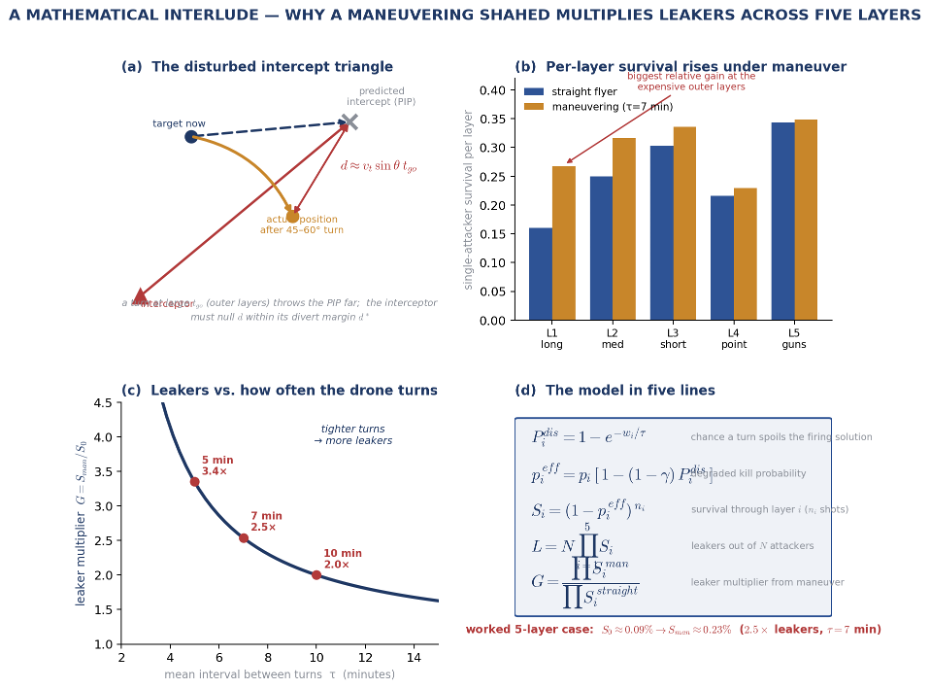
Three things follow, and they matter. First, the damage is not uniform. The outer, long-range layers fire interceptors with long flight times, so a mid-course turn throws their predicted intercept point furthest — and those are precisely the expensive, magazine-limited systems you can least afford to waste. The terminal gun systems, engaging at a few seconds’ notice, barely notices the turn. Manoeuvre peels the shield from the outside in. Second, run the arithmetic and a seven-minute turn interval moves survival from about 0.09 per cent to about 0.23 per cent — a leaker multiplier of roughly two and a half. Tighten the turns and it climbs past three and a half; relax them and it falls toward two.
The maths of the turn: a 30–60 degree jink every few minutes disturbs the intercept geometry, peels the expensive outer layers first, and multiplies leakers by roughly two and a half across five layers.
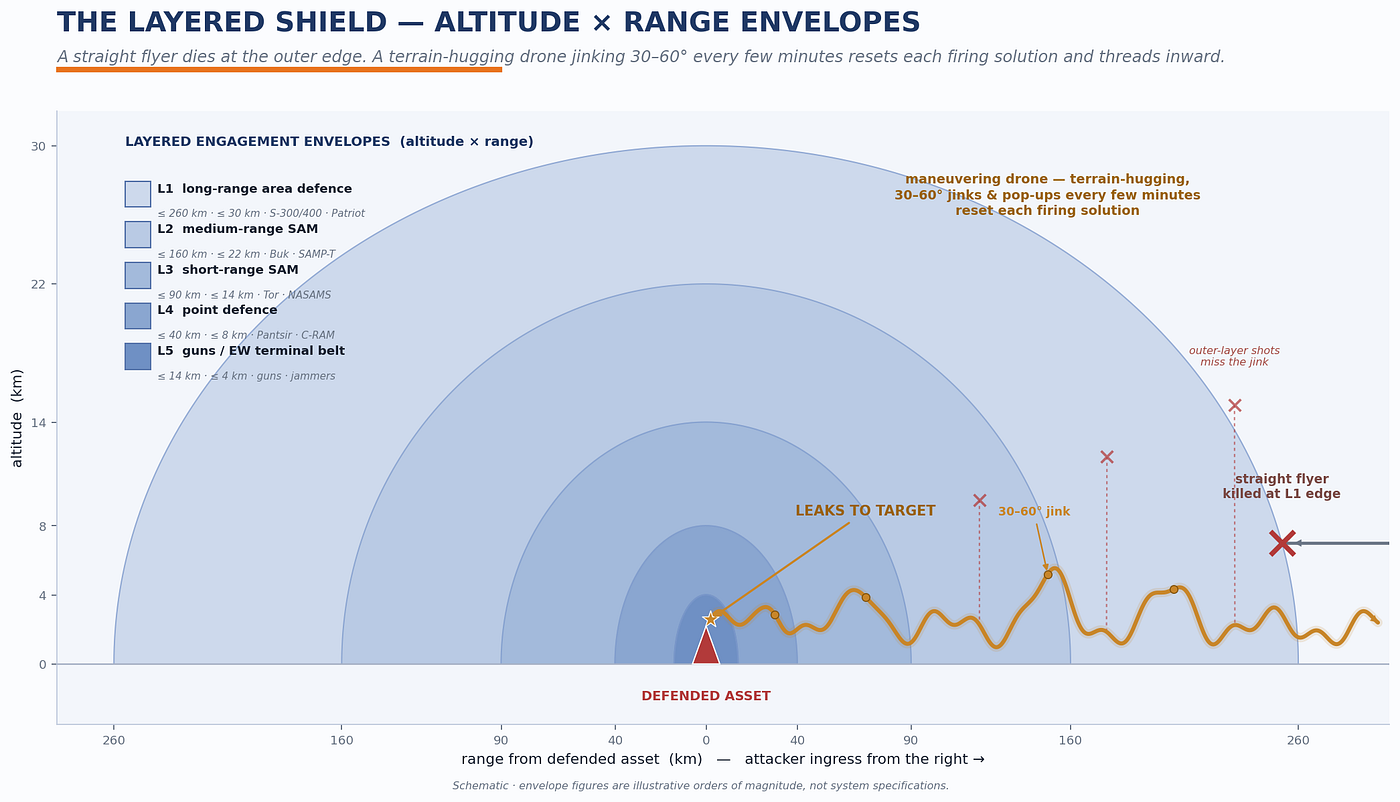
Why does a factor of two and a half matter when the numbers are this small? Because the baseline was so small. A defence built around a sub-0.1-per-cent leak has its entire interceptor economy premised on almost nothing getting through. Double or triple that leak and you double or triple the warheads on target — and, because every disrupted shot is a wasted interceptor, you drain the magazine faster at the same time. The manoeuvring drone attacks two of the five numbers at once — leakers and magazine — for the price of a different line of code. A turn is free. An interceptor is not.
And here is the strategic punchline that took me a while to see clearly. Because manoeuvre degrades the long-range outer layers most and the terminal belt least, its real effect is — to transfer the engagement load inward — to push targets that the expensive area-defence tier should have killed down onto the cheap, short-range terminal tier, which has the least magazine depth and the shortest reaction time.
That inner tier then saturates first. Evasive flight is not merely evasion. It is a magazine-shifting tool that funnels the raid toward the exact layer most vulnerable to being overwhelmed. The same logic as engagement envelopes. The straight flyer is killed at the outermost layer; the terrain-hugging drone that jinks and pops up resets each firing solution and threads inward to the target.
The argument that directed-energy weapons (DEW) reverse this trend is half right — and the half it gets wrong is the one that matters. Directed energy raises the price of saturation for the attacker. It does not repeal it. A laser is a sequential weapon — lock, dwell, kill, repeat — while the swarm pushes four more through the same sky. High Power Microwave (HPM) kills across a cone, but a cone has an axis: split the raid across many bearings and stack it in altitude, and no single pulse catches more than a slice — the rest you attempt to harden against. Directed energy makes saturation costlier to attempt; it cannot make it stop working, at least not all the time.
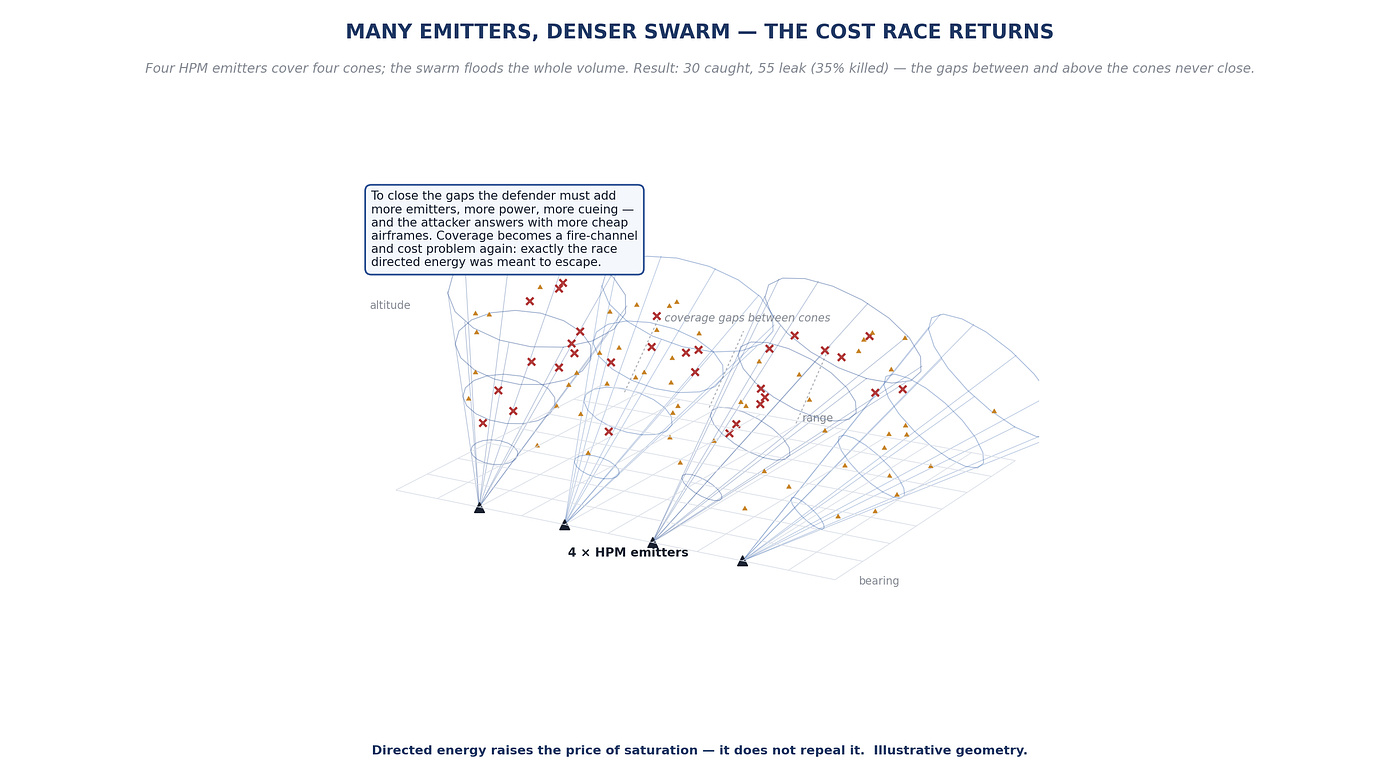
I should be honest about what this model is and is not. It is a heuristic, illustrative not predictive. Real engagements add sensor fusion across radar and electro-optics and acoustics, shoot-look-shoot doctrine, interceptors with mid-course updates, and decoy discrimination that improves over successive raids — all of which a good defender uses to claw back some of the lost probability.
But the direction of every term is robust, and the direction is the point — manoeuvre raises survival, peels the outer layers first, and shifts the load onto the saturable inner tier.
The cheapest munition you can build
IfI could carry one lesson from Ukraine into every future arsenal, it would be the value of the decoy. A plywood-and-foam costing a tenth of a strike drone but painting the same radar return does three things at once. It forces emitters to radiate — and an emitting radar is a dying radar in the anti-radiation age. It forces launchers to spend interceptors against nothing. And it inflates the raid count past the defender’s channel capacity, so the real warheads transit untouched.
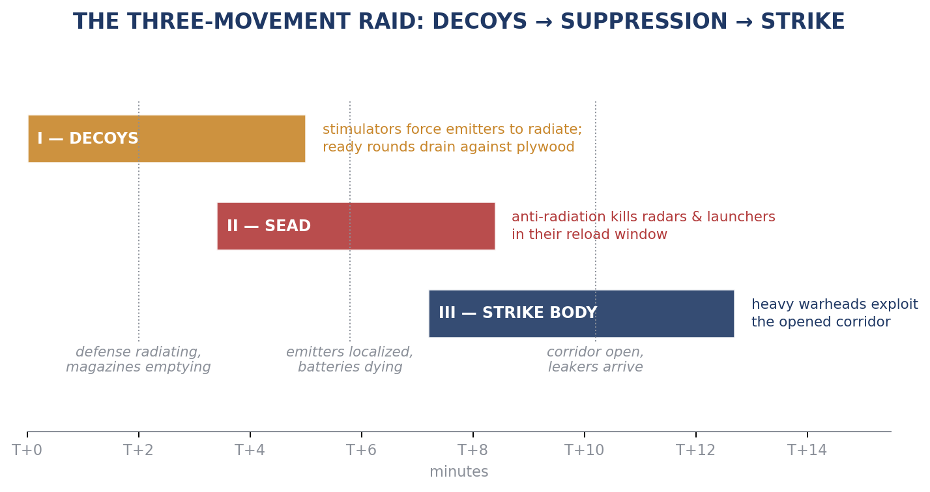
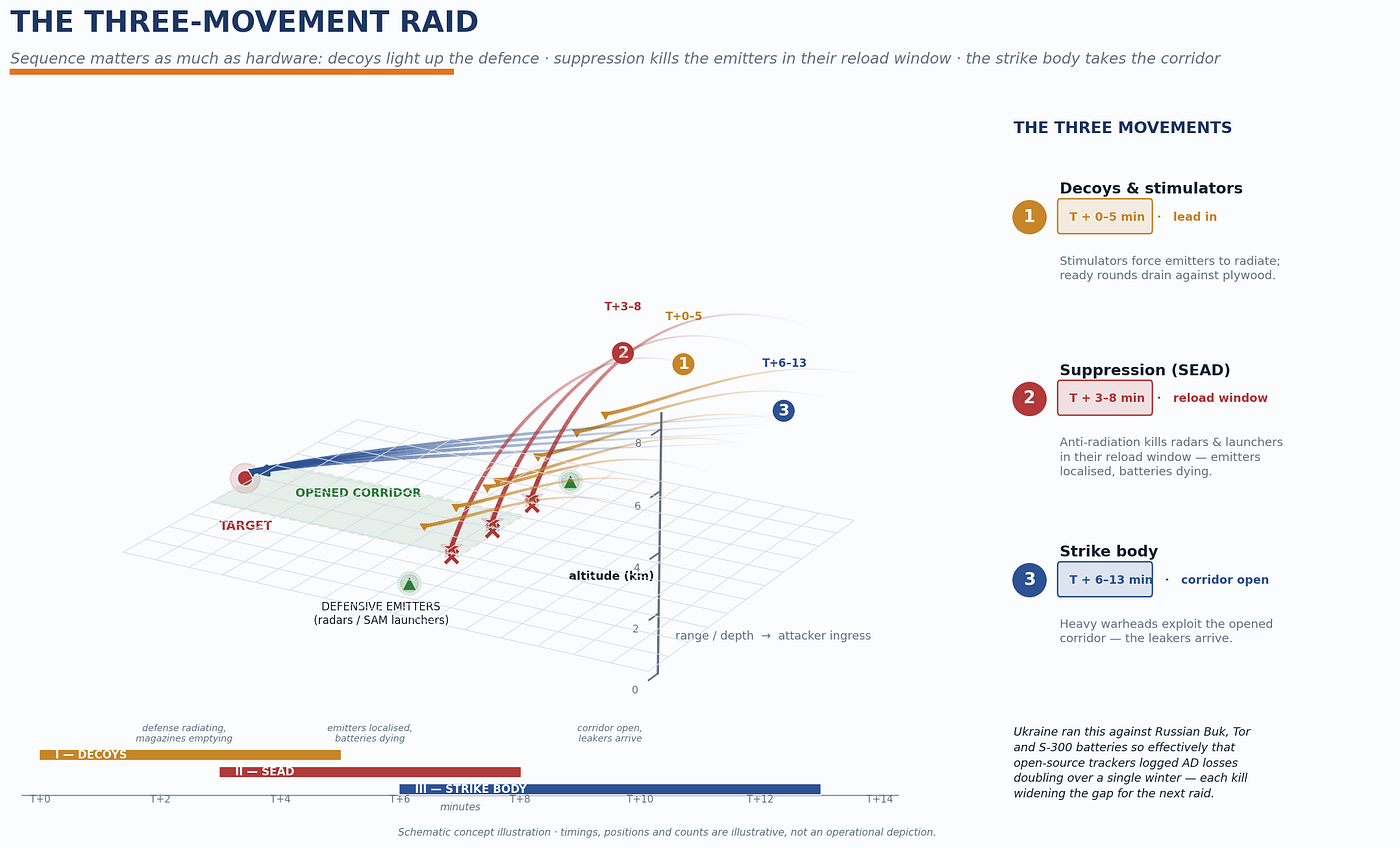
The sequence matters as much as the hardware. The mature raid runs in three movements. Decoys and stimulators lead, lighting up the defensive order of battle. Suppression elements — anti-radiation seekers, loitering munitions cued by the now-located emitters — strike the radars and launchers in their reload window. Then the strike body exploits the corridor that has opened. Ukraine ran this against Russian Buk, Tor and S-300 batteries so effectively that open-source trackers recorded Russian air-defence losses doubling over a single winter, each kill widening the gap for the next raid.
The three-movement raid — decoys stimulate, suppression kills the emitters in their reload window, the strike body exploits the corridor.
The defender’s counter is discipline — emission control, decoy discrimination, and the iron rule that you never spend a premier interceptor on an unclassified track. Easy to write — Agonising to execute at three in the morning against a contact that might be plywood and might be a cruise missile heading for an ammo dump.
Two tiers, and the death valley between them
The deepest structural lesson of this period — and the one I have argued hardest for in the context of India’s own programmes — is that future strike arsenals split into two tiers, and neither works alone.
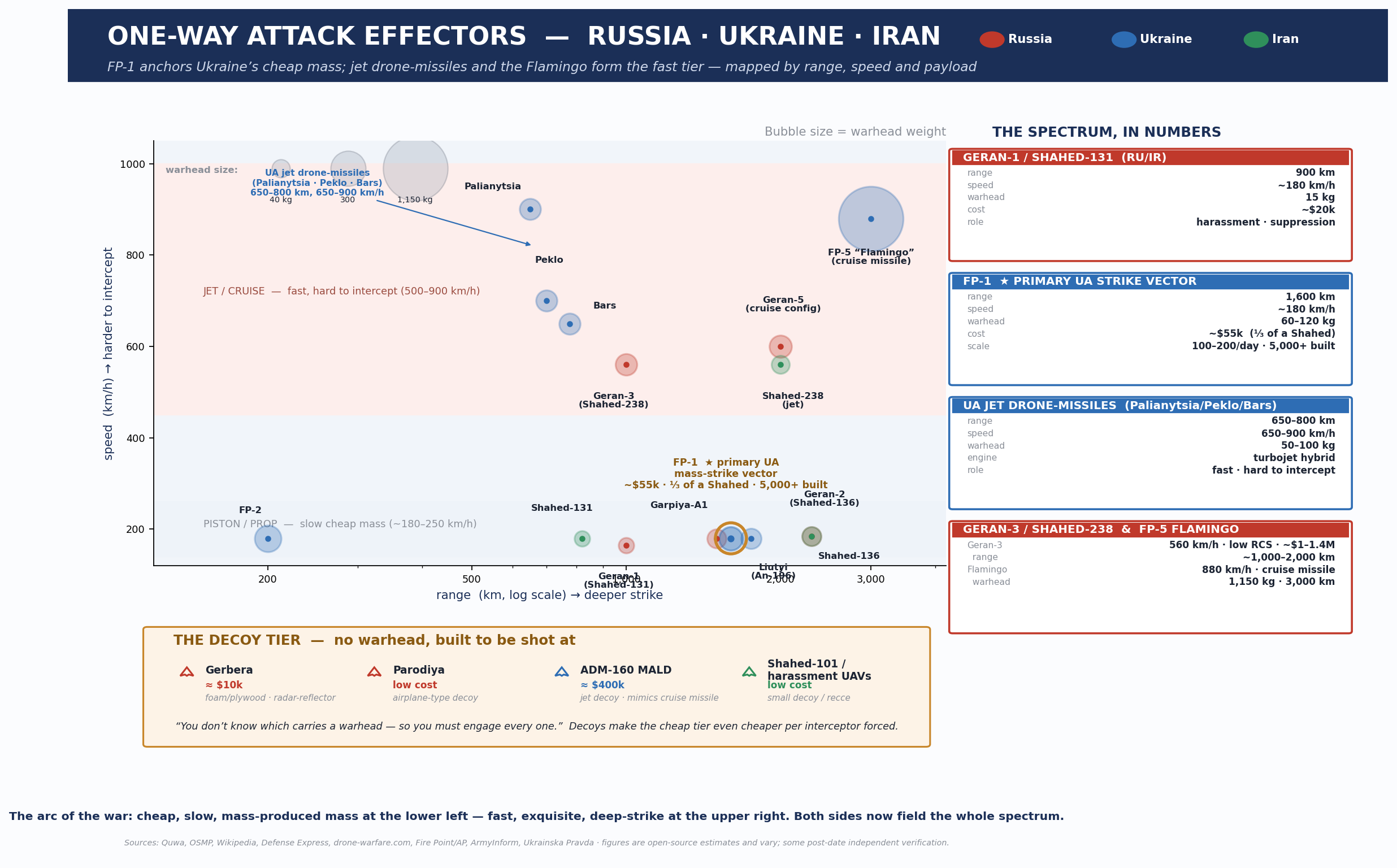
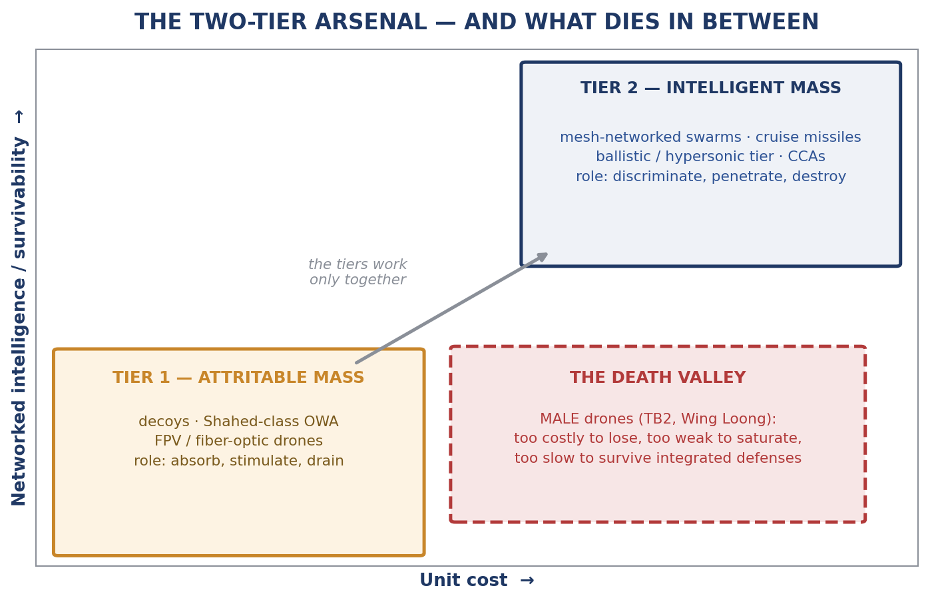
The first tier is attritable mass: cheap, producible, good-enough airframes whose only job is to be numerous. They soak up interceptors, stimulate sensors, drain magazines, impose cost. Losing one is an accounting entry, not a tragedy. The Shahed-136 is the archetype — crude, slow, loud, a financial auditor’s delight and strategically transformative because you can build it in the thousands and improve it every month.
The second tier is intelligent mass: networked, autonomy-capable, heavier-payload systems that exploit what the first tier creates. They carry the warheads that matter, a jet engine that speeds, the seekers that discriminate, the mesh links that let the package re-plan when the defence reacts.
The platforms that fit neither tier are dying in front of us — The medium-altitude long-endurance drone — the TB2, the Wing Loong, the slow hybrid that looked revolutionary over Karabakh in 2020 — proved indefensible over Ukraine the moment integrated defences recovered their composure. Same for the twenty plus MQ-9s lost in the Middle East skies in the last couple of years. The MALE UAV will not survive in contested space. Too expensive to throw away like the first tier, too weak and too few to fight like the second.
The two-tier arsenal — and the “death valley” where platforms too costly to lose and too weak to saturate are dying.
And this is where I want to plant my flag. Read the wars of the last three years together and a direction of travel emerges that is the whole point of this essay —
Where cheap mass succeeded — Ukraine, the Gulf, against Israel — it succeeded because it was qualified by something more than cheapness: by deep magazines and continental geography in Ukraine, by short-range rate compression and fast ballistic missiles in the Gulf, by coordinated ballistic salvos against Israel. Where it was merely cheap, numerous and dumb — a competent layered shield ate it.
The uncomfortable synthesis is that the solid, drilled, layered defence has largely solved the undifferentiated cheap drone — with one honest boundary condition. That defeat is reliable only once the defender has had time to learn and to stock the right mix of cheap inner-tier effectors. In a long continental war it is far less settled; Russia keeps extracting cumulative effects from Shahed-class systems against an adapting Ukraine precisely because production rate and learning speed keep both sides in the fight. But the trend is unmistakable.
What the layered shield has not solved — and on current evidence cannot cheaply solve — is the threat that is hard on its own terms — the manoeuvring, denied-navigation, precision-guided airframe that does not depend on numbers to leak.
The wars that prove it
OpSindoor, on our own subcontinent, was the negative proof. Pakistan’s drone offensive failed because it lacked density at any single point, payload at any single target, and coordination across the package. India’s layered grid — guns, legacy SAMs, modern SAMs, electronic warfare — serviced it in detail. The case matters because it shows the threshold is real. Below critical density, the defender’s arithmetic wins and the attacker has merely donated airframes and revealed his doctrine. Cheap drones do not make cheap victories.
June 2025 Israel — Iran clash was saturation against the best defence on earth. Iran stripped the drones and cruise missiles out of its main salvos and bet on coordinated ballistic mass to compress warning and deny reload windows. The American and Israeli network performed magnificently — and still forty-nine missiles arrived, still the interceptor stockpiles bent toward exhaustion in under two weeks, and still the only sustainable answer turned out to be offensive — killing launchers inside Iran so the raids shrank to a size the magazines could survive. Against true saturation, defence buys time for offence, or it buys nothing — The Israeli defensive layers intercepting the overwhelming majority still leaked forty-nine missiles and burned years of interceptor production in twelve days.
And then, in end Feb 2026, came the Gulf conflict — the strangest laboratory of all. Iran launched Operation True Promise IV and, for the first time, struck every member of the Gulf Cooperation Council (GCC) at once. The reported opening volumes read like a textbook: the UAE alone reported 165 ballistic missiles and 541 drones, most destroyed but enough leaking to close airspaces across six countries; Jebel Ali burned; intercepted drones over Ras Tanura shut down one of the planet’s most important oil terminals.
The interception percentages were, by any standard, superb. The Iranian campaign still achieved its purpose in the first forty-eight hours.
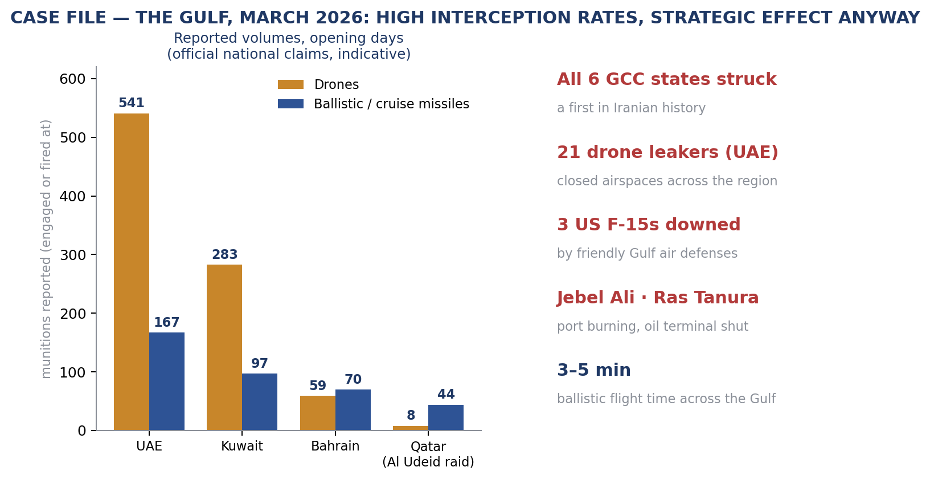
The Gulf inverted every comfortable assumption. The geography is the opposite of Ukraine’s — a flat, over-water dash of 150 to 300 kilometres, no terrain to hide behind, a radar picture as clean as a defender could wish — and Iran penetrated anyway, by raw rate rather than by routing. Beyond the expected military targets, most targets for the Iranian Shaheds and the ballistic missiles were an economy’s nervous system: airports that are national business models, desalination plants that are the water supply, energy terminals that price the world’s oil, and even a rogue attack on an Emirati nuclear facility. Against such targets the leaker arithmetic changes meaning entirely.
Twenty leakers in Ukraine is a good night for the defence. Twenty leakers in the Gulf rerouted global shipping and put a question mark over the insurance premises of an entire economic model.
And the defence was a coalition patchwork, not a forged national net — six sovereign systems plus the US military, integrating in real time on the first night. The most telling incident of the whole campaign was not an Iranian success at all: friendly air defences shot down three American F-15s in a single engagement.
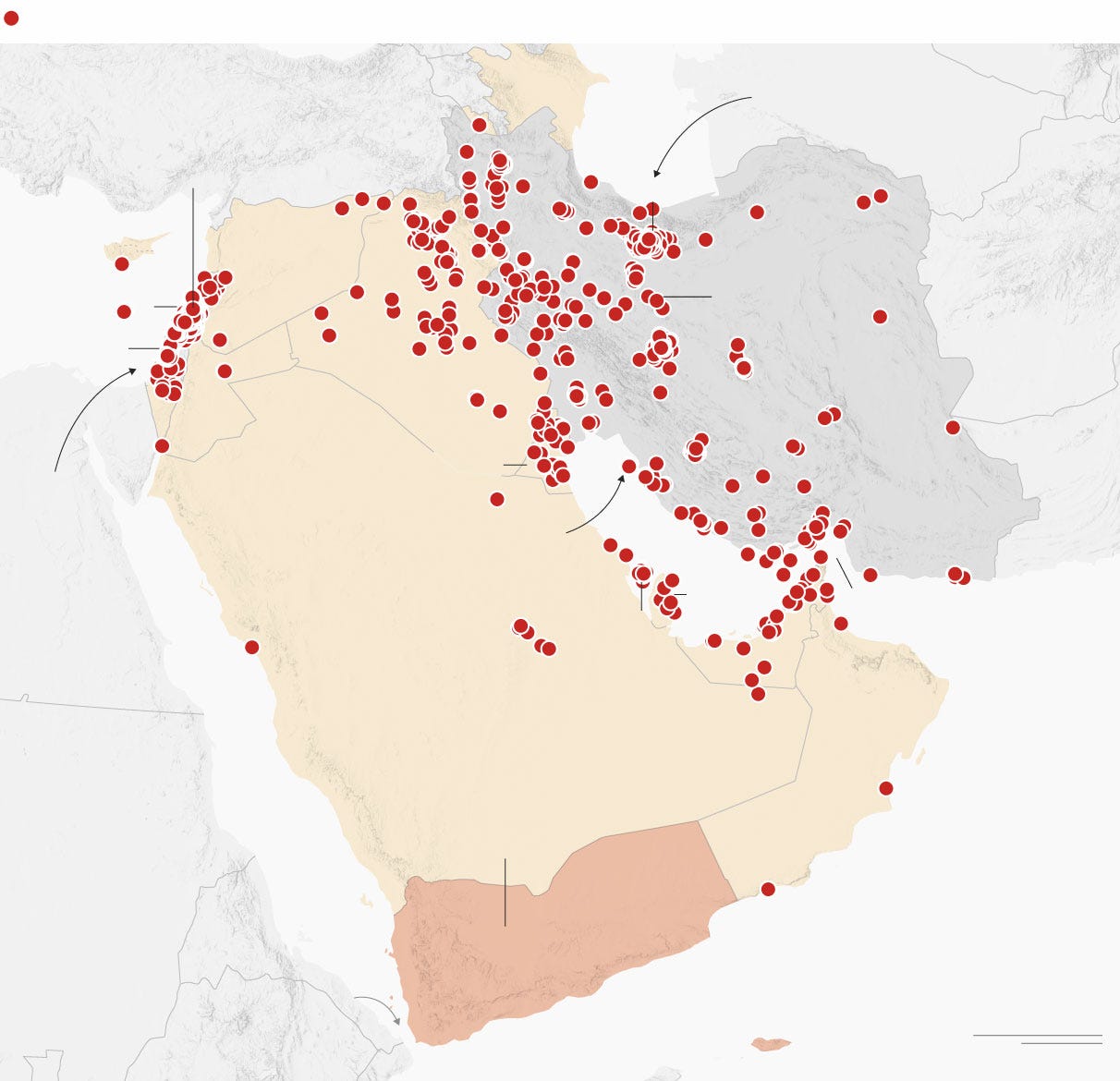
The Gulf completes the syllabus. Ukraine teaches what saturation looks like inside a long war between mobilised societies. The Gulf teaches what it looks like on the first night, against rich, peacetime, coalition-defended, economically fragile targets at short range. Which is to say, it is the closest live rehearsal yet for the opening hours over a Taiwan — and for any prosperous coastline within drone range of a determined adversary.
Also Read: From Turkey-made Bayraktars to fibre-optic FPVs: Ukraine drone evolution showcases future of warfare
The cost ledger nobody can escape
Before I get to the future, one number every planner should tattoo somewhere visible. The defining feature of this era is not that drones are unstoppable. It is that stopping them, the way we currently stop them, costs more than launching them — by one to three orders of magnitude.
The honest ledger — the unit cost of attacking munitions against the interceptors fired to defeat them, on a logarithmic scale. The exchange runs catastrophically against the defender.
This is why the Red Sea mattered out of all proportion to the Houthis’ sophistication. A sub-state actor with containerised weapons imposed a great-power-sized air-defence bill simply by existing in range of shipping. Every coastline planner on earth should read that twice. The answer is not to abandon the exquisite interceptor — you still need it for the ballistic tier — but to build, underneath it, the wide cheap bottom of the pyramid that Ukraine learned to build because poverty forced it: gun trucks, interceptor drones, jamming at every checkpoint, fifty-thousand-dollar answers to fifty-thousand-dollar questions. A defence whose cheapest reliable effector costs a million dollars is a defence the other side can bankrupt with plywood.
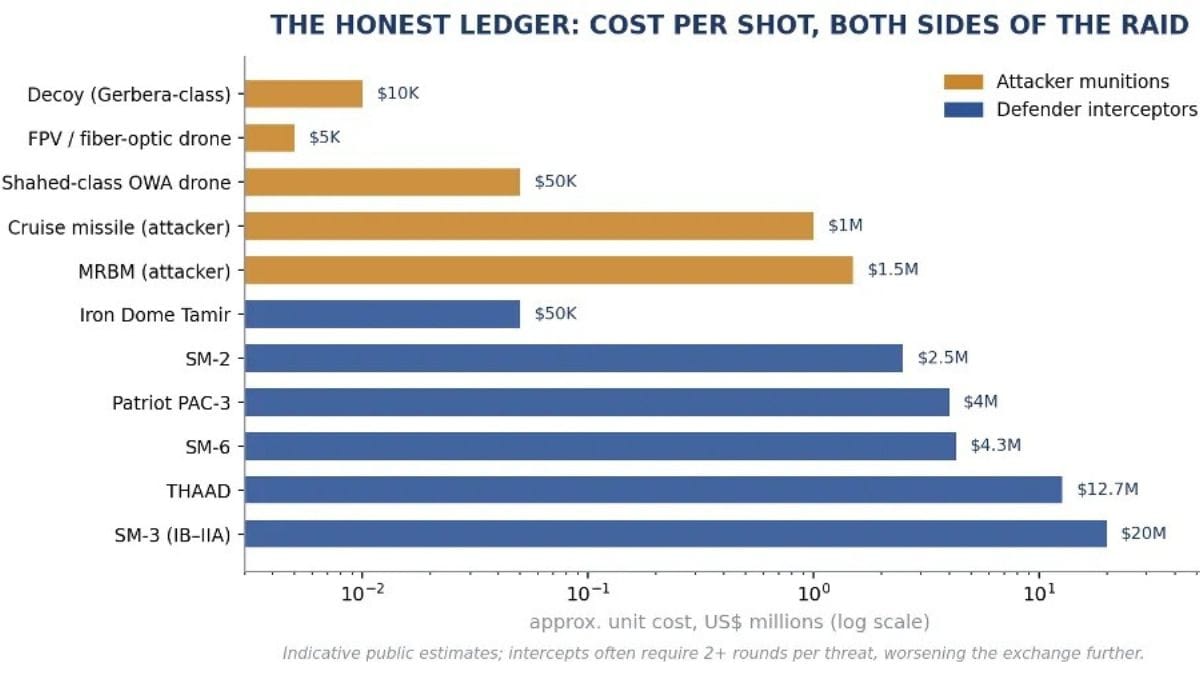
Aword on the cheap interceptor drone— The cheap interceptor changes the ledger, but it does not balance it. For three years the exchange ran the wrong way by one to three orders of magnitude — a multi-million-dollar Standard Missile or Patriot round spent to kill a fifty-thousand-dollar drone, a trade no economy can sustain at scale. Ukraine’s answer was to stop fighting cheap with expensive: interceptor drones at a thousand to five thousand dollars now down the bulk of the Shahed threat, and for the first time the defender’s shot can cost less than the attacker’s airframe. That is a genuine breakthrough, and it has dragged the per-engagement exchange back toward parity. But cost-per-kill was only ever one of the five numbers, and it is not the one that decides a saturation fight.
Time is — A cheap interceptor still occupies a fire channel, still needs a sensor track, still has to be cued, launched, and flown to its target — and there are only so many of those loops a network can run per minute. Flood the sky with two hundred credible threats from five bearings in eight minutes and the binding constraint is no longer the price of each shot but the rate at which the defence can take them. The attacker can always add airframes faster and cheaper than the defender can add fire channels, sensors, and trained loops to service them; mass scales on an assembly line, but engagement capacity scales on infrastructure and people. And yes, interceptor drones roll off assembly lines too — Ukraine is building them by the thousand a day — but an airframe is not an engagement: each interceptor still needs a sensor to see its target, a track to follow it, and a human or algorithm to commit it, and that cueing chain is the part that does not mass on a production line.
So the cheap interceptor wins back the cost war and blunts the cheapest, dumbest mass — which is exactly why the contest is migrating away from cost and toward the things cheap interception cannot solve — speed, manoeuvre, and autonomy. You can make every shot affordable and still be overwhelmed, because saturation was never really about money. It was about arithmetic, and the attacker still writes the larger number.
When the swarm starts to think
Everything I have described so far is choreography written before take-off. Today’s Shahed is a dumb instrument of a smart plan. It flies its preprogrammed route, holds its preprogrammed height, and dies without telling its siblings what killed it. The intelligence lives entirely in the planning cell, and the moment the package launches, the plan only degrades. Every defensive adaptation discovered mid-raid is paid for in airframes and answered only in next week’s raid.
The next inflection — and I have spent the last several years of my professional life building toward it — is the moment that intelligence migrates from the planning cell into the package itself. The answer to a layered shield that has learned to defeat cheap, dumb mass is not more cheap, dumb mass. It is mass that thinks. Call it the intelligent Shahed class — the same producible, attritable, tier-one airframe, plus four cheap additions — a mesh radio, a commodity processor, denied ops capability and a decentralised swarm algorithm — that turn the raid from a salvo into an organism.
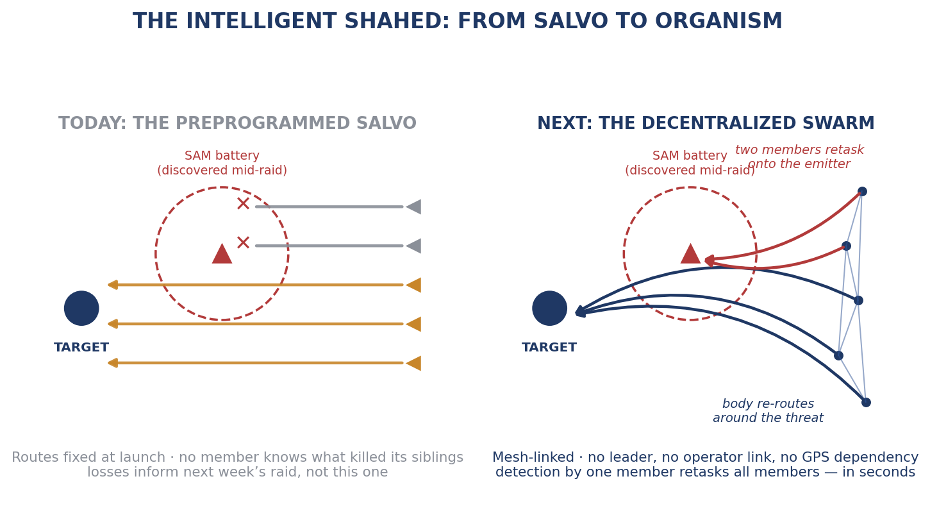
The critical word is decentralised. A swarm commanded from a ground station or a leader — follower topology, is a puppet show with a single string for the jammer to cut. A decentralised swarm has no commander to kill. Each member runs the same algorithm, shares its picture laterally with its neighbours, and the collective behaviour — formation, target allocation, role assignment — emerges from local rules, the way a murmuration of starlings turns without a lead bird. Cut the swarm in half and you have two swarms. Jam the satellite navigation and the members navigate by terrain-matching and each other. Kill the operator link — there is no operator link. The architecture deletes, by design, every single point of failure that current counter-drone doctrine is built to attack. Evidence of all facets of these technologies exists.
What this does to the engagement is profound. The raid stops being separate from its intelligence picture and becomes its own reconnaissance: the moment any member detects an emitter, is engaged, or simply dies, that becomes shared targeting data within seconds. The swarm does not fly through the defence’s gaps. It finds them in real time and retasks members to kill the emitter that just revealed itself. Russian Shaheds with a mesh network and man on the loop have been exhibiting this capability for a while now. The three-movement raid — stimulate, suppress, strike — collapses from a pre-scripted sequence into a single adaptive behaviour running concurrently, at machine speed, inside the defender’s reload window.
Ukraine’s counter-air-defence campaign took eighteen months of human learning. A meshed intelligent OWE swarm will run that loop in one raid.
And the decoy distinction, the one I called the cheapest munition you can build, dissolves entirely — because roles are assigned in flight. Any member can fly the provocative profile that draws fire; any member can go quiet and turn terminal. The defender’s discrimination problem, already the hardest part of the engagement, becomes formally unsolvable, because the answer changes after the question is asked.
The only safe assumption is that everything is armed, which is precisely the assumption that empties magazines.
Here is the genuinely disruptive part, and the reason I keep building toward it. Historically, smarter meant exquisite. Intelligence rode on million-dollar platforms. The intelligent Shahed breaks that correlation. Because the intelligence is software riding on commodity compute, the airframe stays tier-one cheap — Shahed economics with cruise-missile cunning, mass and brains in the same machine for the cost of additional electronics/ hardening.
My company’s own work on Sheshnag 150 series rests on exactly this thesis — Shahed-class producibility married to decentralised coordination and meaningful payload, because platforms individually too weak to destroy a defended target must be able to mass their effects cooperatively.
I want to be careful not to oversell it. Building this is hard in ways the powerpoint decks rarely admit. Reliable decentralised coordination on small, cheap, attritable platforms under heavy electronic warfare is not solved at scale. Target discrimination and fratricide avoidance in a dense raid are genuinely difficult. And there is a real engineering tension between cheap enough to lose in thousands and smart enough to matter for the end user — who is smitten by the widely reported $30k Shahed bug. China’s military literature openly describes AI-driven swarming as the next stage of unmanned combat, and the PLA’s deepest investments run that way — but Beijing’s conviction that intelligent swarms will leapfrog cheap-mass warfare may tempt it to skip the unglamorous lessons of producibility and attrition that Ukraine and Russia are teaching the rest of us at first hand. The race is not between concepts. The concept is settled. The race is between industrial bases and iteration speeds.
Pakistan is also learning in the shadows, albeit with Chinese and Turkish support. I intend to cover their options in a seperate article.
What this means for India
Place this framework over the scenario that keeps planners in three capitals awake, and the lessons sharpen.
For an attacker like China, the Taiwan Strait is both gift and filter. The gift — Taiwan is fixed, mapped and close, its defences catalogued and attritable for years before a shot is fired, and Chinese industry can build first-tier mass at a scale no adversary matches, atop a rocket force that supplies the high-fast tier Iranian planners could only envy. The filter — 130 kilometres of water strip out the short-range tier and expose every launch signature to the best surveillance architecture on earth. China’s campaign will be a mid- and long-range affair, run by a military whose last war predates every technology I have described, against a defender who has watched the same wars and is building the layered, distributed, gun-heavy, decoy-wise grid that works well in Israel— not the shallow exquisite shield that has failed in Russia.
For a defender, the syllabus is explicit, and it is the same syllabus whether you sit in Taipei, Tel Aviv, or New Delhi. Depth in layers beats depth in quality. This is the real meaning of the porcupine — you win not by buying a handful of exquisite batteries that the counter-defence campaign can find and kill, but by distributing many cheap, redundant, hard-to-target layers that degrade gracefully and cannot all be suppressed at once. Magazine depth is the deterrent — interceptors stockpiled and co-produced before a crisis closes the resupply lane. And the hardest lesson of all: the ultimate counter to saturation is offensive. Israel survived by striking the launchers. Long-range strike that shrinks the raid at its source is not escalation. In this grammar, it is the load-bearing wall of the defence.
For India specifically, the message is not to admire these wars from a safe distance but to internalise that saturation is now the default grammar of the first night of any conflict on our borders. Op Sindoor was a warning shot we should be grateful was fired against an under-density raid. The next attempt by our adversaries will be denser, smarter, and two-tiered.
We should be building both halves of the answer at once — the cheap inner-tier effectors that absorb the dumb mass, and the intelligent strike that the dumb mass exists to enable.
Build, or Be Counted
Saturation warfare rewards the unsentimental. It does not care about the heritage of your air force or the press release boasting your interception rate. It cares about five numbers — channels, magazines, leakers, cost-per-effect, and time. Nothing else makes the cut.
And those numbers are moving — all of them, in one direction. For three years the cheap drone held the initiative. That window is closing. The layered shield, drilled night after night, has learned to spend cheap effectors on cheap threats and hoard the expensive ones for the targets that matter. Against that disciplined grid, undifferentiated mass flown dumb and predictable is no longer a breakthrough. The cheap-mass shortcut has not vanished — it has been demoted, from the weapon that gets through to the decoy that empties the magazine so the real weapon can. And the real weapon is changing. What leaks now — what will decide the next war’s first night — is intelligent mass: the airframe that navigates without satellites, flies through jamming, manoeuvres to break the firing solution, coordinates without a commander to kill, and strikes with precision when it arrives.
The shield and the storm are locked in a race of arithmetic, and autonomy is now rewriting the sums. 2026 is the year that race tips — the year swarms stop being a briefing slide and start being an order of battle. The side that counts honestly, builds in tiers, and iterates without mercy will hold the sky. The side that worships its own equipment — or assumes yesterday’s cheap drone is tomorrow’s threat — will learn what Russia learned over its burning refineries and its premium hardware turned to scrap; that the age of the exquisite shield is over, that cheap mass was only the overture, and that the age of intelligent mass has already begun.
The machines that win the next decade are being designed and built right now, in workshops from Kyiv to Alabuga; Isfahan to Shenzhen — and the United States heartland. The question is not whether they are coming. The concept is settled. The only questions left are who builds them first, and who learns fastest.
The next war’s first night is already being designed. The only choice left is whether we are in the workshop building a OWE — or in the blast radius.
Sameer Joshi is a former Indian Air Force Mirage 2000 fighter pilot. He has seen combat in the 1999 Indo Pak Kargil conflict. He is currently the CEO of NewSpace Research & Technologies Pvt. Ltd, Bengaluru. He writes extensively on military subjects and his article on the Air War in Syria, won the best military aviation submission at the 2017 Paris Airshow.
Views are personal.
This article was first published on Medium. Read the original article here.