





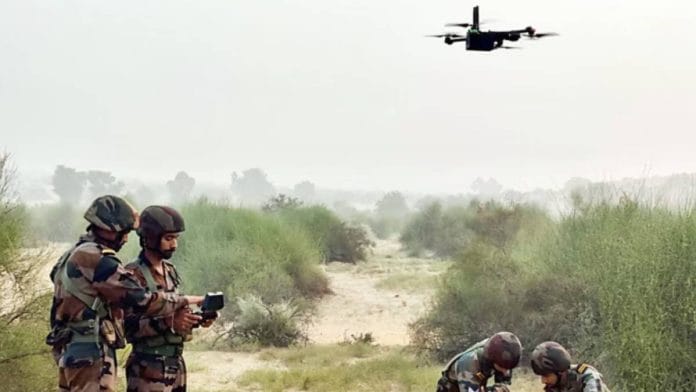


New Delhi: Noting that the robotic warfare of future is already here, India’s Chief of Integrated Defence Staff (CISC), Air Marshal Ashutosh Dixit, Friday said that unmanned aerial systems are no longer just enablers but means of warfare in their own right.
He was backed by Indian Air Force (IAF) chief Air Chief Marshal A.P. Singh, who said unmanned aerial systems are no longer just the eyes in the sky but “claws in the sky”.
In very candid remarks by an Air Force officer about the future of warfare, Air Marshal Dixit said that unmanned aircraft are “already replacing manned aircraft in an increasing variety of roles”, and already influencing the outcome of conflict.
Both officers were speaking at a seminar organised by the IAF think-tank Centre for Aerospace Power and Strategic Studies.
The IAF chief, however, underlined that while drones are now an actual means of warfare, manned aircraft and the human in loop are to remain here. He said that if that was not the case, major militaries around the world would not be investing in sixth-generation aircraft.
Giving his understanding of the future of warfare, Air Marshal Dixit said Operation Sindoor was India’s first high-intensity, multi-domain military response, conducted under the new paradigm in which speed, strength and precision shaped a decisive and favourable outcome.
“In that operation, drones became a weapon of choice for the first time Indo-Pak (conflict),” he said.
Talking about the ongoing Russia-Ukraine war, he said it is not simply a war between two nations but “a living laboratory of hybrid asymmetric warfare, which is the most rapid technological innovation seen since the Second World War”.
He asserted that robotic war is the future, in which autonomous machines will dominate every battlefield. “In the air, on the ground, there will be combat robots who will go over the land, autonomous underwater vehicles, and orbital systems in space,” he added.
“Human beings will not disappear. They will rise, they will become commanders of autonomous operations, making impact-level decisions and machine skills in AI as their starting point,” Air Marshal Dixit explained.
He underlined that in 2025 alone, Russia launched more than 56,000 drone attacks against Ukraine and that on 15 separate nights, more than 500 drones were deployed each night.
“The nightly drone barrage had become as routine as the sunrise. This is not the future we are talking about. This has already happened. We are transitioning to what experts call data-centric warfare. Data is collected continuously,” he said.
Air Marshal Dixit further said that warfare is now about sensors, satellites, drones and their signals processed by AI and converted to decisions in near real time.
“The commander who sees faster, understands faster and acts faster wins. Without credible end user connectivity and secure data links, this entire edifice collapses,” he pointed out.
However, he warned that the proliferation of sensors has made the battlefield transparent.
“Both sides can see each other almost continuously. This has made conventional mass obsolete. You cannot concentrate forces without being seen,” he said, adding that this has springing a surprise far harder.
“The drone threat is 24 hours, 365 days a year, not just in war, but right now, along our borders, and deep inside our country,” he warned.
Air Marshal Dixit also said that for decades, everyone believed precision and mass were opposites. “You could be accurate, or you could be overwhelming. But not today. Not without spending a fortune. Drones have ended that trade-off. Today, a nation can launch hundreds of individually-guided platforms, each costing a fraction of a conventional guided bomb.”
“To achieve the effect that was required, may be, a full-strength package of manned aircraft, sea-missions and cruise missiles,” he said, underlining that this is mass-precision, quality-and-quantity together and it is the defining concept of modern combat.
He said Russia is testing combat robots in Ukraine while China’s PLA (People’s Liberation Army) is deploying autonomous underwater gliders in the South China Sea.
“Thereby integrating ground robots into military formations. These are not accelerators. They are deployments, and they are accelerating,” he said.
(Edited by Nida Fatima Siddiqui)
Also Read: As drones usher in new era of warfare, India’s growing UAV industry begins to take flight