





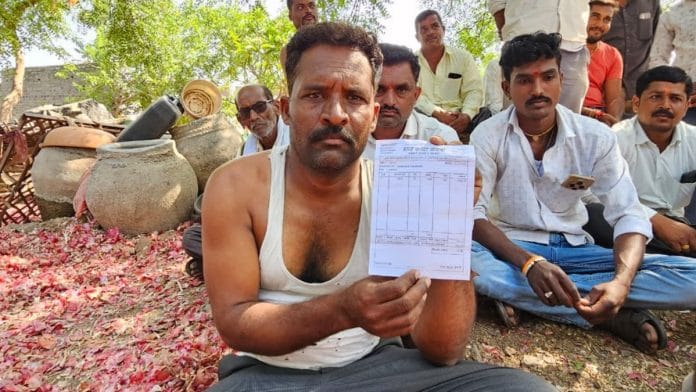

Mumbai: A few days ago, the plight of onion farmers in Maharashtra resurfaced, in the form of a video. It showed an onion farmer who went to a government mandi to sell his crop—and left not with any earnings, but a receipt showing he owed Re 1 as market fees out of his own pocket. The farmer, identified as Prakash Galdhar from Varudi village in Paithan taluka, ferried 1,262 kg of onions to the Agricultural Produce Market Committee (APMC) market. His produce fetched him Re 1 per kg. His total earnings came to Rs 1,262.
But, the APMC charged him a fee of Rs 1,263. The net result: he ended up in the red.
“When it was time to take out the onions that I had cultivated, it rained in our village, and all of my onions got destroyed. And when I took them to the APMC market, I got Re 1 per kg. This is nothing. I am totally devastated now,” Galdhar told ThePrint over the phone.
He is not alone.
Across Maharashtra, onion farmers are suffering heavy losses as the price of onions, often called “red gold” in the state, has crashed to as little as 50 paise to Re 1 per kg in several mandis because of declining export demand and the war in West Asia.
With prices crashing, some farmers are left with no option other than burning their crops or throwing them away. They have also been hit by unseasonal rains and extreme heat, which either destroyed their standing crops altogether or damaged their quality.
“Most of my onions were damaged, and those that were fine were fetching Re 1 or 2 per kg. So what is the use? I threw away around 250 quintals of onions,” said Galdhar, who had grown around 450 quintals of onions on his 4.5-acre farm. One quintal is 100 kg.
According to government data, more than 1.22 lakh hectares of land have been affected by unseasonal rain in Maharashtra this year. The worst-hit districts include Nashik, Ahilyanagar, Jalgaon, Dhule, Buldhana and Chhatrapati Sambhajinagar, where standing and harvested rabi crops have suffered large-scale damage. Vegetable crops like onions, tomatoes, and chillies were damaged due to waterlogging.
A senior state agriculture department official told ThePrint, “We are aware of the situation and are closely monitoring it. Prices work according to demand and supply. We will assess the situation in the coming days and take a decision, if necessary.”
ThePrint reached Maharashtra Agriculture Secretary Parimal Singh via email for comment but had not received a response. This report will be updated if a response is received.
Peeling away the layers
The crisis is visible in Lasalgaon, one of Asia’s biggest wholesale onion markets.
Raviraj Shinde, a farmer from Lasalgaon, told ThePrint that his condition was dire. He cultivated onions on a three-acre field, but heavy rains in December washed away the seeds. He then had to buy new seeds and replant his crop.
“This increased my cost, and the crop was late by a month or so, which damaged its quality. And when it was ready to be taken to the market, it rained again,” said Shinde.
He said that about 50 percent of his onions got destroyed.
Onion farmers in Maharashtra ThePrint spoke to also said production costs have risen in the past few years, including expenses related to pesticides, fertilisers, transport, and labour.
Besides, many labourers receiving money from government schemes are unwilling to work in the fields as they are getting money without working, according to Shinde; and those who are available demand higher wages.
The biggest challenge is the market price. According to traders and farmers’ groups, average-quality onions are currently fetching around Rs 8-10 per kg in many APMCs, while some smaller varieties were being sold for as little as Rs 1-4 per kg, well below input costs.
Narendra Wadhavane, secretary of the Lasalgaon APMC market, told ThePrint that weakening demand from Bangladesh and Sri Lanka, the biggest buyers of Indian onions, has added to the crisis. Bangladesh, he said, had not bought Indian onions for a year now.
According to government data, India’s onion exports to Bangladesh dropped to merely 12,000 tonnes last year from around 7.24 lakh tonnes in 2023-24.
Sri Lanka, another major buyer of India’s onion exports, hiked its import duties last year.
“This affected the farmers. Also, other [Indian] states have onions, and this has affected demand for Nashik onions. Besides, unseasonal rain has damaged the quality of onions, so they are not fetching a good price,” said Wadhavane.
The West Asia crisis has added to their problems. Traders say that with containers not going to Gulf countries, rent and operational costs have risen sharply. “This is not feasible for traders as well,” said Wadhavane.
Farmers ThePrint spoke to say that the coming months will be challenging and want the government to intervene.
In the Nandgaon APMC premises in Nashik, farmers dumped onions Monday, demanding that the Centre and Maharashtra government announce a minimum support price of Rs 2,000 per quintal and provide financial assistance to those affected by the price crash.
“Farmers are compelled to die by suicide because of these conditions. We sell dreams to our children. We want to buy things for them, but we can’t,” said Shinde. “It is a very serious condition, and I blame the government for not coming up with good policies.”
Meanwhile, Galdhar says he’s struggling to provide his children with a good education.
He took out a crop loan of around Rs 8 lakh, which has now increased to Rs 10-12 lakh because of interest. He has three children: an older daughter and two sons, one in Class 11 and the other in Class 9.
He says he also took out an approximately Rs 1.5 lakh loan for his daughter’s wedding two years ago, and is still repaying that. “I thought this season I would get around Rs 10-12 lakh income. I had cultivated cotton before onions; even that got destroyed. I managed to recover what I had invested. But I did not get any profit out of it.”
(Edited by Sugita Katyal)
Also Read: NAFED procuring onions only a bandage. Govt must plan long-term measures, loop in farmers