





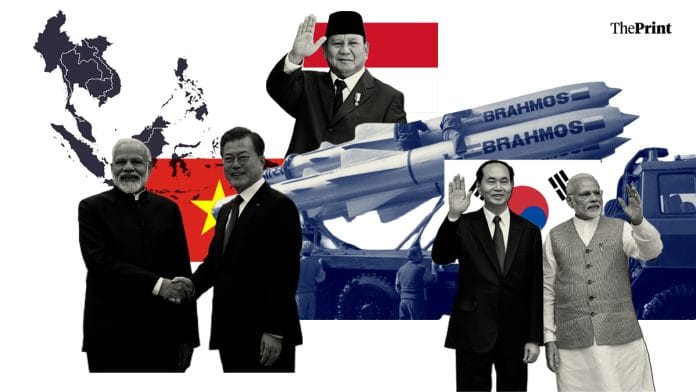


New Delhi: Prime Minister Narendra Modi is set to visit Indonesia next month, as the Indian government continues to deepen its engagement with Southeast and East Asia. The recalibration of New Delhi’s outreach comes as the geopolitical situation continues to change rapidly in large part due to US President Donald J. Trump.
For decades New Delhi positioned itself to first ‘Look East’ and more recently to ‘Act East’. However, questions over India’s approach to countries such as South Korea and member-states of the Association of Southeast Asian Nations (ASEAN), have remained.
But, with the imposition of global tariffs by US President Donald J. Trump and the disruption to international markets, a sort of push-pull has emerged, with countries looking for new partners in the Indo-Pacific region. This has ensured that both India and countries to its east are showing a keen interest in deeper ties.
“I think it’s two-way traffic. It’s not just India moving into Southeast Asia, but I think it is also the Southeast Asian (countries) wanting to engage India for a whole host of reasons, the primary one being the fast-changing geopolitical environment,” Bilveer Singh, an associate professor at the National University of Singapore (NUS) explained to ThePrint.
He added: “It was only with the end of the Cold War that this whole idea of ‘Look East’ came. And what you are seeing today is the culmination of that ‘Look East’ policy post-Cold War. India, in Southeast Asia, they came late, but number two. In the last 30 over years or so, they have played catch up.”
For India, a full embrace of countries in Southeast and East Asia has been difficult, given that the majority of economies are competitors in global markets. Vietnam, for example, is a large exporter of textiles. In 2024, Vietnam reported around textile exports worth $49 billion, largely to the US. That same year, India’s textile exports stood at around $37.7 billion, with a third reaching US shores.
A deeper embrace was tested through the signing of the ASEAN-India Trade in Goods Agreement (AITIGA) in 2009. The agreement has been in force since 2010, and has had a significant impact of increasing ASEAN exports to India. In 2025-26, India’s exports of goods to all 11 member-states of ASEAN stood at $38.46 billion, while its merchandise imports from the region was $89.96 billion. India’s trade deficit stood at $51.49 billion.
India has been focusing on the review of AITIGA, which has remained difficult as countries such as Indonesia and Vietnam have yet to eliminate tariffs as per the terms of the agreement. India has liberalised roughly 80 percent of all tariff lines for ASEAN member-states, but that has not been reciprocated across the board.
“Some economies are extremely open, like Singapore; others are not so open. So our contention was that it should not be the simple average of all the tariff line liberalisations, but it should be weighted by the size of the economy. That should be the comparison yardstick. So we seem to have arrived at some kind of an understanding,” P. Kumaran, then Secretary (East) in the Ministry of External Affairs said at a special briefing on 6 May.
It’s not just AITIGA that has emerged as an issue for India. India had in 2010 signed a Comprehensive Economic Partnership Agreement (CEPA) with South Korea, which has come under several rounds of review. The agreement, which saw a 70 percent increase, in trade within two years of implementation, to $20.6 billion, has since stagnated. In the last fiscal, India-South Korea merchandise trade stood at $27.36 billion.
The CEPA has come under scrutiny in India, as the trade in goods deficit stood at $15 billion in 2025-2026. While South Korean companies were early investors in India in the late 1990s, a second wave of investment has yet to come, especially as the Chinese economy grew in the late 1990s and early 2000s to become the global manufacturing hub.
The gaps surrounding trade and investment have seen India push harder to deepen engagement with the region-at-large, especially as global trade architecture has been in a state of flux since Trump returned to the White House in 2025.
The rise of China has played an important role in changing the dynamics of the region. It has grown to become the “greatest superpower” in Southeast Asia, explains Singh.
“Many of us are wary, and we have disputes (with China). India does not have any territorial dispute with Southeast Asia. China has, and we are equally concerned with the United States,” added Singh.
With the US’ focus on tariffs under Trump’s second presidency, a sort of “push-pull effect” was seen in ties between India and countries of the region, explains Torunika Roy, a Research Associate at the Council for Strategic and Defence Research (CSDR).
Roy adds: “Imposition of global tariffs by President Trump has made third countries look for new partners in the Indo-Pacific region. The regional security situation has also evolved, with countries like Vietnam and the Philippines facing different threats. India is looking to act as a supplier of defence technologies to the region.”
Defence, the growing area of convergence
Modi’s visit to Indonesia follows visits by the Vietnamese General Secretary and President To Lam to India last month, followed by the state visit of the South Korean President Lee Jae Myung to the national capital.
Defence and strategic ties have emerged as a means for both sides to engage one another. While larger competition exists in other parts of trade between India and the region, defence and strategic technologies have grown to become a point of convergence.
Indian firm Larsen and Toubro (L&T) has already worked with South Korea’s Hanwha Aerospace on domestically producing the K-9 Vajra howitzers. A new follow-up order was announced in 2024.
India has signed deals with the Philippines and Vietnam to export its BrahMos missiles and platforms, while other areas of defence cooperation have seen substantive growth in discussions. India and Indonesia have also looked to deepen defence cooperation, with the two countries inching towards signing a deal on the export of the BrahMos missiles as well.
“After Operation Sindoor, India has got a chance to promote itself as a defence supplier of technologies to the region. There has been a substantive change in discussions between India and countries in the region,” said Roy.
The Indian Prime Minister’s visit to Indonesia will be his first standalone bilateral since 2018, despite travelling to the country for various multilateral fora since. India-Indonesia ties have seen an evolution in the last two decades, after many years of differences, especially due to Jakarta’s historical support for Pakistan since the late 1960s.
Indonesian President Prabowo Subianto was the chief guest at India’s 2025 Republic Day celebrations, further underlining the strategic convergences emerging in recent years. Defence, semiconductors, critical minerals are all expected to feature heavily in discussions between the two leaders.
With inputs from Kyra Menon, intern with ThePrint
(Edited by Viny Mishra)
Also read: US-Indonesia sign key defence pact, Washington eyes Strait of Malacca