



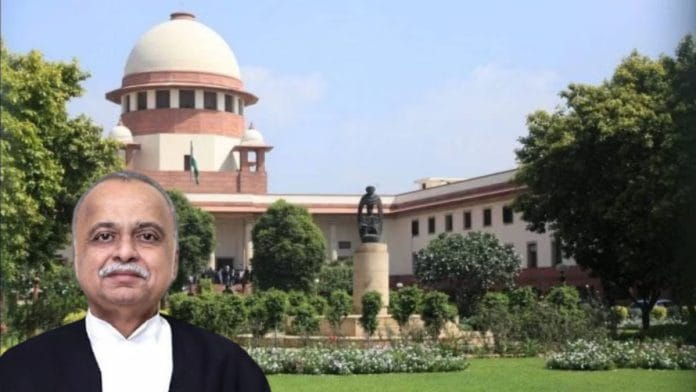
New Delhi: Keeping in abeyance the order of conviction and sentence against Gujarat High Court senior advocate Yatin Oza, the Supreme Court on Monday characterised its decision as an exercise of “extraordinary grace”, marking a final attempt to ensure reform.
In a judgment that balances the “majesty of the law” with judicial compassion, a top court bench of Justices J.K. Maheshwari and A S. Chandurkar invoked its plenary powers under Article 142 of the Constitution to indefinitely suspend the consequences of Oza’s criminal contempt conviction, provided his future conduct remains “impeccable”.
Quoting Fyodor Dostoevsky’s Crime and Punishment, the judgement opened with “The man who has a conscience suffers whilst acknowledging his sin. That is his punishment.”
The proceedings originated from a 2020 live press conference on Facebook where Oza, acting as President of the Gujarat High Court Advocates’ Association (GHCAA), branded the high court a “gambling den” and alleged that the Registry showed “undue favour” to high-profile industrialists and “smugglers”. He was representing junior advocates struggling to list matters during the pandemic.
The High Court, registering a suo motu criminal contempt case, found these remarks to be “scurrilous, reckless and completely irresponsible”, ultimately holding Oza guilty of criminal contempt.
Oza’s senior designation was unanimously recalled by a full bench of the Gujarat High Court on July 21, 2020 calling his behaviour “unworthy of the designation”. Although Oza tendered an unconditional apology, the court rejected it as a “paper apology” and a calculated strategy, noting his “chequered history” of similar misconduct in 2006 and 2016 and his habitual “slap, say sorry and forget” policy.
Taking Oza’s objection on record, the high court heard the matter on merits and held him guilty of criminal contempt. Oza appealed against the high court order before the top court in the same year.
Although the Supreme Court agreed that Oza’s statements were “intemperate” and lowered the authority of the institution, it noted the mitigating circumstances of the time. Oza argued his remarks were a “spontaneous emotional outburst” triggered by the “misery and sufferings” of junior advocates struggling to list matters during the pandemic. While the Court refused to interfere with the High Court’s findings on merits, it chose to look beyond “rigid retribution”.
Also Read: Gujarat HC bar chief apologises for accusing registry of corruption, says he got ‘carried away’
Bar-bench relationship
Central to the Court’s reasoning was an extensive meditation on the foundational relationship between the Bar and the Bench. The court described the two entities as “inextricably linked, serving as the two indispensable wheels of the chariot of justice”. This relationship, according to the judgment, is like “two sides of the same coin, forever complementing each other”, where the Bar acts as the “relentless seeker of truth” and the Bench serves as the “ultimate custodian of the Constitution”.
“The court’s magnanimity is unparalleled; it is a testament to the measured patience of the court that justice must be tempered with mercy… A diligent, ethical Bar elevates jurisprudence and enables judicial precision, whereas indiscipline obstructs the Bench and stalls the chariot of justice. Reciprocally, a patient and engaged judiciary empowers the Bar to advocate fearlessly…. Accountability is paramount, but it must always be balanced with the patience to guide, reform, and elevate,” wrote Justice Maheshwari in the 67-page judgement.
The court emphasised that the dignity of the Bench and the honour of the Bar are “mutually reflective”, noting that conduct that diminishes the stature of one inevitably tarnishes the sanctity of both. For the chariot of justice to move forward, the court held that the Bench must adopt a “somewhat ‘parental’ temperament”, acknowledging that the immense emotional strain of high-stakes legal practice—especially during the “unprecedented” Covid-19 period—can lead to errors born in the “heat of the moment”.
The Supreme Court described its decision as a “final act of forgiveness”. This grace was extended despite a “chequered history” involving previous contempt proceedings in 2006 and 2016, when Oza had similarly been pardoned after tendering apologies. The court acknowledged that while Oza’s 2020 conduct might have been the “straw that broke the camel’s back”, the judiciary’s true essence lies in restraint and reformative guidance.
Describing the current intervention as “the last chance, after the last chance”, the court opted for a recourse of “measured forgiveness or forgiveness with vigil”. The judgment explicitly states that “justice must be tempered with mercy” and that “a fault committed by one does not warrant the other to resort to punitive destruction”.
Conditions of reform and periodic review
The suspension of Oza’s conviction and sentence is not absolute but is contingent upon his continued ‘impeccable behaviour’. To ensure his solemn undertaking does not merely turn into empty words, the Full Court of the Gujarat High Court has been directed to periodically review his conduct every two years.
If Oza is found to have committed any further acts of a similar nature, the High Court is at liberty to move the Supreme Court to give “immediate effect” to his conviction. This arrangement ensures that while Oza is spared the immediate disqualification from practice under the Advocates Act, he remains under a permanent vigil by the institution he serves. The court concluded with a “sanguine hope” that Oza realises this “extraordinary grace” is his final opportunity to ensure his conduct remains above board.
(Edited by Nardeep Singh Dahiya)
Also Read: India’s contempt law has three problems. Reform is difficult