



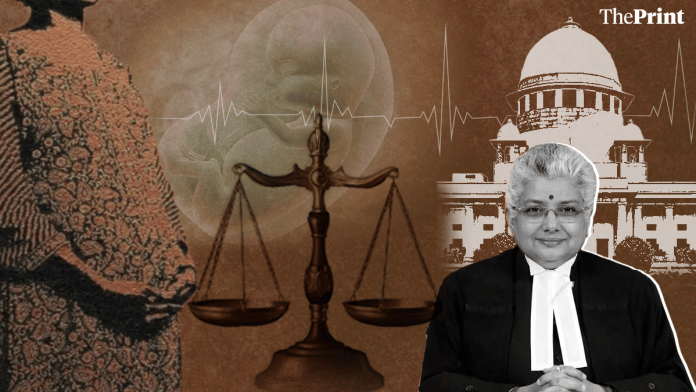

New Delhi: Justice B.V. Nagarathna, the Supreme Court’s lone woman judge, has since her elevation to the top court repeatedly taken a jurisprudential position on medical termination of pregnancy that puts above all a woman’s right to bodily autonomy.
The cases span a 26-week pregnancy case split verdict that went against her, a series of late-term terminations involving minor rape survivors, and at least one case in which she overruled a high court to uphold a petitioner’s right to terminate on mental health grounds.
Across each of these, her reasoning followed a recognisable architecture: mental trauma and curtailed life prospects weigh as heavily as physical risk; foetal viability does not displace the woman’s rights; and the court cannot compel a woman to carry an unwanted pregnancy.
The most recent test of that position came on 24 April, when a bench of Justices Nagarathna and Ujjal Bhuyan permitted a 15-year-old minor to terminate a 28-week pregnancy.
In India, medical termination of pregnancy is allowed up to 24 weeks in some cases, including those of women who have been rape survivors, victims of incest, minors, or are differently-abled.
In the teenager’s case, an AIIMS medical board had opposed the termination, saying that the procedure could result in the premature birth of a child requiring intensive care.
But the two-judge bench was unpersuaded. No court, it held, can compel a woman—especially a minor—to continue a pregnancy; decisional autonomy was the governing principle.
AIIMS then sought a review this week, citing ethical concerns about late-stage termination and foetal viability. The bench refused to interfere.
When AIIMS pressed further with a curative plea, a bench of the Chief Justice of India Surya Kant and Justice Joymalya Bagchi declined to reopen the matter, holding that “an individual’s choice ought to outweigh that of an institution”.
Justice Nagarathna was elevated to the Supreme Court in 2021. She is set to be the first woman Chief Justice of India in 2027, although her tenure at the post will be just over a month.
February 2026: Adoption not a substitute
A month earlier, Justices Nagarathna and Bhuyan had intervened after the Bombay High Court refused to permit termination of a 30-week pregnancy by a minor sexual assault survivor.
The High Court had pointed to foetal viability and the possibility of adoption.
The medical board, formed in this case, had found no foetal abnormalities and confirmed that termination was possible, but flagged that the Mumbai hospital lacked the expertise required and that there was a risk of premature delivery if abortion was permitted.
The woman approached the Supreme Court.
The two-judge bench allowed termination, expressly rejecting what it called “adoption as an alternative” to abortion when the woman does not wish to continue the pregnancy.
Compelling a minor to carry a pregnancy to term would cause severe mental and physical trauma, it held. The ruling grounded the right to terminate in bodily autonomy and Article 21 (personal liberty) of the Constitution.
April 2024: The 24-week threshold is a ceiling, not a floor
Two years ago, a top court bench involving Justice Nagarathna permitted a 15-year-old girl to terminate a 30-week pregnancy, reaffirming that compelling a minor to continue a pregnancy violated her constitutional rights under Article 21.
In other rulings from 2024, Supreme Court benches involving Justice Nagarathna clarified that medical boards cannot refuse termination solely on the grounds that a pregnancy exceeds 24 weeks; the board must assess the specific physical and mental health impact on the woman concerned.
October 2023: The split verdict
A defining moment in Justice Nagarathna’s MTP jurisprudence came in October 2023, when she and a fellow judge delivered a split verdict on a 26-week pregnancy case later referred to a three-judge bench as X vs Union of India.
The petitioner was an adult mother of two. An AIIMS medical board found that the foetus had a strong chance of survival and raised the question of whether termination would constitute preterm delivery rather than abortion.
Justice Nagarathna held that forcing a woman to carry an unwanted pregnancy—even one framed as a “preterm delivery” rather than an abortion—violated her bodily autonomy and constitutional rights.
She held that the woman’s “strong determination” not to continue pregnancy must be respected and that the issue was not about viability, but about the mother’s rights and circumstances.
Even if the child survives, the State could assume responsibility, opined Justice Nagarathna.
Justice Hima Kohli (now retired) disagreed. Writing from “judicial conscience”, Justice Kohli held that she could not permit termination when the AIIMS medical board had indicated a strong chance of foetal survival.
Acknowledging the mother’s mental health struggles, Justice Kohli noted that the pregnancy had been voluntary and that the 24-week statutory mark had already been crossed. She was not inclined to allow termination simply because the parents had “got cold feet”.
The matter was referred to a three-judge bench, which eventually declined the termination plea, citing foetal viability and directing AIIMS to deliver the child safely.
Earlier that year, a bench of Justices Nagarathna and Bhuyan dealt with a petitioner more than 25 weeks pregnant who sought termination on the ground of grave injury to her physical and mental health. Her treating doctors had certified her fit for the procedure. The bench overruled a high court’s verdict and permitted termination, holding that reproductive choices free from State interference are central to human dignity.
Also Read: ‘Unwillingness is decisive’—SC allows 30-week abortion, says no woman can be forced to give birth