



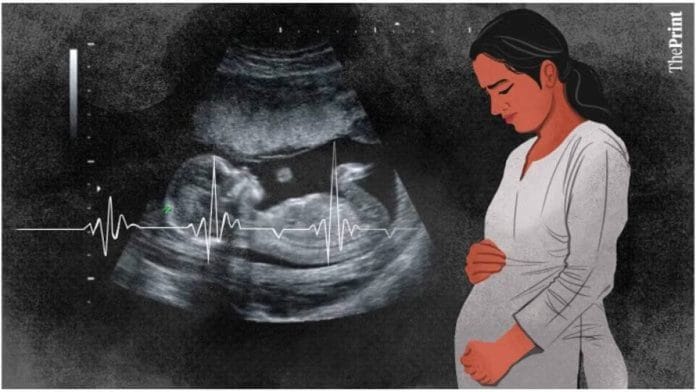

New Delhi: A Chief Justice of India-led bench of the Supreme Court Thursday stated expressly that it won’t entertain AIIMS’ curative petition to revisit the court’s order permitting termination of 27-week pregnancy of a 15-year-old girl.
CJI Surya Kant and Justice Joymala Bagchi told Additional Solicitor General Aishwarya Bhati that an individual’s choice ought to outweigh that of an institution. Further, the judges said, the cut-off date within which pregnancy can be terminated is the work of a statutory authority. But as protectors of constitutional rights, they were bound to go with the individual’s choice.
In the present case, the judges told Bhati that the 15-year-old desired to terminate the pregnancy, a choice which the court will respect. When confronted with medical opinion, advising against termination at such a belated stage for the well-being of the minor as well as the unborn child, the bench suggested counselling for the minor and her parents.
Medical expertise should serve as a guide for informed consent rather than a mandate to compel a minor into an unwanted pregnancy, the bench told Bhati.
“You don’t press this curative petition. If someone has to file it, it should be them,” said the bench, pointing towards the lawyer representing the minor girl.
AIIMS curative petition was filed Thursday against a day-old SC order that had dismissed the institute’s review petition against the court’s 24 April judgement directing the termination of the 27-week-old pregnancy.
“It is strange that the review petitioner, All India Institute of Medical Sciences, is not inclined to obey the order of the Supreme Court and instead, is assailing the order of this court dated 24.04.2026 in order to defeat the constitutional rights of the minor daughter of the appellant herein,” the court said Wednesday.
The bench was led by Justice B.V. Nagarathna and comprised Justice Ujjal Bhuyan.
On 24 April, allowing the termination, the bench had emphasised on the victimisation of the minor, saying that it should not become a permanent scar. It exercised its extraordinary powers to allow the termination, overriding statutory time limits. The Medical Termination of Pregnancy Act (MTP) bars termination after 24 weeks.
Also Read: India saw 67% rise in recorded abortions over last 5 years, Centre tells Parliament
AIIMS argument & SC rebuke
According to AIIMS’ curative petition, mentioned by Bhati Thursday morning before the CJI’s bench, the earlier two-judge bench judgement required to be “cured” as it had not considered the medical board’s opinion that warned about medical risks for the minor mother as well as the child in case born alive.
The institution also submitted that it has only two options before it: one being foeticide, the other to carry out a pre-term delivery. Foeticide at this stage would entail a complex medical process and affect the minor mother’s health in future. And if the foetus is allowed to be born, then the child would live with life-long disabilities.
AIIMs had suggested that the pregnancy be carried on for four more weeks to give the child a “fighting chance” and allow for adoption. Bhati also pointed out that the pregnancy arose out of a consensual relationship between two minors.
However, the bench rebuked the institution’s attempt to “compel a 15-year-old rape survivor” to carry an unwanted pregnancy to term.
The minor child should focus on her education and not forced into motherhood against her will. To let her continue with pregnancy against her wishes would be a violation of her dignity, the court said.
To the argument that in a “foetus vs child” conflict, balance must be struck, the court remarked that the law must be “ruthless” when justice demands it.
The court spoke of trauma and social humiliation the minor would face throughout her life.
It said: “Now it is a viable life. What happened to the innocent child? Today, now that she knows everything, do you think—just imagine what is going on in her mind. The degree of agony. Somebody can imagine.”
CJI Kant was of the view that the law in India should be amended to do away with the 24-week deadline in cases of pregnancy of a minor.
“I had dealt with this; the first judgment in this country on this point was authored by me. Unfortunately, this court stayed that judgment; otherwise, the law would have been well-settled at that time,” the CJI said, recalling his order as an HC judge.
“We will not let the institution choose for the parents,” the court said, asking Bhati to allow the parents an informed choice.
“Sometimes choices are uninformed. There, the experts and the state are in a better position to share information and advice, but thereafter, it is up to the citizen to decide,” the bench said, giving AIIMS an opportunity to counsel the minor girl’s parents.
“Please amend your law so that in cases of unwanted pregnancy on account of rape of a minor girl, the time limitation will not be there. Let not medical personnel, because of their specialised knowledge, become the masters of the will of the people. The people will decide. As judges, we cannot decide for the litigant; similarly, doctors cannot decide for their patients… see, innocent’s victimisation should not become scar for her,” the court added.
(Edited by Nida Fatima Siddiqui)
Also Read: ‘Unwillingness is decisive’—SC allows 30-week abortion, says no woman can be forced to give birth
While no sensible person will argue that women should not have bodily autonomy, all rights have a limit. 24 weeks is roughly six months. If a woman does not wish to proceed with a pregnancy, simply because of her own choice, surely six months is sufficient time to figure that out? I support the arguments put form by AIIMS. At 27 weeks, a woman is no longer carrying a foetus, but a viable human being, who is innocent and does not deserve to be killed.