





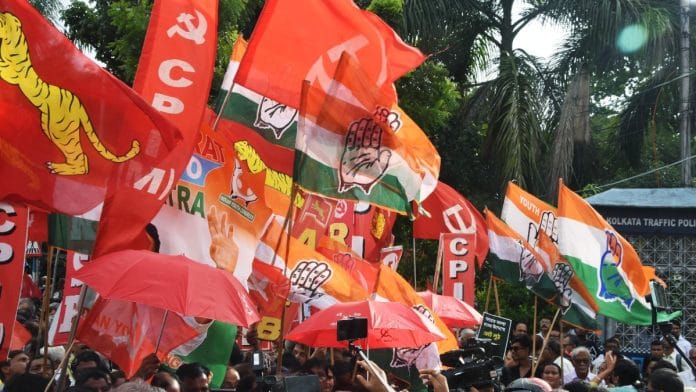


New Delhi: Relegated to the political margins, the Congress, the Left and the Indian Secular Front failed to regain much of their lost ground in West Bengal, managing to win just four seats among them in an election that rewrote the state’s political landscape.
The Congress won the Farakka and Raninagar seats. The Communist Party of India (Marxist) won the Domkal seat, where its candidate Mostafijur Rahaman secured the most votes. Lastly, ISF’s Nawsad Siddique won from his seat, Bhangar.
As partners in the last assembly election in 2021, only the ISF had secured a seat while the Congress and the Left had drawn a blank. This year, the three parties contested the polls separately.
Adhir Ranjan Choudhury, former state Congress chief, lost to the BJP’s Subrata Maitra by 17,548 votes in the Baharampur constituency. In Malatipur constituency, Mausam Noor of the Congress lost to the TMC’s Abdur Rahim Boxi by 59,747 votes.
The Left pinned significant hopes on its Panihati candidate, Kalatan Dasgupta, who had been associated with protests following the RG Kar hospital rape and murder incident. The BJP fielded the victim’s mother, Ratna Debnath, who emerged victorious.
Kalatan Dasgupta finished third with only 15,004 votes, trailing behind Ratna Debnath, who clinched 56,865 votes, and TMC’s Tirthankar Ghosh, who got 36,066 votes.
In a state where the contest was largely bipolar between the ruling TMC and the BJP, the Congress contested all 294 seats, while the Left fielded candidates in 252.
The Congress, which had aligned with the TMC in the 2011 assembly elections, switched camps to ally with the CPI(M)-led Left front in the 2016 assembly elections. They ended up with a combined tally of 77 seats (Left 44, Congress 33) in 2016.
The alliance was revived in 2021, as part of the broader Sanyukta Morcha, which also included the Indian Secular Front. But it failed to win a single seat, a collapse that further cemented the dominance of the TMC in 2021.
For the Left, contesting independently in this election, signalled a reset—an attempt to rebuild its ideological identity and reclaim lost ground. It still hasn’t changed the party’s electoral luck.
The Congress, which had lost much of its support base to Mamata Banerjee after she quit the party in 1997, launched a broadside against both the TMC and the BJP this election. Ahead of the elections, Rahul Gandhi’s attacks on the TMC government highlighted widening faultlines within the INDIA bloc.
The Left
In decline, the CPI(M)-led Left retains scattered pockets of competitiveness, rather than clear strongholds. These include parts of North Bengal and Alipurduar, where tea garden workers and legacy union networks still offer some support. Western districts such as Purulia and Bankura has remnants of its earlier rural base, while isolated seats in the Howrah–Hooghly industrial belt continue to show traces of its old trade union influence.
But, the party, which once dominated every layer of Bengal’s politics, has found itself increasingly sidelined, with a fragmented vote share across its former strongholds.
The decline of the CPI(M)-led Left Front in West Bengal was not sudden but the result of a gradual erosion after decades in power. It ruled the state uninterrupted from 1977 to 2011—one of the world’s longest-serving democratically elected Communist governments. Its dominance, however, began to fray in its later years, which Mamata Banerjee leveraged to position herself as a stronger alternative. Critics say prolonged incumbency led to growing anti-incumbency, while the leadership was increasingly seen as disconnected from shifting ground realities.
Protests in Singur (2006–08) and Nandigram (2007) began when the Left government attempted to acquire farmland for industrial projects, including a car factory. Many farmers said they were not properly consulted or compensated, and clashes with police led to injuries and deaths. The events damaged the Left’s image as a pro-farmer, pro-poor government and gave the TMC a strong political opening to mobilise support. Since 2011, the Left has struggled to recover, steadily losing both organisational strength and voter base in a political landscape that has shifted toward a TMC vs BJP narrative.
Also Read: Bengal is staring at the winner’s curse. A win isn’t an endorsement of either Mamata or BJP
The Congress
The Congress retains relevance in a narrow belt of central and north Bengal, particularly in minority-dominated and legacy strongholds.
Districts like Murshidabad continue to form the party’s core base.
In neighbouring Malda, some seats remain competitive, mainly due to strong local networks and the long-standing influence of Congress leaders.
Beyond this belt, however, the party’s presence drops sharply, with limited impact elsewhere in the state.
Left’s election campaign
The Left Front ran a multi-pronged campaign focused on youth mobilisation, livelihood issues, and anti-corruption messaging. The party fielded a new generation of leaders, including figures like Minakshi Mukherjee and other former Students’ Federation of India (SFI) activists, to connect with younger voters and shed its ageing image—an approach that has yielded limited results.
The Left’s manifesto emphasised job creation, labour rights, and women’s safety, alongside a model “free from corruption”.
At the same time, the campaign sought to present a secular alternative to the BJP, captured in slogans like “No Mandir-Masjid, Bengal needs employment”.
However, despite visible ground activity, candidate renewal, and issue-based campaigning, the Left remained a relatively quiet player in the election.
The Congress’s campaign
Rahul Gandhi’s campaign—marked by direct attacks on Chief Minister Mamata Banerjee—was widely seen as an attempt to carve out independent political space in a state where the Indian National Congress (INC) has not been in power on its own since 1977.
Experts described Rahul Gandhi’s approach as “naive” and “poorly timed”, but Congress leaders defended his speeches, arguing that he was well aware of the state’s political dynamics. That defence, however, appears to have fallen flat.
The Congress contested all 294 seats in West Bengal but managed to win only two seats, underscoring its limited traction on the ground. Significantly, even in Muslim-dominated pockets, where the party has traditionally sought to consolidate support, the Congress failed to convert its presence into dependable strongholds.
The Congress’s strategy in West Bengal has been marked by visible inconsistency—allying with the TMC in 2011 to unseat the Left, then pivoting to join hands with the CPI(M)-led Left in 2016 and 2021, while at other times choosing to go solo. These shifting alignments—often with parties that have sharply divergent ideologies—have blurred the INC’s positioning in the state, making it appear opportunistic.
Experts suggest that this lack of a consistent political line has weakened its organisational base and made it harder for voters to identify where the Congress stands.
(Edited by Madhurita Goswami)
Also Read: CAPF deployment in West Bengal has set a new benchmark in Indian electoral history