








A series of firsts marked the 2026 West Bengal Assembly elections. It recorded moments rarely seen in Indian electoral history, particularly on the security front.
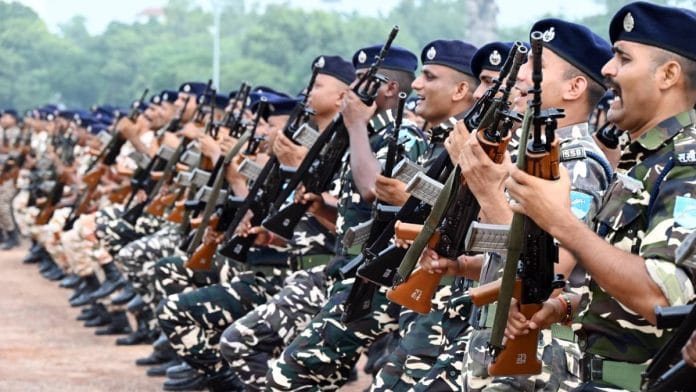
More than 2.4 lakh personnel from the Central Armed Police Forces (CAPF) were deployed this time—nearly three times the strength used in the 2021 Assembly election. The CAPF, a group of armed units — BSF, CISF, CRPF, ITBP, NSG, and SSB — also set up its own control room for direct monitoring, while Quick Response Teams were deployed on a massive scale.
Over the past one-and-a-half months, personnel were tasked with providing security within a 100–metre radius of polling stations. Drones were pressed into service for digital surveillance, and armoured bulletproof vehicles were brought from Chhattisgarh and Jammu and Kashmir.
Mobility restrictions, including curbs on motorcycles, were imposed. In an extraordinary show of coordination, chiefs of all CAPF units met at Kolkata’s Science City on 18 April to review the law and order situation. Even teams from the National Investigation Agency (NIA)—the premier counter-terror body whose mandate is not law-and-order management—were stationed in sensitive zones.
And this list is far from exhaustive.
In another first, at a rally in Kolkata, Union Home Minister Amit Shah announced that around 70,000 CAPF personnel would remain deployed in West Bengal until “further orders” even after polling concludes.
Normally, once polling ends, CAPF battalions begin returning to their original postings, with only 30 to 40 battalions typically retained for post-poll law-and-order duties in sensitive areas, as these forces are often temporarily diverted from critical assignments across the country.
The CAPF deployment is caught between two sets of narratives — the Trinamool Congress’s allegations that the move amounts to “central overreach” and an attempt to “intimidate”, and the Centre’s claim of it being a necessary step for free and fair elections. In a state scarred by post-poll violence, one thing is clear: such scrutiny and security cover are unprecedented in the history of Indian elections.
And that is why the CAPF deployment in West Bengal is ThePrint Newsmaker of the Week.
‘Unprecedented in scale, not strategy’
Speaking to ThePrint, a former CRPF officer who has previously been involved in election preparedness in multiple states said the scale of deployment in West Bengal only appears unprecedented because of the sheer numbers involved. It is not an electoral strategy to influence the outcome, he added.
“For every election, depending on threat perception and the sensitivity of an area, a security plan is drawn up, and whatever mechanisms are required are put in place. The same has been done in West Bengal,” he said, adding that specialised security arrangements are also not new; only the technology changes.
For instance, during elections in Chhattisgarh, drones were used for surveillance wherever polling companies moved because of the threat of landmines, the officer said, adding, “So this is not happening for the first time, but yes, use of AI and control room is new.”
Given West Bengal’s long history of poll violence, he said, such extensive deployment was necessary.
During the 2021 Assembly election, the state witnessed at least 50 poll-related deaths and 300 incidents of violence, with both the ruling TMC and opposition BJP blaming each other for the violence. This time, however, he said only one death was reported, and even that was unrelated to political violence.
A second senior CRPF officer echoed the same view, saying that while the deployment was indeed massive, the concentration of polling in just two phases instead of the earlier five-phase model led to increased deployment.
“Since polling was held in only two phases this time, maximum booths had to be secured simultaneously, which naturally required more force,” he said. “Considering Bengal’s history of election violence, this was necessary.”
On the use of technology, the officer said advancements in surveillance and monitoring systems, including AI tools, control rooms and high-tech drones, must be used to strengthen law-and-order operations and ensure free and fair elections.
“The results are in front of you. No poll-related death due to violence has taken place this time, which itself is unprecedented given Bengal’s bloody electoral history,” he said.
Former Union Secretary and retired IAS officer EAS Sarma called the deployment nothing short of “intimidation” by the Centre, saying the Election Commission’s approval of such security presence was “distressing.”
“The way elections have been conducted in West Bengal is unacceptable. It is distressing to see the ECI deploying central paramilitary forces on such a large scale, making a mockery of the Commission’s impartiality,” Sarma said.
“I felt distressed to see a few central paramilitary personnel roughing up women during polling in the state, shown widely on some TV channels. That should be thoroughly investigated,” he added.
He argued that while the ECI had effectively taken control of the state’s police and administrative machinery on the stated premise of insulating them from political influence, it had failed to apply the same standard to Central agencies.
“Why has the ECI not exercised similar control over Central investigating agencies, timing their raids against opposition leaders between the first and second rounds of polling?” he asked.
Also read: Why the 2026 Bengal assembly election is Mamata’s toughest battle and BJP’s best bet
‘Companies staying back not new’
Soon after Shah said, “Don’t worry about Didi’s goons. The Election Commission has deployed CAPF in every nook.” The development led to another wave of reactions.
Officers, however, said the move was not new. They maintained that while most forces would eventually return, a certain number of battalions are routinely retained for post-poll duties, depending on the sensitivity of the region.
The number of battalions left behind is determined by threat perception. For instance, in Kashmir, 50-60 battalions were retained even after polling due to fears of retaliation against voters, an officer said.
CRPF Director General GP Singh said that 500 companies would remain in West Bengal, including 200 CRPF, 150 BSF, 50 CISF, 50 ITBP and 50 SSB companies. An additional 200 companies have also been tasked with securing strong rooms where electronic voting machines are stored, Election Commission officials confirmed.
“There is always both pre-poll and post-poll deployment during elections. In places like Kashmir or Chhattisgarh, battalions have been retained after polling to maintain peace. The scale depends entirely on threat assessment,” an officer said.
“In Kashmir, a full withdrawal rarely happened because there were concerns that those who voted could be targeted. In Naxal-affected areas too, there is often a risk of law-and-order breakdown. These are just two examples, but generally such deployments are planned well in advance, including how many battalions will be sent before polls and how many will remain afterwards,” the officer added.
Once the election process is over and a new government assumes office, the decision to retain or withdraw central forces becomes the prerogative of that government, based on the prevailing security situation.
Also read: Maach & mutton for Mission Bengal. What BJP-TMC are cooking in new poll battleground
‘Increased voter turnout tells a story’
Opposition parties criticised the heavy CAPF deployment, with TMC MPs Mahua Moitra and Abhishek Banerjee calling the forces Shah’s “private army”. Abhishek also alleged that the central forces were “terrorising ordinary citizens, slapping women, assaulting the elderly, and even targeting children.”
But a third senior CRPF officer rejected the political framing, arguing that security forces cannot make a party win or lose. Their role is solely to ensure voters can exercise their franchise freely, he said.
“In such a scenario, the forces are there only to stop troublemakers from doing what they have always done. If anyone has a problem with that, it should only be those looking to create trouble,” the officer said.
“Only those doing wrong should fear security forces watching them. Their job is to create a safe, conducive environment for people to step out and vote and not to influence the outcome in favour of any party,” he added, pointing to voter turnout as evidence.
This election saw the turnout rise sharply to 92.49 per cent, up from 81 per cent in 2021.
“The numbers are there for everyone to see. This time, there were zero deaths linked to political violence, and turnout was high because people were not scared to vote,” the officer said.
If this deployment was a central overreach or a necessary intervention will remain politically contested, but on the security front, the sheer scale of scrutiny and militarised preparedness has set a new benchmark.
Whether it was a one-off for West Bengal or becomes a template for future elections, however, remains to be seen.
(Edited by Saptak Datta)