






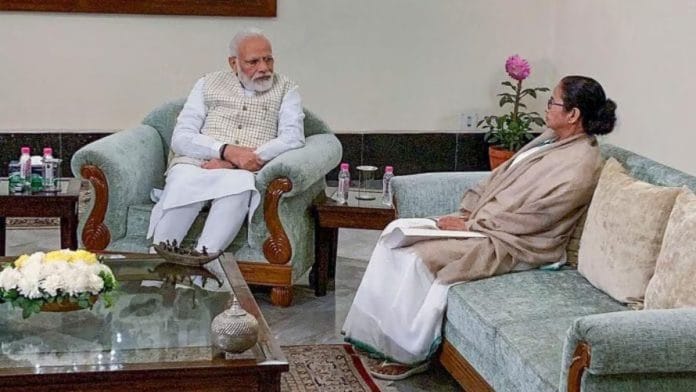


In recent times, an assembly election in India has rarely generated the kind of buzz and social media frenzy that the ongoing one in West Bengal has. From meme wars to non-vegetarian food narratives, the contest has spilled far beyond generic rallies and television debates.
It is being called the mother of all electoral battles, a do-or-die situation for the two principle competitors. On one hand, Trinamool Congress (TMC) supremo and West Bengal Chief Minister Mamata Banerjee aims to defend her turf for the fourth consecutive term. On the other hand, the BJP, which has expanded its footprint in the state in a very short time, continues its venture to finally conquer West Bengal.
Conquering this eastern state is crucial for the BJP playbook, not only because of its strategic significance—the Siliguri corridor, also referred to as the chicken’s neck, a narrow chokepoint in North Bengal connecting north-east to the rest of India—but from an ideological standpoint as well. Bengal happens to be the birthplace of Syama Prasad Mukherjee, the founder of Bhartiya Jan Sangh, the predecessor of BJP, and winning it will be politically and ideologically significant.
For 71-year-old Mamata, too, this election is crucial. She knows if she loses this election, it will be an uphill battle to bounce back, five years from now. Her nephew and TMC national general secretary and likely heir apparent, Abhishek Banerjee, is there, but it’s largely her face that people of Bengal associate with TMC. In fact, during her campaigning, she has repeatedly said to consider her as the candidate contesting in all 294 seats of the West Bengal Assembly, drawing parallels with the BJP, which tries to make Prime Minister Narendra Modi the face of elections across the country.
The BJP had its eye on Bengal for a long time and built its base in the state, one step at a time. The party started with a mere 4.14 vote percentage in 2011. In 2016, the vote percentage went up to 10.28 per cent, and winning three seats and 38.26 per cent, securing 77 seats in 2021. Having reached so close, the BJP is leaving no stone unturned this time. The party seems to have moved its might and machinery to win Bengal.
The Special Intensive Revision (SIR) rolled out to revise the electoral rolls in the state last year further aggravated TMC’s trouble.
The SIR ended up deleting around 63 lakh voters, who are either dead or have shifted outside Bengal, in the final electoral rolls, and further disenfranchising 27 lakh people in the supplementary list published on 6 April. A majority of the 27 lakh names were from three districts where Muslims are in the majority—Murshidabad, Malda and Uttar Dinajpur.
Besides women, Muslims are another core votebank of TMC.
It is amidst these challenges that Mamata’s TMC is fighting the 2026 Bengal assembly elections. This is the reason that the West Bengal election is ThePrint’s Newsmaker of the week.
A formidable opponent for BJP
BJP knows very well that it’s up against a formidable opponent, unlike any other it has experienced in states where it has come to power.
Mamata is one of the most consummate politicians of her time and has proved to be a perfect match for the political shrewdness of her opponents.
If the SIR, a routine administrative process to clean up the electoral rolls, led to the deletion of 91 lakh names, Banerjee ensured that it became the most dominant narrative of the Bengal elections this time. In February, in a first for a sitting CM, she appeared in the Supreme Court as a “common citizen” against the “unprecedented hardship and distress” that deletions were causing to the citizens of West Bengal.
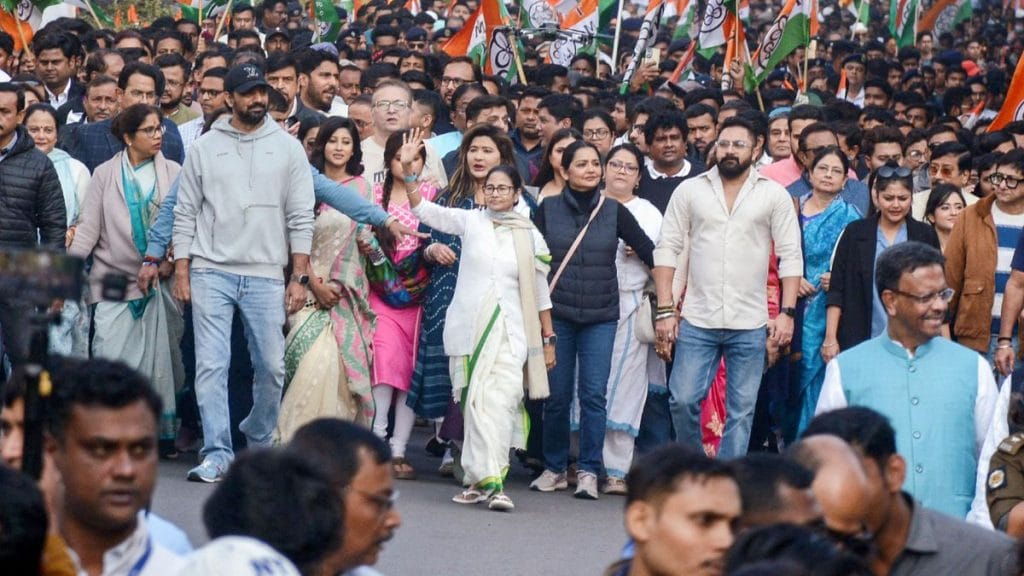
In the first week of March, she began a week-long sit-in protest in Kolkata against the large-scale SIR deletions. By the time campaigning picked up in mid-March, complaints against SIR deletions became the main talking point of the election.
But the BJP did not hold back.
It used the SIR to play the polarisation card and consolidate the Hindu votes. It built a counter-narrative about how the TMC government had, in the past, used fake voters to increase its numbers, how this has led to “ghuspaithiyas’ (infiltrators) entering Bengal and slowly changing the demography of the state in the border areas.
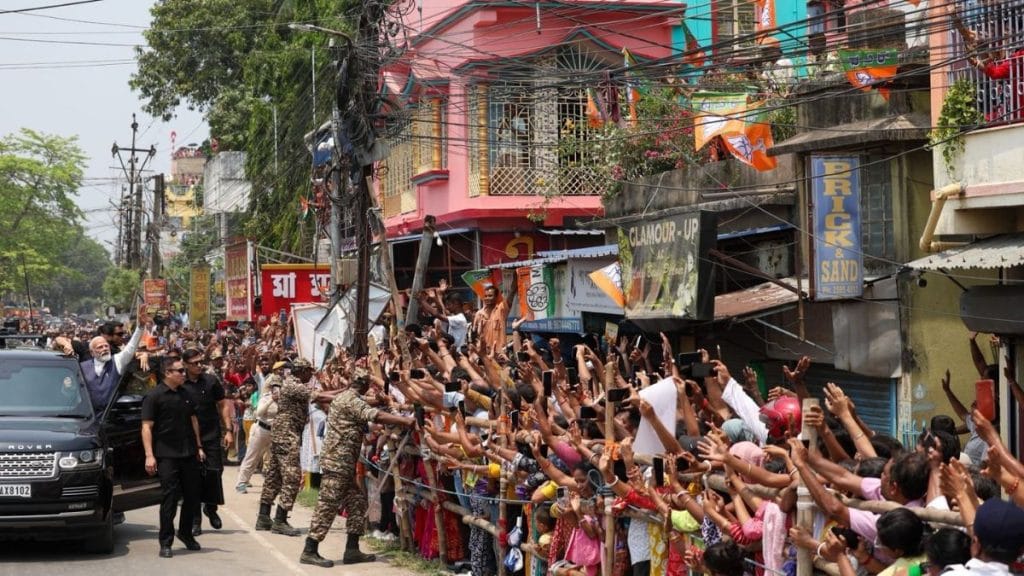
Besides Modi, Home Minister Amit Shah and cabinet ministers, the BJP also roped in CMs from at least half a dozen BJP-ruled states for campaigning. The party flew in its top brass—from Uttar Pradesh CM Yogi Adityanath and Assam CM Himanta Biswa Sarma to Madhya Pradesh CM Mohan Yadav and Rajasthan CM Bhajan Lal Sharma—to campaign and strategise in Bengal, a state with a long history of political violence.
Learning its lesson from 2021, where the TMC made Bengali asmita a big poll issue, which played a major role in trouncing the BJP, the saffron brigade this time ensured to deploy some Bengali-speaking leaders from the north, be it former Union minister Smriti Irani or the young BJP MLA from Bihar, Maithili Thakur.
Also read: Maach & mutton for Mission Bengal. What BJP-TMC are cooking in new poll battleground
Challenges galore
It’s not that Mamata is not aware of the disenchantment among voters.
In power for 15 years, she is well aware of the massive anti-incumbency against her government. From lack of infrastructure to jobs, corruption to syndicate raj, charges have flown thick and fast against her government’s inability to deliver.
BJP has leveraged this disenchantment against TMC, especially the fear factor, to the hilt this time. In fact, one of its main campaign slogans this time around is “Bacchte chai tai BJP chai” (I want to live and that is why I want BJP).
However, the fact also remains that on the ground, despite the complaints, her personal popularity has more or less remained intact. A common refrain that you hear while talking to people is “Didi (elder sister) bhalo kintu didir sanger loke ra theek na” (Didi, as Mamata Banerjee is commonly referred to in Bengal, is popular, but her people are not.)
Mamata is also aware of her connection with the voters, especially the women voters, her core vote bank. Women across different regions in the state, ThePrint travelled to for close to three weeks, spoke about the different welfare schemes launched by her government for women and girls, including the popular Lakshmir Bhandar, where women across the state were getting Rs 1,000 every month. Just before elections, she increased it to Rs 1,500 for general category women and Rs 1,700 for those belonging to the Scheduled Caste category—a move seen as echoing the “caste” arithmetic often associated with the BJP.
The BJP understood that Mamata has the first-mover advantage. And there is a very slight dent in her grip on women. The only way they could counter it was by promising to double the amount in their election manifesto.
Both parties also tapped into another crucial votebank—lakhs of Bengali migrants working outside the state. From air-conditioned buses to special trains, both the BJP and the TMC leaders and volunteers provided whatever logistics were required to bring the migrants back to vote.
It’s not the first time that migrants have returned home to vote. But the fear generated by the deletion of names in SIR ensured that probably one of the highest numbers of migrants returned home this time.
Despite the shrunk voter base because of large deletions, the high voter turnout in the first phase of polls on April 23—92 per cent—reflected how not just the migrants but people in general have turned out to exercise their right.
A day after the polling, both parties are on the edge, trying to figure out which way the wave will swing. But one thing is clear. The outcome of this election is going to be a make-or-break for both parties.
(Edited by Saptak Datta)