





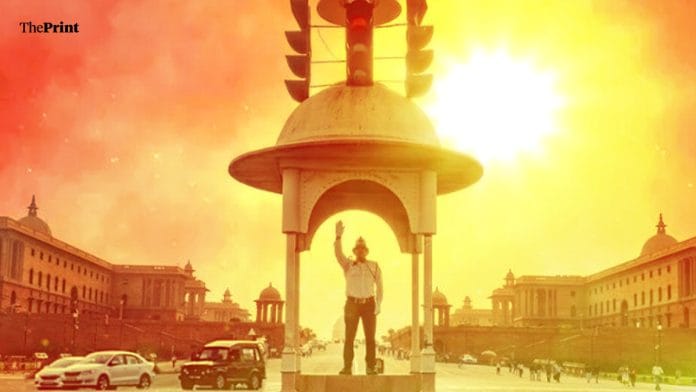


New Delhi: The heat is on. As roads shimmer in the sun, metal burns to the touch, and death-dealing loo rules the daylight hours, even standing still outdoors for long becomes an ordeal. Delhi’s traffic cops live through this searing hell every year; there are no options for them, only quickfixes. And hope.
At the Palam flyover, a 35-year-old constable has been on duty since 7 am. Earlier in the day, he attended to a bus that had broken down in the scorching heat before returning to an island of shade under a nearby tree where he drinks lifegiving nimbu-paani (lemonade) brought from home. “When there is congestion and during peak traffic time I stay at my spot, and then I sit in the shade under a tree,” he said stoically.
Similarly, in Dwarka’s Sector 10, a 39-year-old head constable who recently joined the Traffic Police after serving in the Crime Branch monitors commercial goods vehicles during restricted—No Entry—timings between 7 and 11 am, and again from 5 to 11 pm.
During his shift, he mixes homemade sattu (roasted gram flour) with cold water to stay hydrated in the heat.
“Only after the no-entry timing is over do we go sit near the police booth,” he said.
Across Delhi, traffic police personnel have quietly built routines around surviving the heat—carrying homemade drinks, standing under trees between congestion periods and waiting for brief moments of shade during long deployment outdoors.
On 17 May, amid the ongoing heatwave and fuel-saving efforts, the Delhi government advised private organisations to adopt a two-day work-from-home policy, stagger office timings and encourage carpooling and public transport. But, while office workers are being advised to stay indoors, traffic police remain structurally tied to Delhi’s roads.
Heat does not pause policing.
At 4 am, long before Delhi’s roads begin to fill with office traffic and school buses, a traffic police constable leaves his home in Gurugram and heads towards Sardar Patel Marg.
There’s VIP movement scheduled later for that morning, which means the route has to be cleared hours in advance. By sunrise, he is already on the road, checking for parked vehicles, coordinating traffic arrangements and standing guard along one of the Capital’s most heavily monitored stretches. By noon, as temperatures climb past the dread mark of 40 degrees Celsius, he is still on his feet, directing traffic.
“When there is VIP movement you cannot sit down,” a head constable stationed at Sardar Patel Marg told ThePrint. “If the movement is at 7 am, we have to report by 4 am.”
The policemen stationed there said they usually work in two shifts—7 am to 3 pm and 3 pm to 11 pm—but VIP arrangements often stretch their hours further. They get one day off every eight to 10 days. Traffic police personnel continue to manage congestion, enforce commercial vehicle restrictions, monitor signals, clear breakdowns, coordinate VIP movement and ensure that Delhi’s traffic keeps moving, whatever the weather.
The constable posted in Palam, who has been stationed there for over a year, said the heat feels harsher this year. “It is definitely hotter than previous years,” he said.
For traffic police personnel, the work itself requires physical presence. Officers stationed at intersections spend hours exposed to direct sunlight, dust, vehicular pollution and hot, dehydrating wind while regulating traffic flow. Yet, traffic policing cannot move indoors.
“If trucks are travelling during no-entry hours and they do not have the necessary papers, we stop them,” the Dwarka head constable said, adding that low staffing often stretches shifts to longer than scheduled. Most of his shift is spent standing.
“There is no morning staff in the area sometimes because people get deployed for VIP movement,” he said, referring to arrangements planned around events such as the Indo-Africa summit that was later cancelled.
Also Read: Heat stress is not a temperature. India needs to learn that
Plans and gadgets
The Delhi government’s Heat Action Plan 2024-2025 states that the Delhi Police and Traffic Police should “ensure shade for on duty traffic police personnel as they are more exposed to heat waves, and distribution of cool jackets for Traffic Police personnel”.
A senior police official told ThePrint they had “no knowledge” of cool jackets being distributed. The Delhi government has also announced a broader Heatwave Action Plan for 2026. Chief Minister Rekha Gupta said on X that over 10 lakh ORS packets had been distributed across the city and that mobile heat relief vans had been deployed. Within the traffic police, officials say several interventions are now being tested to help personnel cope with prolonged outdoor exposure.
As reported earlier by ThePrint, Additional Commissioner of Police (Traffic) Vijayanta Arya said that the department is organising an awareness session with a senior dermatologist within the next 10 to 15 days to advise personnel on dealing with heat exposure, pollution and dust.
“We are organising a session with a senior dermatologist to give advice to the Traffic Police on precautions to take when they are in the sun and preventions against the dust and pollution,” Arya said.
The department has also launched a pilot project involving AC helmets and portable hand fans. “The AC helmet and fan is a pilot programme and is being used on a trial basis to see if it serves the desired purpose,” Arya said.
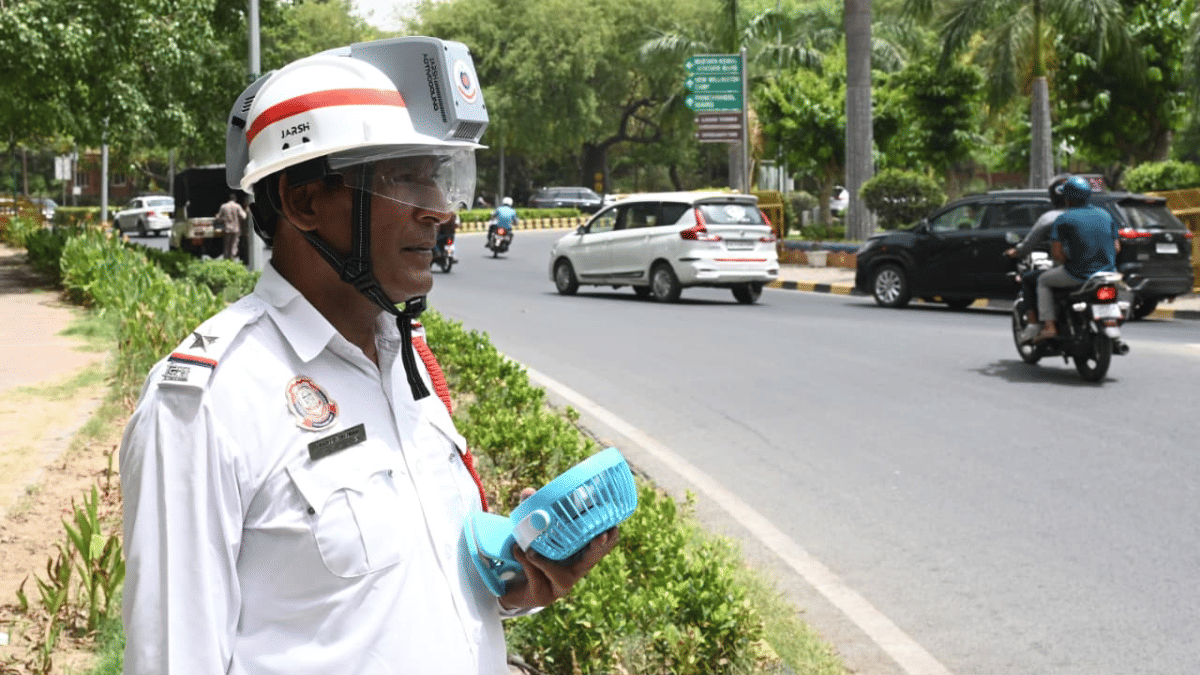
At Ashoka Police Lines, ThePrint saw one of the helmets currently being tested. The helmet, called the ActivCooling Helmet and assembled by Jarsh Safety, has a battery life of around five to six hours and comes with four cooling modes—25 percent, 50 percent, 75 percent and 100 percent—along with separate low and high airflow settings.
Officials said every traffic circle in New Delhi has currently been given one helmet for testing purposes. The helmets are still under evaluation and wider distribution will depend on feedback from personnel using them.
“We are giving the helmets to various people to get a better understanding of whether it is useful or not,” a senior police official said. “If the staff says it is providing them relief and improving their working conditions then we will order more.”
Another senior official said the department wanted to observe the devices over a longer period before deciding on expansion. “Give it a few days. What may seem good on Day 1 may not be useful in the long run,” the official said.
The department has also introduced mobile canteen vans that provide cold water during long deployments and traffic arrangements. But among personnel on the ground, reactions to the cooling equipment remain mixed.
At Palam, the constable said he had only seen videos of the AC helmet. “It has not yet come to our circle,” he said. “Usually they give these things to VIP areas first. Only if it’s successful then they will give it to us.”
In Dwarka, the head constable questioned how much relief the equipment could realistically provide. “If you give me a helmet for the head, the head will be cool, but what about the rest of the body?” he said.
At Sardar Patel Marg, officers said they had not received any helmet yet. “Hame koi helmet nahi mila (we didn’t get any helmet),” one of them said.
When ThePrint showed them a video of the same helmet being demonstrated in the area, the officers said they did not know filming had taken place there.
ThePrint also tried on the helmet during the demonstration at Ashoka Police Lines. While the internal fan circulated air, the air itself felt warm in the afternoon heat, and the helmet felt heavier than a regular traffic helmet.
The portable hand fans being tested alongside the helmets also raised practical questions among personnel deployed on roads. “Haath mein fan pakde ya arrangement dekhe (should we hold fans or see to our duty)?” one officer asked.
Even basic relief infrastructure remains complicated. Traffic personnel stationed at Sardar Patel Marg have access to a small seating area with two benches and a fan. But one officer said that during peak afternoon heat, even the fan becomes difficult to use.
“When it’s really hot we can’t even turn on the fan because there’s only hot air,” he said. Several personnel said they wanted more traffic booths near major intersections and deployment points.
“There should be more booths near the main points,” the Palam constable said. “But, we are posted at places where there is no place to make a booth, like on top of this flyover.”
Officers acknowledged the contradiction built into their work. “Can’t make a police booth everywhere,” the Dwarka head constable said. “People will think the police are sitting in the booth and not managing the traffic.”
Many of the personnel ThePrint spoke to describe coping with the heat not through institutional protections but through self-devised routines. Some sit under trees between congestion periods. Some carry homemade sattu. Some wait for truck restrictions to end before briefly resting near booths.
Others simply described endurance as part of the job. “Kaam toh karna hi hai, aadat pad gayi hai (the job has to be done, we are used to it),” officers at Sardar Patel Marg said.
“Roz pollution, dhul, mitti khaate hai (pollution and dust is our daily bread),” another officer added.
One officer stationed in Chanakyapuri summed it up more bluntly. “We have left it God; ours is but to get the job done,” he said.
Extreme heat is a public emergency serious enough to alter office timings and encourage work from home. But the traffic won’t stop.
And someone still has to manage it all.
Mrinalini Manda is an alum of ThePrint School of Journalism, currently interning with ThePrint.
(Edited by Nardeep Singh Dahiya)
Also Read: India’s bats to Australia’s Koalas—animals around the world are dying from heat stress