



New Delhi: The partridge with foie gras and truffle stuffing had been catered by Maxims of Paris, accompanied by Pink Dom Perignon and a Château Lafitte from the Rothschild vineyard. For four and a half hours, Empress Farah of Iran, dressed in gold brocade and a wreath of diamonds towering above her head, stood by the side of her husband Mohammad Reza Pahlavi, mingling with the world’s royals.
Emperor Haile Selassie of Ethiopia, King Frederick IX of Denmark, King Mahendra of Nepal, Prince Bernhard of the Netherlands, Prince Philip of Britain, and General Yahya Khan of Pakistan, President Nikolai Podgorny of the workers’ paradise (i.e., the Soviet Union) and India’s austere President V. V. Giri: Everyone who mattered, and many who did not, were all present under the light of the giant chandeliers, to honour 2,500 years of the Persian monarchy.
For just those few hours on 15 October 1971, the resentments and tensions of the real world seemed to have been put aside: Even though dignitaries from South Africa were present, the Africans did not walk out; the Indians and Pakistanis, almost at war, chatted with each other. Little things—among them the refusal of the British to loan Iran the clay tablet of Cyrus the Great kept in London—were glossed over.
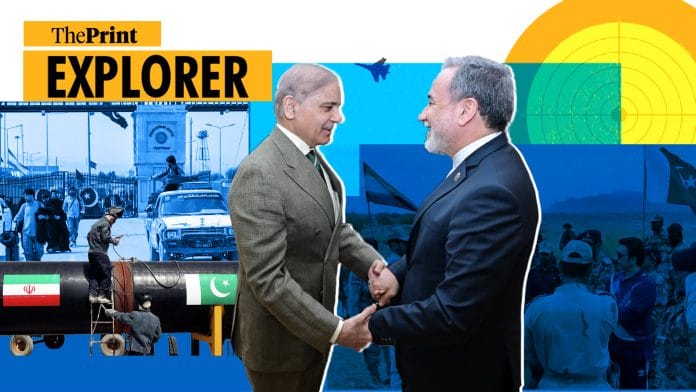
For many days now, the world’s been trying to make sense of Pakistan’s emergence as a key actor in the peace talks between Iran and the US. I’m going to be looking today in particular at how Iran and Pakistan came to be enmeshed in a closed geopolitical embrace. What you might call a ‘friends with benefits’ relationship and why that relationship sometimes became very, very poisonous. The story has all the elements of a great novel. Geopolitics, faith, wealth, hubris, betrayal, it was all there.
That very day, 15 October 1971, as Empress Farah and the Shah entered the grand tent designed by the Parisian interior-design firm Maison Jansen, the Government-in-Exile of Bangladesh had requested India for formal diplomatic recognition. Fleeing genocidal violence by the Pakistan Army, millions of refugees had begun to arrive in India. Led by Major-General Sujan Singh Uban, Indian covert forces had begun operating deep inside East Pakistan, preparing the ground for the Army in the war that was now certain.
Pakistan Foreign Secretary A.H.Amin had called the American ambassador with a desperate appeal to the White House, at around the same time the foie gras was being served in Tehran to Yahya Khan. “For West Pakistan to survive as a nation,” a classified diplomatic cable records Amin as saying, “it is necessary that it be provided additional fighter aircraft. The present trickle of MiG-19s and F104s cannot stem the tide.”
Amin didn’t have to tell the Americans where those aircraft were coming from. American diplomats posted in Tehran had heard from a businessman who had seen three state-of-the-art McDonnell Douglas F-4 Phantom II parked at the Tehran airport, with Pakistan Air Force (PAF) markings.
The businessman had been really intrigued. Because Pakistan did not fly F4s, he made the obvious deduction. Later on, Iranian officials told the American diplomats that the planes had come from Libya, but inquiries rapidly established that the tail numbers were part of a consignment of eight that had been parked in California, and never delivered. Someone else had paid for them and kept them ready for the Pakistanis.
The Shah, another diplomatic cable from Tehran noted on 8 December 1971, had urged the US to tell King Hussein of Jordan to send his country’s F104 fighters to Pakistan. Iran, he went on, would move two squadrons of F104s to Jordan, to protect it for the duration of the Bangladesh war. The deal never did fully work out, but it is clear some numbers of those F104s were sent. The MiG19s—similar to the J6 Chinese knock-offs flown by the PAF—likely came from Syria, a country where the PAF was then training fighter pilots.
All of this had no real impact on the war—but it helps show the enormous geo-political challenges before India, as it struggled to operate in the Middle East that was just as important then as it is now but configured politically very differently.
The West’s Islamic Empire
Long queues of Iranians can often be seen outside 1250 23rd Street NW in Washington DC—the Pakistani Embassy. The Iranians aren’t there hoping to visit Pakistan. The Islamic Republic’s laws mandate that all individuals of Iranian origin can travel home with only an Iranian passport. Every year, the Iranian diaspora in the US grows, and some of them need that passport to visit relatives in their homeland.
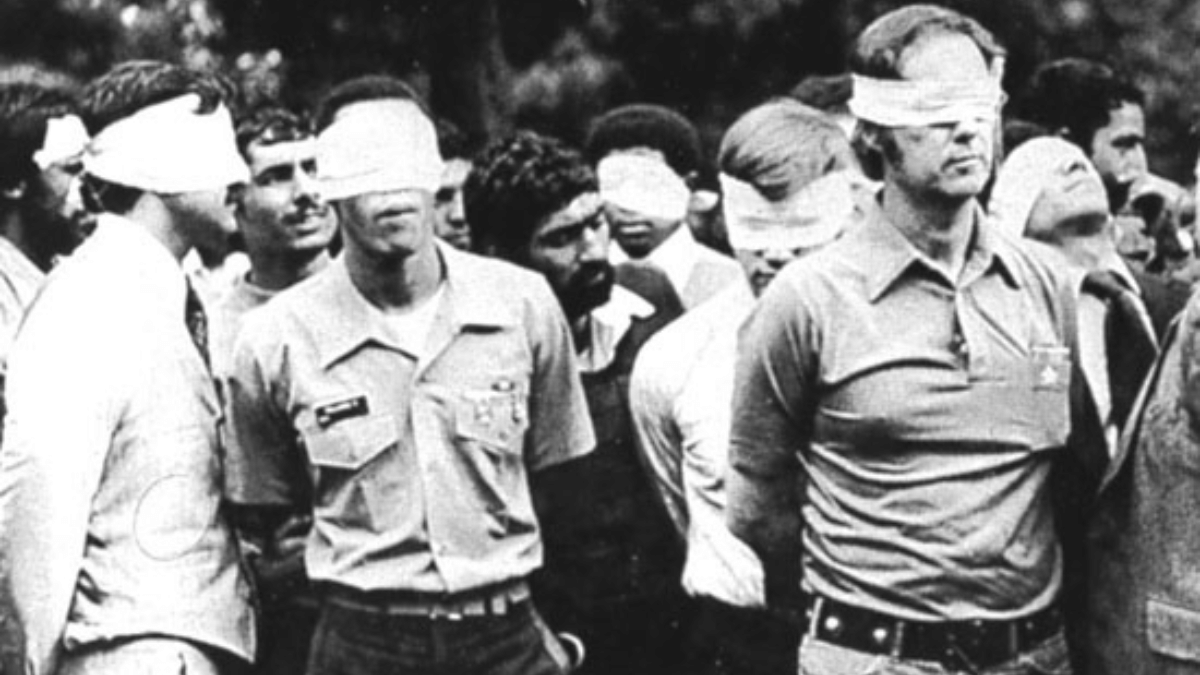
In 1979, students seized the American embassy in Tehran, and held its staff hostage, in one of the most notorious episodes in diplomatic history. The US seized the Iranian embassy in Washington as retaliation.
The two countries, though, agreed in 1981 to let a third country house bare-bones diplomatic missions in each others’ capital. Algeria was initially nominated by Iran to serve as what is called a “protecting power.” The Algerians, though, broke their ties with Iran in 1993, after the clerics ruling Iran supported a terrorist group called the Islamic Salvation Front, which had killed thousands of Algerians. Islamabad then agreed to step in and house the Iranian interests office in Washington. This began as a small office on Wisconsin Avenue, which later shifted to the large premises it is at now.
To really get why this alliance existed at all, though, you have to go a lot further back in history. The military power of Maharaja Ranjit Singh, and his successors, the East India Company, ensured Persia’s Qajar dynasty was never able to expand east beyond the Indus. I’ll tell you the story, one of these days, of a wonderful Indian spy working for the East India Company called Mohan Lal Kashmiri, who terrified the Persians into keeping their eyes off Punjab. Anyway, the point is: the British feared the Czars might expand south, and saw Persia as a kind of buffer between the Russian Empire and India.
For their part, the Persians were extremely suspicious of British intentions—with good reason. The Portuguese presence in the Persian Gulf—which had swallowed up local powers—was inherited by the East India Company. The East India Company, of course, occupied Sindh, and then soon expanded further west. bringing it to the borders of Persia. Not all this expansion was military. Hindu merchants and Sikh truck drivers blazed new routes through the Baluchistan desert, bringing Indian-made goods into Iran.
Even though the British never formally colonised Iran, everyone knew who was the boss. The British influence kept expanding, until, in 1941, the British and the Soviet Union simply carved up Iran into two zones of influence to keep away the Nazis. Reza Shah Pahlavi, who the British had installed as the monarch of the brand-new Pahlavi dynasty in 1925, was kicked out of the country, and his teenage son installed in his stead.
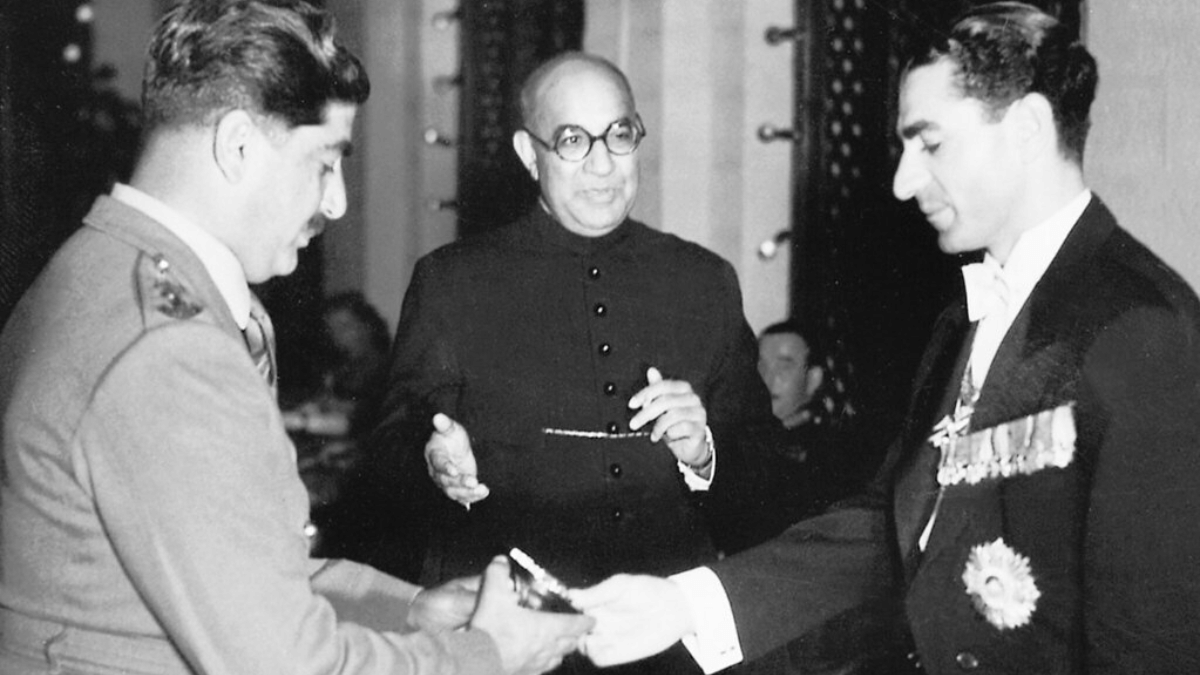
The Second World War, though, drained the UK of resources. The empire could no longer afford to police its restive Asian colonies, and it was clear it would soon have to give up the West Asian territories it had acquired to protect the routes to India. The Americans, and their client, Saudi Arabia, slowly began to emerge as the region’s most important axis of power. In 1953, when the UK wanted to bring down the too-independent Iranian government which had nationalised its oil industry, they turned to the Central Intelligence Agency (CIA) to get the job done. And from the mid-1960s, the British realised the time had come to get out of the Persian Gulf.
And that’s where Pakistan came in. Francis Tuker, the last Commander-in-Chief of the British Indian Army, spells this out pretty clearly in his memoirs. Tuker, like many of his peers, believed a Left-leaning Turkey and a decayed Persia had no chance of resisting a communist push southwards towards India.
Hindus, Tuker simply despised, asserting that “no other race could live among them”: “There was much therefore to be said for the introduction of a new Muslim power supported by the science of Britain. If such a power could be produced and if we could orient the Muslim strip from North Africa through Islamia Deserta, Persia and Afghanistan to the Himalayas, upon such a Muslim power in Northern India, then it had some chance of halting the filtration of Russia towards the Persian Gulf.”
Look at the map and you will know what he is talking about. He is talking about Pakistan and a broad alliance of Islamic powers stretching up to Egypt.
“With a northern Indian Islamic State of several millions, it would be reasonable to expect that Russia would not care to provoke them too far,” Tuker said.
America didn’t always have the expertise on hand to challenge this kind of thinking. US Secretary of State John Foster Dulles attempted to educate the eminent journalist Walter Lippmann in 1954, on why America needed a mutual defence pact with Pakistan. “The only Asians who can really fight are the Pakistanis,” John Foster Dulles declared. “That’s why we need them in the alliance. We could never get along without the Gurkhas.”
Lippmann gently pushed back: “Foster, the Gurkhas aren’t Pakistanis, they’re Indians.” “Well,” Dulles replied, undisturbed by reality, “they may not be Pakistanis, but they’re Moslems.” “No, I’m afraid they’re not Moslems, either,” Lippman persisted. The journalist was wasting his breath:
That defence pact happened, leading to the creation of a kind of Eastern NATO, called the Baghdad Pact, later renamed the Central Treaty Organisation, commonly known as CENTO, involving Turkey, Iraq, Iran and Pakistan. Iraq walked out of this grouping in 1959, and nothing really came of it—but America ended up sabotaging its relationship with India for many decades.
Islamabad became superb players of this Islamic anti-communism card. General Akhtar Abdul Rahman Khan, the Inter-Services Intelligence (ISI) Director General who led the jihad against the Soviet Union, put it to an American delegation thus: “An Islamic Afghan Republic could be expected to join with Pakistan, Turkey and an Iran come to its senses, in an Islamic league to oppose southward Soviet expansion”. This kind of Islamic Bloc, General Akhtar argued, could alone defend Pakistan against the Soviet “historic desire to expand toward the warm waters of the Persian Gulf and the Arabian Sea”.
American Ambassador to India John Gunther Dean, who’d read a book or two, knew the Czars had never actually wanted to expand south, that the Soviets didn’t have the resources to do so, even if they wanted to. The Ambassador wrote a one-word comment on the side of the Akhtar memo when it came to his table: “Nonsense.”
Also Read: Tracing the story of Iran’s nuclear programme & turning points as Israel-US try to obliterate it
The Cold War in the Middle-East
Islamabad’s membership of the Baghdad Pact opened doors for its military across the Middle East. Pakistan at that time was the only Islamic power that had a proper British trained military in substantial numbers with engineering and logistics knowledge, with officers who knew teaching. It had another advantage: its troops were Muslims but not Arabs entrenched in local fights and struggles.
The American decision to provide military equipment to Pakistan also damaged the prospects of intelligence and military cooperation with India. Prime Minister Jawaharlal Nehru and his Intelligence Bureau chief B.N.Mullik had been positive on developing the US relationship. This was, in part, because many of the challenges to the new republic came from the Communists, like in the present day Telangana. Even after the rise of CENTO, India kept lines of cooperation with the US open, realising the rising threat from China. But the relationship never flowered and Pakistan, on the other hand, was doing better.
Iran was the first country to contribute significantly to Pakistan’s military effort. A recently-declassified CIA memorandum, prepared in 1973, records that: “The Indians are fully aware that in 1966, Iran bought 90 Canadian built Sabre jet fighters in West Germany and then transferred them to Pakistan.” The document also notes that Iran provided the Pakistanis with ammunition and safe harbour for their military aircraft in the 1971 war.
Tehran’s motives for cultivating Pakistan are not well documented but it’s possible to make some informed guesses. Almost certainly, the Shah saw the Pakistanis as insurance to ensure regime survival, if push came to shove. The British had begun their pullout from the Persian Gulf in the early 1960s. That had led to a bunch of coups and counter-coups in the Gulf emirates.
In 1962, a rebellion broke out in Oman’s Dhofar region, pitting Left wing North Yemen against an alliance of Saudi Arabia, Jordan, and, secretly, Israel and Britain. Iran sent in some 1,200 troops, on the Saudi side, and rapidly learned a well-equipped army wasn’t the same thing as a well-trained one. Through the same decade, Iran began seizing islands in the Persian Gulf, irking its one-time CENTO partner, Iraq, as well as the Persian Gulf states.
Large numbers of other countries in the region also hired Pakistan in various quasi-mercenary roles—sometimes paying for its services with cash, loans, cheap-oil and so on Amman developed ties with both India and Pakistan, through its Kolkata-born Princess Sarvath el-Hassan, part of the family of the prominent politician, and later Pakistani Prime Minister, Huseyn Shaheed Suhrawardy.
Princess Sarvath El Hassan inaugurates 36th Exhibition of Bunayat Center for Special Education#petra #jordan https://t.co/V7RqJ9RhbJ pic.twitter.com/yyd1cln3s9
— Jordan News Agency (Petra)-English News (@PetranewsEN) May 11, 2025
In September 1970, when Palestinian insurgents tried to overthrow King Hussain’s regime, a Pakistani brigade led by to-be army chief Zia-ul-Haq was called in. Little documentation has surfaced on the Pakistani role in the fighting, but former CIA officer Bruce Riedel has written that Zia was key to leading the Jordanian response.
There are several accounts of Pakistani pilots fighting on the side of Syria in the wars of 1967 and 1973. The Syrian embassy in Islamabad honoured Air Commodore Sattar Alvi for his role in the 1973 war. Alvi, media accounts say, shot down an Israeli Mirage while flying a Syrian MiG-21. The citation does not refer to this shootdown, though.
Even more important, Pakistan was paid to set up a division sized armoured formation in Tabuk, Saudi Arabia. The Saudi monarchy had been destabilised by a coup d’etat attempted by a few hundred followers of the fundamentalist of the Al-Jamaa Al-Salafiyya Al-Muhtasiba in 1979. That was a Right-wing Salafist organisation similar in ideology to Al-Qaeda would become later but nowhere armed as it was. But the pressure was coming from the poorer Saudi Arabs who left out by not having the shares of the oil boom and felt that there was too much cultural liberalisation going on.
And there is a rather large mythology surrounding this issue in Pakistan and people say that Pakistani commandos were very involved in protecting Mecca in this operation. But, there’s no serious account of what happened. Instead. Saudi Arabia turned to French special forces—at the risk of provoking anger among some Muslims, who insist no unbeliever can enter the city.
Following the Iranian revolution, Pakistan is reported to have provided military services to some 22 countries in the Middle-East—though the source of that count is not clear. The Pakistani Division in Saudi Arabia was pulled out after the First Gulf War, when large numbers of American troops entered the Kingdom. Now, though, Saudi Arabia seems to have invited them back in, as part of the process of making back-up plans, in case things go wrong.
Ties that bind
The relationship between the Islamic Republic of Iran and Pakistan has been much more complicated than the ties in the period of the Shah. The two countries have cooperated, but also clashed. Pakistani nuclear scientist Abdul Qadeer Khan sold Iran the technology that allows it to enrich its uranium—one of the root causes of the unfolding crisis.
At the same time, though, Pakistan is also putting land forces in Iran’s rival Saudi Arabia. By some accounts, Pakistan has even promised to defend Saudi Arabia with nuclear weapons, should a crisis involving one ever develop in the region. Saudi Arabia is known to have contributed hundreds of millions of dollars to Pakistan’s nuclear and missile programmes in the past, too.
Iran and Pakistan have criticised India on Kashmir several times, but Tehran has steadily cooperated with New Delhi to battle the Taliban and other jihadists in Afghanistan. Indeed, Pakistan complains that Iran has turned a blind eye to Indian intelligence activities in Baluchistan. India and Iran cooperated on Chabahar, a direct challenge to Pakistan’s plans for its rival port at Gwadar. Iranian and Pakistani forces, meanwhile, have clashed on the border in Baluchistan regularly over the last decade.
And, even while all this happens—Pakistan hosts Iran’s interests in Washington, and mediates its talks with the US. Or, to be precise, it sometimes says it is mediating, and sometimes says it is just facilitating. We may only come to know the whole truth decades from now.
Like Pakistan’s relationship with the US itself, its ties to Islamabad are not ideological. Both sides are concerned with extracting what gains they can, as they navigate a dangerous and often-hostile world. There is a lesson India can learn from this: Diplomacy isn’t about making friends and enemies, but taking what you can get when you can get it. Principles and past good deeds or villainous deeds don’t actually count for a lot.
At the same time, the Iran-Pakistan story also shows that a durable relationship needs to go much deeper than just a mercenary exchange, if it’s to have any solidity. A deeper economic relationship with the Middle-East might have given Pakistan a real heft, but it had nothing to bring to the table for an economic or a technological relationship.
Where do things go from here? Well, Pakistan is a useful messenger to pass messages without committing either Iran or the US to a face-to-face dialogue. Pakistan is also a valuable ally that all players in the Middle East can use from time to time to their own ends. It doesn’t fundamentally alter any relationship. But it does tell an important lesson: Geopolitics isn’t about friendship. It’s about getting what you can get.
(Edited by Tony Rai)