





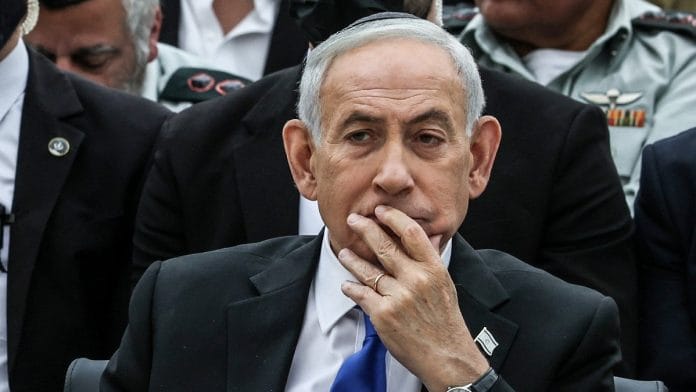


New Delhi: Israeli Prime Minister Benjamin Netanyahu’s office Wednesday claimed he made a “secret” visit to the United Arab Emirates at the height of the now-paused war with Iran. Abu Dhabi took just hours to reject the statement, declaring that no such visit had taken place.
“In the midst of Operation Roaring Lion, Prime Minister Benjamin Netanyahu secretly visited the United Arab Emirates, where he met with UAE President Sheikh Mohamed bin Zayed,” Netanyahu’s office said in a statement on social media platform X. “This visit has led to a historic breakthrough in relations between Israel and the UAE,” it went on to say.
Shortly afterwards, the UAE Ministry of Foreign Affairs categorically denied that such a visit had taken place. The statement said that “its relations with Israel are public and conducted within the framework” of the Abraham Accords.
The Abraham Accords, dating back to US President Donald Trump’s first term, are a set of agreements that normalised relations between Israel and several Arab countries.
“Accordingly, any claims regarding unannounced visits or undisclosed arrangements are entirely unfounded unless officially announced by the relevant authorities in the UAE. The UAE calls on media outlets to exercise accuracy and professionalism, and to refrain from circulating unverified information or promoting misleading political narratives,” the Emirati statement added.
The back and forth between Tel Aviv and Abu Dhabi showcases the diplomatic tightrope that the Emiratis are walking in West Asia. While the UAE has doubled down on its defence partnership with Israel and the UAE, with Tel Aviv even setting up and operating an Iron Dome air defence missile system in the country during the roughly 40-day war with Iran, Abu Dhabi also recognises that public sentiment remains largely anti-Israel within the region.
Iran weighed into the back and forth, with Foreign Minister Seyyed Abbas Araghchi highlighting that those “colluding” with Israel “will be held to account”. Araghchi made this statement while in New Delhi ahead of the BRICS Foreign Ministers’ Meeting where he will come face-to-face with the Emirati representative.
“Netanyahu has now publicly revealed what Iran’s security services long ago conveyed to our leadership. Enmity with the Great People of Iran is a foolish gamble. Collusion with Israel in doing so: unforgivable. Those colluding with Israel to sow division will be held to account,” Araghchi said in a statement on social media platform X.
The UAE bore the brunt of Iran’s retaliation during the 40-day war, engaging with over 2,500 missiles and drones launched by Tehran. The Emiratis have engaged with Israel for over half a decade following the signing of the Abraham Accords.
The UAE maintains a strong economic and strategic partnership with Israel, as Abu Dhabi seeks to increase its ties to the security axis provided by the US in the region. Prime Minister Narendra Modi will also be travelling to Abu Dhabi on Friday, his first visit to the region since the war began and his visit to Israel in February.
Iran has maintained that it has not specifically targeted the UAE, but only US assets in the region, but Abu Dhabi has been seen to move strategically closer to Israel and the US. Netanyahu’s office did not indicate when the Israel Prime Minister made the trip to the UAE or what the “historic outcome” was.
The Israeli Prime Minister had spoken to UAE President Mohamed bin Zayed al Nahyan after reports indicated that Tehran launched attacks at the country earlier this month. Iran, Israel and the US have maintained a fragile ceasefire since 8 April.
Negotiations for a final settlement have seemingly stalled, with US President Trump rejecting Iran’s latest proposal that would see the termination of the war in exchange for the opening of the Strait of Hormuz. Tehran had proposed to discuss its nuclear programme and the lifting of unilateral sanctions at a later stage, following an end to the war.
(Edited by Nardeep Singh Dahiya)
Also Read: Days before Pakistan-brokered ceasefire, UAE carried out strikes against Iran—WSJ report