





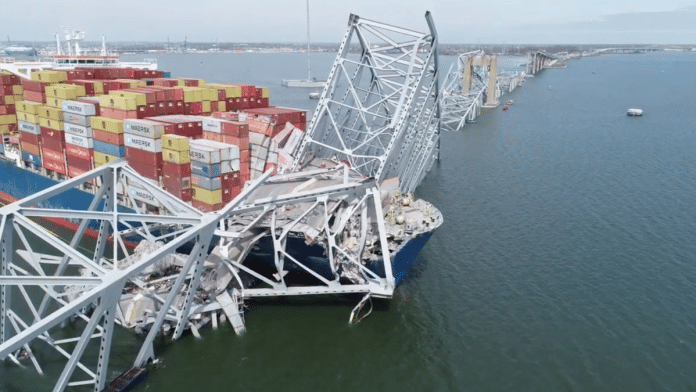


New Delhi: Two years after the deadly Baltimore bridge collapse, the US Department of Justice (DOJ) has announced criminal charges against the Singapore-based operator of the ship involved in the crash and its Indian employee.
Six construction workers were killed after cargo ship Dali, registered in Singapore, crashed into the Francis Scott Key Bridge on 26 March 2024. The construction workers were part of a maintenance crew working on the roadway. The bridge had collapsed into the Patapsco river as a result of the impact, bringing the Baltimore port to a standstill for two months.
“Two corporate entities and a shoreside superintendent face criminal charges in connection with the vessel crash that knocked down the Francis Scott Key Bridge in Maryland,” the DOJ said in a statement released 12 May.
The Attorney’s Office for the District of Maryland unveiled the indictment, charging three defendants with conspiracy to defraud the US and with causing the death of six construction workers on the bridge, among other charges.
The economic loss is at least $5 billion, according to the indictment.
“Synergy Marine Pte Ltd, based in Singapore, and Synergy Maritime Pte Ltd, based in Chennai, India, along with Radhakrishnan Karthik Nair, 47, an Indian national who worked for both companies as the Technical Superintendent for the Dali, are charged with conspiracy, willfully failing to immediately inform the U.S. Coast Guard of a known hazardous condition, obstruction of an agency proceeding, and false statements,” the DOJ statement said.
Adding, “The two Synergy corporations are also charged with misdemeanor violations of the Clean Water Act, Oil Pollution Act, and Refuse Act for the discharge of pollutants into the Patapsco River, including shipping containers and their contents, oil, and the bridge itself.”
Acting Attorney General Todd Blanche said that this indictment was a critical step toward holding accountable those whose reckless disregard for maritime safety regulations caused this disaster.
“Six construction workers lost their lives, critical infrastructure was destroyed, pollutants were released into the Patapsco River and Chesapeake Bay, and the economic damage now exceeds five billion dollars. This Department is committed to securing justice for the victims and ensuring those responsible are held to account,” Blance said.
The indictment, according to special agent in charge Jimmy Paul of the FBI Baltimore Field Office, “reveals a pattern of deception and egregious violations that led to the unsafe operation of the Dali which recklessly endangered the public and resulted in the ship striking the bridge.”
Following the crash, the Federal Bureau of Investigation (FBI) and the US Coast Guard had opened a criminal investigation.
Also Read: Bookie, bot & the ban: An insider’s view of India’s murky online gaming-betting industry
The crash
According to the indictment, the Dali lost power twice in a four-minute span, as it navigated out to sea from the Port of Baltimore, causing it to crash into the bridge.
It further alleges that a “loose wire in a high-voltage switchboard likely caused the first power loss”.
Critical systems on the Dali were originally designed with reliable redundancies and automatic restart capabilities, so the Dali could quickly regain power after a blackout, the DOJ statement said.
But shortly after the vessel regained power, it lost power again. The defendants allegedly altered the ship and relied on a flushing pump to supply fuel to two of its four generators.
However, the flushing pump was not designed to automatically restart following a blackout, and the Dali’s generators could not operate without a fuel supply, so the ship ultimately experienced a second blackout, it said.
The indictment alleges that if the Dali used the proper fuel supply pumps, the vessel would have regained power in time to safely navigate under the bridge.
Synergy and Nair are also charged with obstruction of an agency proceeding and providing false statements and documents to the National Transportation Safety Board (NTSB) as it conducted a casualty investigation.
The obstruction charges relate to, among other things, Nair’s statements to the NTSB that he was unaware that the Dali was using the flushing pump to provide fuel to the generators.
‘Criminalising a tragic accident’
Meanwhile, on 13 May, the Synergy Group, in a statement said, “we are surprised and disappointed by the announcement that the US Department of Justice is pursuing criminal charges against Synergy.”
The DOJ, it alleged, is “criminalising a tragic accident.”
“The allegations in the indictment are baseless and have nothing to do with the Dali’s allision with the Francis Scott Key Bridge. The DOJ’s reference to the vessel’s use of the flushing pump is wholly irrelevant to the cause of the allision and runs contrary to the conclusions reached by the NTSB following a comprehensive 20-month maritime accident investigation.”
Allision is a maritime law term used to describe a moving vessel hitting a stationary object, such as a bridge, dock, platform, or an anchored vessel.
This was a “maritime casualty that should be assessed through the full factual, technical and regulatory record, rather than through selective mischaracterisations in a criminal indictment,” the group contended.
The Dali experienced a power loss due to a manufacturer’s latent defect: a loose wire in the ship’s electrical system.
The group said that when that occurred, the vessel was approximately three ship lengths away from the bridge, transiting at approximately 8.5 knots.
“Both the NTSB and well-respected maritime experts have conclusively determined that the accident was inevitable due to the loose wire, which was in no way attributable to Synergy’s operation of the vessel,” it added.
The NTSB factual reports, it said, do not indicate that the probable cause of the allision was because the Dali was out of compliance with any code, law, regulation or rule governing her operation, or with the builder’s recommendations, at the time of the allision.
The Dali, and other vessels managed by Synergy, had a near-flawless Port State Control record, it added.
“DOJ’s allegations are inconsistent with the clear and well-documented findings of the specialist maritime professionals involved in the NTSB investigation. Synergy will vigorously defend itself against these inaccurate allegations. Synergy and its employees have fully cooperated and have been transparent at all times during the NTSB’s investigation, and any allegations to the contrary are woefully inaccurate,” it added.
(Edited by Tony Rai)