





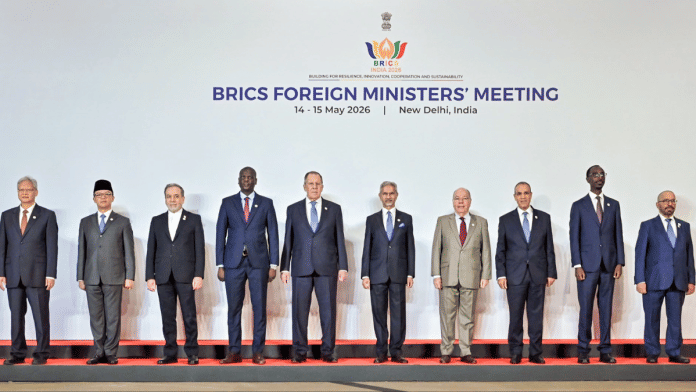


New Delhi: Representatives of BRICS member states met in New Delhi last week for the BRICS Foreign Ministers’ Meeting, but failed to reach a consensus on a joint statement owing to Iran’s dissent on two paragraphs on Palestine and the Red Sea.
The meeting was a prelude to the annual BRICS Summit, which India will chair in September.
At the risk of ruffling some feathers, during the meeting on 14 May, External Affairs Minister S. Jaishankar called for “unimpeded maritime flows,” including through the Strait of Hormuz, in the presence of Iranian Foreign Minister Seyed Abbas Araghchi and UAE Minister of State for Foreign Affairs Khalifa Shaheen Al Marar.
Araghchi urged member states to condemn the US and Israel for their “aggression” against Iran, laying bare how conflicting alliances within the grouping have weakened BRICS’ ability to function cohesively. A primary example of this was the lack of a joint statement—a likely conclusion at a BRICS meeting or summit.
But, were these contradictions embedded in BRICS from the very beginning?
ThePrint explains how BRICS came into being, what makes it unique, why it has continued to expand over the years, and why it may be the only grouping that was neither born out of a crisis nor has any common denominator.
How BRICS came into being
In 2001, Goldman Sachs’ research division published a report that coined the term BRIC (Brazil, Russia, India, and China). The paper, titled “Build Better Global Economic BRICs,” authored by Jim O’Neill during his tenure as head of Global Economic Research at Goldman Sachs, projected that over the following decade, the share of the “BRIC” in global GDP would rise dramatically.
This report became a canonical work, prompting further research. Another paper by Goldman Sachs in 2003 titled, “Dreaming with BRICs: The Path to 2050,” argued that BRIC countries would take over the “largest developed economies” by 2039.
Then, in 2008, Russian President Vladimir Putin called a meeting of the four BRIC countries in Yekaterinburg. In July that year, the first informal BRIC summit took place on the sidelines of the 34th G8 Summit in Hokkaido, Japan.
The next year, in 2009, Moscow hosted the first official BRIC summit in Yekaterinburg. Rachel S. Salzman, in her book “Russia, BRICS, and the Disruption of Global Order,” writes about how Russia’s leadership in BRIC’s nascent phase was symbolic of its desire to counter US hegemony and redraw the geopolitical map.
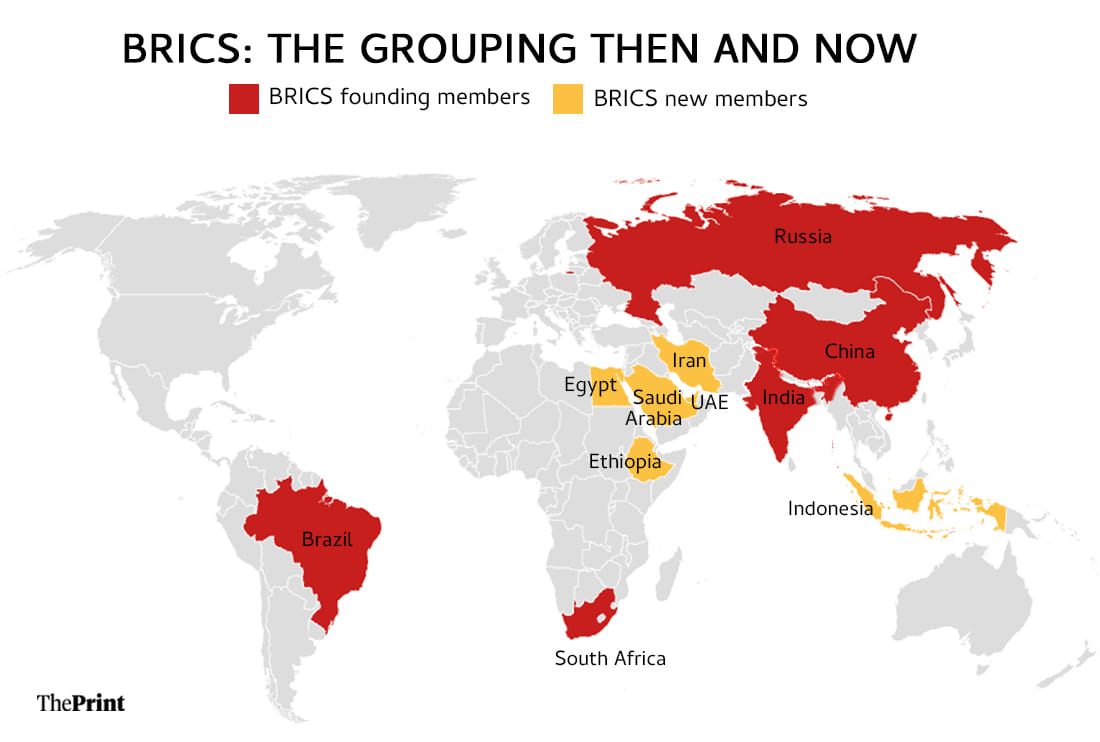
In 2010, South Africa joined the group at the invitation of China, completing the acronym BRICS. To position itself “as the most reputable and representative group of non-Western developing countries”, BRICS started expanding outwards.
BRIC’s first meeting took place in 2008, the year of the great economic recession in the US, when the IMF and the World Bank had faced criticism for not foreseeing the crisis. The BRICS had thus emerged as a “relevant group for the restructuring of the global economic order”.
Moreover, institutions like the IMF, World Bank and OECD were also dominated by America and Europe, leaving little room for emerging economies.
The US dollar has been included in the IMF’s Special Drawing Rights since 1969, the British pound since 1974, the Japanese yen since 1981, and the euro since 1999. It was only in 2015 that the Chinese Renminbi (RMB) was included in the SDR basket.
By convention, the World Bank President is an American citizen, while the IMF traditionally has a European Managing Director. The US is also the only country that effectively holds veto power over major IMF decisions, with more than a 16.49 percent voting share.
The developed countries eclipsed the membership of new entrants, too.
Grouping without common denominator
However, even as more countries joined the group, BRICS never shared a common geopolitical vision coherent enough to act as a counterweight to the US and US-dominated international forums.
At the 2023 BRICS summit, the group extended its membership to six more countries: Argentina, Egypt, Ethiopia, Iran, Saudi Arabia, and the United Arab Emirates (UAE). Argentina’s President Javier Milei rejected the offer, pledging a West-oriented direction, saying it would not “ally with communists”.
Egypt, Ethiopia, Iran, Saudi Arabia and the UAE became full members of BRICS in 2024, and Indonesia in 2025.
BRICS’ 2023 expansion came at a time of great uncertainty due to the Ukraine-Russia war. China and Russia strongly pushed for expansion as a way to strengthen BRICS as a counterweight to Western-led institutions, even as India and Brazil remained cautious that a larger bloc could dilute their own influence and increase China’s dominance.
Egypt, which has close commercial ties with China and India, and political ties with Russia, joined BRICS in hopes of attracting investment and reviving its struggling economy, while Ethiopia’s inclusion reflected China’s long-standing investments aimed at making it a key Belt and Road hub in Africa. The addition of Saudi Arabia and the UAE also brought the two largest Arab economies and major global oil producers into the bloc, significantly expanding BRICS’ economic and strategic influence.
More than the membership itself, the group’s differing aspirations have become glaring when it has been expected to take a united stand in situations of conflict. As a bloc, BRICS has offered limited support to Russia during its prolonged confrontation with what Moscow describes as the “collective West”.
In the case of India, the grouping allows it to remain in touch with countries who may not be pro-West.
The differences are more acute in the case of the US-Iran war.
“The problem lies within the grouping itself: the structural rivalry between Iran and the conservative Gulf monarchies such as the United Arab Emirates, which is also a BRICS member. The strategic divide between them is too deep. Iran has defined itself in opposition to the United States since the Islamic Revolution of 1979, while the UAE and its fellow monarchies have long been partners of Washington,” writes C. Raja Mohan, a former member of India’s National Security Advisory Board, in Foreign Policy.
Participating in a panel discussion at the annual Munich Security Conference in 2024, Jaishankar said India is “non-West, not anti-West”, though adding that the definition might not apply to other BRICS member states.
Moreover, the chill in India and China’s diplomatic ties has acted as an impediment in the functioning of BRICS, more so since the two countries are also competing for leadership of the Global South. On its part, China has been rapidly trying to expand its influence through the Belt and Road Initiative (BRI).
What makes BRICS unique
What makes BRICS unique is that it’s among the few groupings that offered to collectively finance infrastructure and sustainable development projects.
The New Development Bank (NDB) offers out loans, guarantees, and other financial mechanisms to support development projects and build infrastructure in emerging economies. It was designed to provide greater flexibility, a more equitable shareholder structure, and easier access to financing than the World Bank, whose focus is spread across 190 member countries.
Early years of the NDB saw the emergence of potential institutional architecture, but this was restricted by differing visions of India and China.
NDB’s lending has since focused on sectors such as clean energy, transportation, sanitation, and social development, while also aiming to channel special focus toward projects related to climate action. Since beginning operations in 2015, it has approved more than $32 billion dollars in financing across 96 projects.
Additionally, the group also established a contingency fund, the Contingent Reserve Arrangement (CRA) which can be used by member states during a currency crisis.
BRICS also emerged as a diplomatic off-ramp during moments of crisis between its own members. The clearest example came during the 2017 Doklam standoff between India and China, when troops from both sides remained locked in a tense faceoff for more than two months near the Bhutan tri-junction.
Just days before the 9th BRICS summit in Xiamen, China, held from 3 to 5 September 2017, New Delhi and Beijing announced a disengagement agreement, clearing the way for Prime Minister Narendra Modi to attend the summit hosted by Chinese President Xi Jinping.
Another aspect of the grouping that has been a point of discussion around the world is the idea of a new BRICS currency.
Trump, in 2024, threatened to impose 100 percent tariffs on BRICS members if they were to create a currency to rival the US Dollar. However, BRICS leaders have encouraged and advocated for diminishing the primacy of the dollar by conducting trade in their own currencies. Brazilian President Luiz Inácio Lula da Silva has championed this cause.
For instance, the Petroyuan oil trade is gaining ground in opposition to the Petrodollar trade. “China has reached agreements with Russia, Iran, and select Gulf nations to allow oil payments in the Yuan, thereby reducing their dependence on America’s financial system,” according to a report by GripInvest.
While some member states like China and Russia may have interests in de-dollarisation, the idea of local currency trading has found no mention yet under India’s chairship. On its part, India has rejected the idea of a BRICS currency, with the MEA stating in August 2025 that “de-dollarisation is not part of India’s financial agenda”.
New BRICS members
The expansion of BRICS—Egypt, Ethiopia, Iran, Saudi Arabia and UAE in 2024; and Indonesia in 2025—has once again brought to light issues with the fundamental structure of the grouping.
The BRICS Foreign Ministers’ meeting in New Delhi came at a time when tensions had been simmering between member states following the West Asia conflict and the closure of the Strait of Hormuz. These are precarious geopolitical times, which were visible in the actions of various member states.
The UAE reportedly carried out covert strikes on Iran, according to a report by The Wall Street Journal. Iran, in turn, launched attacks on the UAE and warned of more intense strikes against what it said could no longer be considered a “neighbour” but a “hostile base”.
India’s own energy crunch, perpetuated by the war and closure of the Strait, makes its position tricky in the group.
India, for its part, has maintained a carefully calibrated diplomatic stance on the US-Israel conflict with Iran, reflecting its close ties with both Washington and Tel Aviv. Just days before Israel launched strikes on Iran, Prime Minister Narendra Modi met Israeli Prime Minister Benjamin Netanyahu in Tel Aviv.
New Delhi has also been treading carefully since US President Donald Trump escalated tariff tensions with India, imposing 50 percent punitive tariffs over its continued purchases of Russian oil. A temporary waiver granted in the wake of the West Asia conflict lapsed on 17 May.
With research inputs from Jaydeep Gadhavi, an alum of ThePrint School of Journalism & an intern with ThePrint.
(Edited by Amrtansh Arora)