





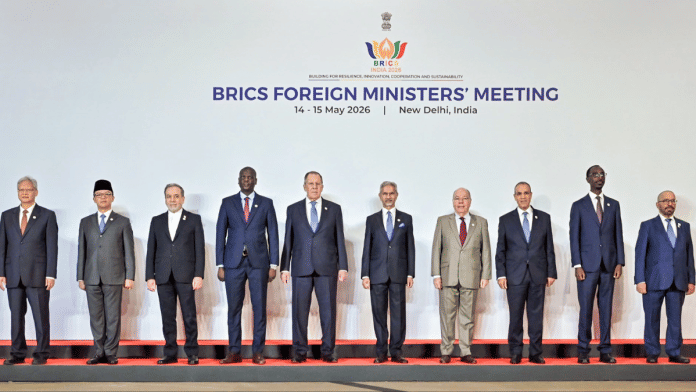


New Delhi: India Thursday outlined its support for a “two-state solution” for Palestine, called for unimpeded maritime transit through the Strait of Hormuz and the Red Sea, hitting out at unilateral sanctions imposed by countries in its national statement read by External Affairs Minister S. Jaishankar during the BRICS Foreign Ministers’ meeting.
“The conflict in West Asia merits particular attention. Continuing tensions, risks to maritime traffic, and disruptions to energy infrastructure highlight the fragility of the situation. Safe and unimpeded maritime flows through international waterways, including the Strait of Hormuz and Red Sea, remain vital for global economic well-being,” the statement published by the Ministry of External Affairs said.
Jaishankar’s national statement hit out at the “increasing” use of “unilateral coercive measures and sanctions inconsistent with international law and the UN Charter.”
“Such measures disproportionately affect developing countries. These unjustifiable measures cannot substitute dialogue, nor can pressure replace diplomacy,” said Jaishankar.
However, the statement does not name the US, which has increasingly imposed unilateral sanctions on firms trading with Iran and Russia in an attempt to pressure countries from trading with them. These measures have an impact on firms’ access to international banking networks due to the centrality of the American banking system to the global economy.
India’s trade with Iran has ground to a halt since the US imposed thousands of sanctions on Tehran in the last eight years, following President Donald J. Trump’s “maximum pressure” campaign to coerce the Iranian government to negotiate with Washington on its nuclear programme.
Alongside its military operation, the US has also launched “Operation Economic Fury” imposing sanctions across a number of companies in the last month, primarily located in China in an attempt to further snap Tehran’s links to the global economy.
The US also spent a large portion of last year imposing 50 per cent tariffs on Indian exports due to New Delhi’s continued purchase of Russian oil. While the penalty tariffs were eventually removed following the agreement for the first batch of the interim trade deal, Washington was later forced to issue a sanctions waiver on the purchase of Russian oil, as its war with Iran roiled the global energy markets.
Jaishankar’s statement also said: “The wider region also gives rise to serious concern. The conflict in Gaza has grave humanitarian implications. A sustained ceasefire, humanitarian access, and a credible pathway towards a durable and peaceful resolution remain essential. India supports a two-state solution where the Palestine issue is concerned.”
As the chair of the BRICS foreign ministers’ meeting being held in New Delhi, External Affairs Minister S. Jaishankar called for BRICS unity and collective action at a time when the grouping has struggled to issue a joint statement on the situation in West Asia.
Consensus has been elusive within the grouping largely due to the presence of both Iran and the United Arab Emirates as full members of the BRICS. The two countries are on the opposite sides of the current conflict launched by the US and Israel against Iran. The UAE has faced the brunt of Iran’s retaliation, engaging with over 2,500 missiles and drones launched by Tehran during the forty days of conflict between the end of February and 8 April.
“Collective action and resolve are essential to promote stability, sustainability and prosperity. Our discussions today are therefore timely. The BRICS must not only deliberate on these issues but also work towards effective and coordinated responses,” said Jaishankar.
The meeting of the Deputy Foreign Ministers and Special Envoys on the Middle East and North Africa organised by India last month ended with no consensus on the situation in West Asia.
Apart from a lack of consensus on the language regarding the war in West Asia, BRICS members were also against the final language proposed by India on the situation in Palestine, which was far narrower in scope than the statement released last year by the grouping under Brazil’s chairship.
However, there is hope that the foreign ministers’ meeting may lead to a joint statement by BRICS on the war that began on 28 February. While a fragile ceasefire continues to hold, there have been attacks on merchant vessels, including on an Indian-flagged vessel off the coast of Oman Wednesday.
India called the attack on the vessel “unacceptable” and called for cessation of targeting of commercial vessels plying through the Strait of Hormuz. The strait has been effectively closed by Iran since the start of the war, which has had massive global repercussions, especially for energy supplies.
Kazem Gharibabadi, the Iranian Deputy Foreign Minister, defended Tehran’s actions as a response to the war, highlighting that Tehran was keen to negotiate a joint outcome document from the meeting due its friendly ties with New Delhi, the chair of the group for 2026.
Gharibabadi accused the UAE of pushing language to condemn Iran’s retaliatory strikes, despite Tehran being willing to have language that does not condemn Israel or the US in the outcome statement for the sake of BRICS unity.
The 11-member grouping consists of Brazil, Russia, India, China, South Africa, Egypt, Ethiopia, the UAE, Iran, Indonesia and Saudi Arabia.
(Edited by Viny Mishra)
Also read: India flexible on Palestine for BRICS FMs’ joint statement as West Asia remains a ‘fracture point’