





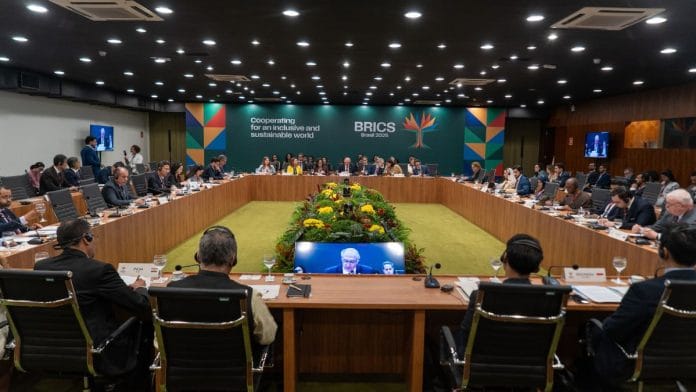


New Delhi: India is flexible on the language on the issue of Palestine conflict, while the Iran war remains a stumbling block with respect to the BRICS Foreign Ministers’ joint statement, ThePrint has learnt.
Eight BRICS Foreign Ministers out of 11 are set to participate in the meeting scheduled for 14 and 15 May in New Delhi.
The three remaining members—China, the United Arab Emirates and Saudi Arabia—will be represented by officials of different rank.
“For BRICS, consensus is the key for decision-making. Unanimity over the situation in West Asia remains the main fracture point amongst the member-states,” a person familiar with the matter told ThePrint.
The development comes after plans for a joint statement failed last month following the BRICS Deputy Foreign Ministers’ meeting in New Delhi last month, primarily due to differences between Tehran and Abu Dhabi over the final language, as well as India’s own shifting language on the situation in Palestine.
Nevertheless, multiple foreign diplomats have confirmed to ThePrint that there is positive momentum to arrive at a consensus for a joint statement at the Foreign Ministers’ meet, which is expected to highlight the necessity for peaceful resolution of the situation in West Asia.
However, two countries involved in the conflict on opposite sides—Iran and the UAE—remain the key roadblock for a consensus on a joint statement.
One foreign diplomat highlighted that this time around India seems to be more flexible with regards to the language on Palestine, while the differences between Iran and the UAE remain the major sticking point.
Another diplomat familiar with the matter told ThePrint that during last month’s meet, Tehran remained unyielding with regards to the language on the conflict in the region, which led to the meeting ending with no consensus for a joint statement.
However, with Iranian Foreign Minister Seyyed Abbas Araghchi present in New Delhi for the Foreign Ministers’ meeting, there is hope that Tehran may be more “flexible” on the final language, ensuring that the BRICS member-states are able to arrive at a consensus, the second diplomat said.
Iranian Deputy Foreign Minister Kazem Gharibabadi Wednesday said that Tehran is keen to support an outcome from the foreign ministers’ meeting that would include a joint statement. The Iranian Deputy Foreign Minister made it clear that Tehran is fine with any language “condemning the US and Israel” being removed from the statement in the interest of ensuring a joint statement by BRICS.
“Firstly, India is the current chair of the BRICS. We are keen on ensuring the success of the meeting being chaired by India. Secondly, we do not want a message to be sent to the world that the BRICS is divided on the issue,” said Gharibabadi.
However, without naming the UAE, the Iranian Deputy Foreign Minister highlighted that the problem remains with a certain “neighbouring Arab country” of Iran, who is keen to include language “condemning Iran” for its aggression in the region.
The grouping is yet to release a joint statement on the conflict in West Asia.
The 11 member-states of the BRICS are Brazil, Russia, India, China, South Africa, Egypt, Indonesia, Ethiopia, the UAE, Iran and Saudi Arabia.
Hopeful for consensus
Last year, under Brazil’s chairship, the BRICS member-states had found consensus for a joint statement that included roughly 16 paragraphs solely on the situation in Palestine.
This year, a diplomat highlighted to ThePrint, the original statement circulated by India as the basis of negotiations before the meeting reduced the number of paragraphs on Palestine from 16 to around nine. However, by the time negotiations between the Deputy Foreign Ministers and Special Envoys began in Delhi, India as the chair sought to further reduce the language regarding Palestine to around two or three paragraphs.
Multiple diplomats told ThePrint that their delegations “were surprised” by the sharp change in India’s position regarding the language on Palestine, given that New Delhi had signed on to the joint statement from March 2025, negotiated during Brazil’s tenure.
The sense at the time was that New Delhi was pushing to incorporate the language agreed to during the Foreign Ministers’ meeting between India and the League of Arab States in January 2026. The language of that declaration was agreed to by the Palestinian Foreign Minister who had attended the meeting.
In the “Delhi Declaration of the Second India-Arab Foreign Ministers’ Meeting” those present agreed to support a sovereign state of Palestine based on the 1967 borders, while making no explicit mention of East Jerusalem as the national capital.
However, the BRICS statement from Rio de Janeiro last year, following the meeting on MENA (Middle East and North Africa), was explicit in the language regarding East Jerusalem as the capital of a Palestinian state. The India-Arab League declaration following the Foreign Ministers’ meeting had five paragraphs on the situation in Palestine.
The push for a change in language led to pushback from Indonesia, Egypt, Brazil, South Africa, China and a number of other countries present at the BRICS meeting last month in New Delhi, a diplomat familiar with the matter explained to ThePrint.
However, the sense remains that New Delhi is willing to negotiate on its position regarding the language surrounding Palestine, as long as all member-states are able to arrive at a consensus for a joint statement.
This is an updated version of the report
(Edited by Mannat Chugh)
Also Read: India to host Iranian FM Araghchi for BRICS meet this week, US Secy of State Rubio end of the month