





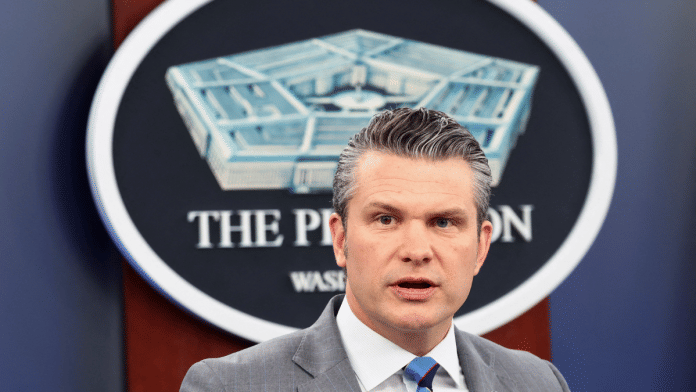


New Delhi: Lashing out at the Democrats and labelling them as the “biggest adversary”, a combative US Secretary of Defence Pete Hegseth clashed with lawmakers during his first appearance in front of the House Committee on Armed Services Wednesday since the war with Iran began at the end of February.
“The biggest adversary we face at this point are the reckless, feckless and defeatist words of congressional Democrats and some Republicans,” Hegseth declared in his opening remarks, setting the tone for the rest of the almost six-hour hearing.
The US Secretary of Defence appeared at the hearing along with Chairman of the Joint Chiefs of Staff General Dan Caine and Jay Hurst, the Chief Financial Officer and Undersecretary in the Department of Defence.
Hurst announced that the administration of President Donald Trump estimates the cost of war with Iran at roughly $25 billion, a declaration met with skepticism from House Democrats on the committee.
In one of the sharper exchanges with Representative Adam Smith from the Democratic Party, Hegseth reiterated that Iran’s nuclear programme had been “obliterated” during Operation Midnight Hammer in 2025, however, Tehran’s “ambitions” to build a nuclear bomb “continued” and led to the current war.
He offered no clear endgame to the war with Iran, apart from defending its necessity through the hearing. Representative Smith’s questioning eventually led to Hurst finally offering a ballpark figure for the cost of the ongoing war.
In a testier exchange with Representative Ro Khanna from the Democrats, Hegseth refused to offer an estimate for the cost of war for Americans, while pushing the Californian congressperson for an answer on what it would cost if “Iran gained a nuclear bomb?”
“Do you know how much it would cost Americans in terms of their increased costs in gas and food over the next year because of the Iran war?” Khanna questioned Hegseth.
The US Secretary of Defence responded with, “I would simply ask you what the cost is of an Iranian nuclear bomb…Playing got you questions about domestic things,” led to a firm rebuttal from Khanna.
“Do you not know? You had no one do the analysis of what the increased cost of gas and food on the American people was going to be?” Khanna questioned Hegseth.
With no answers forthcoming from Hegseth, Khanna offered his analysis—an increased cost of $631 billion or roughly $5000 in increased costs per American citizen. Khanna further hit out at the “incompetence” of the administration, which failed to estimate costs for the American people, while calling the $25 billion estimate as “totally off.”
In another contentious exchange with Representative John Garemendi, Hegseth called him a liar and “handing propaganda to our enemies.”
Hegseth’s appearance, his first in the US Congress since the war with Iran began, came two days ahead of the 60-day milestone since President Donald Trump notified both the House and Senate of the joint American and Israeli strikes on Iran. Under the War Powers Act of 1973, Trump is required to begin troop withdrawal from the war after 60 days, or seek Congress approval to keep the war going.
It also comes amid the US Congress reviewing the roughly $1.45 trillion budget submitted by the Department of Defence for the next year. Representative Mike Rogers, chairman of the committee, had to urge Hegseth to show respect to members of the House of Representatives.
In another surprising statement, General Caine announced that so far 14 US service members have lost their lives in the ongoing conflict, which is slightly higher than the earlier publicly available tally of 13 deaths released by the Pentagon.
The war with Iran began on the last day of February, with the joint US-Israel strikes on Tehran and various installations within the Asian nation. Ayatollah Ali Khamenei, the Supreme Leader of Iran, was killed during the initial round of strikes.
The war continued for roughly 40 days before a ceasefire was announced on 8 April. The fragile ceasefire has not led to a larger peace deal yet. The Strait of Hormuz—the international waterway, accounting for roughly a fifth of global energy supply—continues to remain effectively closed.
The Strait was open before the conflict. Iran had first announced its reopening after the announcement of the ceasefire between Lebanon and Israel on 16 April. However, Tehran moved swiftly to close the Strait after the US announced its continued blockade of Iranian ports. Global energy supplies remain hit due to the current situation in West Asia.
Hegseth is set to appear before the Senate Armed Forces Committee Thursday.
(Edited by Tony Rai)
Also Read: JD Vance worried Pentagon not giving Trump the full picture of the war—The Atlantic report