





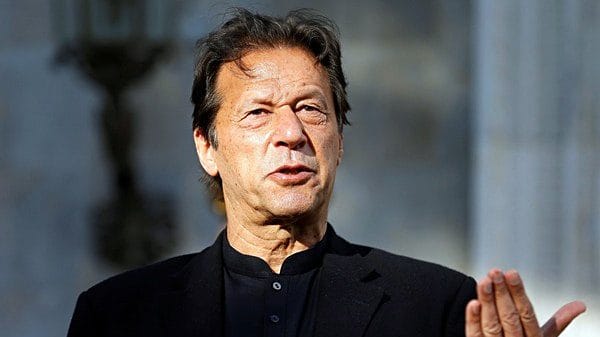


New Delhi: Pakistan’s military orchestrated its former Prime Minister Imran Khan’s removal from power to repair frayed ties with the US—delivering, in the years that followed, everything the American administrations had sought but Khan had refused, a report by Drop Site News said.
Drop Site, a Washington-based media website started by journalists, said in a report published Monday that its investigation was based on leaked diplomatic cables, documents and insider interviews. As part of the report, it also released “for the first time — cable I-0678” that it described in an X post as “the document that triggered the removal of former Pakistani Prime Minister Imran Khan”. It did not cite any response from the US officials and administrations in the latest report.
According to the report, the rupture between Islamabad and Washington had been building for years, and in 2021, a US official told Pakistan’s ambassador in Washington that “all would be forgiven” if Khan was removed in a no-confidence vote.
🚨BREAKING: For the first time, the original Pakistani cypher — cable I-0678, the document that triggered the removal of former Pakistani Prime Minister Imran Khan — is being released in full by Drop Site. https://t.co/nlX8uZCQRX pic.twitter.com/SYskivzAK9
— Drop Site (@DropSiteNews) May 17, 2026
‘All would be forgiven’
In June 2021, US’s Central Intelligence Agency (CIA) director William J. Burns flew to Islamabad, seeking Pakistani cooperation ahead of America’s withdrawal from Afghanistan, including access to Pakistani territory for drone operations.
Imran Khan, Pakistan PM at the time, refused to meet Burns, the report said.
Khan’s office allegedly told Burns that the prime minister would only speak directly with US President Joe Biden—who had declined repeated requests for a phone call with Khan since taking office earlier that year. Burns waited an entire day in Islamabad, and the meeting never took place, the report said. Weeks later, Kabul fell to the Taliban in chaotic scenes that badly damaged the Biden administration’s global standing.
Further, the report said, Khan also refused American requests to allow military bases on Pakistani soil following the withdrawal.
Unlike under President Donald Trump—with whom Khan had enjoyed unusually warm ties—the Biden administration viewed the Pakistan PM as unpredictable, anti-Western and unwilling to align with American strategic priorities, Drop Site said.
Khan was simultaneously resisting pressure from Saudi Arabia, which had been pushing Islamabad to sign a mutual defence pact. Inside Pakistan’s military establishment, concerns were growing that Khan was isolating the country diplomatically, the report read.
Those concerns allegedly hardened into action. In July 2021, the generals quietly hired a former CIA Islamabad station chief as a lobbyist in Washington—without informing Khan’s government, the report alleged. The Drop Site report describes this as evidence that the army had begun to conduct foreign policy independently of the civilian leadership.
The break became worse after the Russia-Ukraine war began in February 2022. Khan was in Moscow meeting President Vladimir Putin on the very day Russian forces crossed the border—a trip American officials had explicitly asked him to cancel, the report said. Biden’s national security adviser Jake Sullivan had personally contacted Pakistan’s national security leadership before the visit. Khan allegedly ignored the warnings.
The following month, a classified cable from a meeting between Pakistan’s ambassador in Washington and Donald Lu, then assistant secretary for South and Central Asian affairs, showed how ties had frayed. The cable was leaked later, Drop Site said.
Lu allegedly told the ambassador that “all would be forgiven” if Khan was removed through a parliamentary no-confidence vote. The Biden administration denied any interference, the report said. It added that the cable nonetheless became the centrepiece of Khan’s claim that Washington and the Pakistani military had jointly engineered his removal.
On 9 April 2022, Khan was voted out of office in a no-confidence motion. What followed was, by the Drop Site account, a sweeping crackdown.
Khan’s political party, the Pakistan Tehreek-e-Insaf (PTI), was stripped of its election symbol ahead of the 2024 polls and effectively prevented from contesting as a unified force. Senior leaders were arrested, pressured to defect or forced underground. Khan himself is now in prison.
Pakistan’s foreign policy pivoted sharply after his removal. Islamabad revived security cooperation with Washington, repaired ties with Gulf monarchies and began distancing itself from China, the Drop Site report said. Major projects under the China-Pakistan Economic Corridor (CPEC) stalled amid financial disputes, security concerns and a strategic realignment within the army’s senior leadership.
The military also began delivering on what Washington had sought. According to leaked documents and former officials cited by Drop Site, Pakistan’s new military-backed government quietly began supplying artillery shells and munitions to Ukraine through American defence contractors and intermediary countries. Former officials told the outlet that American support for Pakistan’s next IMF bailout was tied to the continuation of this arms pipeline. In July 2023, the IMF approved a $3 billion standby arrangement for Pakistan. By early 2024, Western governments had largely muted criticism as Pakistan’s military oversaw elections widely criticised by opposition groups and rights observers.
Retired General Qamar Javed Bajwa had laid much of the groundwork before handing over command. In October 2022, he flew to Washington and met Defence Secretary Lloyd Austin and Sullivan, assuring American officials that Pakistan would limit the range of its missile programme and seek to reduce tensions around its nuclear posture, and signalling a willingness to distance from Beijing. He subsequently sought to facilitate American access to sensitive Pakistani nuclear facilities—a move the Drop Site report says was resisted by Pakistan’s Strategic Plans Division, which oversees the country’s nuclear command structure.
Shortly after, President Biden publicly described Pakistan as “one of the most dangerous nations in the world” because it possessed “nuclear weapons without any cohesion”. Bajwa retired soon afterwards.
Asim Munir’s rise
General Asim Munir, now Field Marshal Asim Munir and Pakistan’s first Chief of Defence Froces, took command of the army in November 2022.
Munir’s own history with Khan is woven through the story. In 2019, Khan had removed Munir from his post as Inter-Services Intelligence (ISI) chief after the Iranians allegedly complained to the Pakistan PM about “undiplomatic language” used by him during a visit to Tehran.
By 2025, Munir had emerged as Pakistan’s dominant figure, consolidating sweeping authority over military and state institutions.
Under Munir, Islamabad privately offered Beijing permission to establish a permanent naval base at Gwadar port in exchange for sweeping military and nuclear assistance. China reportedly rejected the proposal, with the report noting that demands related to nuclear deterrence capabilities were a particular sticking point. As relations with Beijing stagnated, Pakistan moved steadily closer to Washington and Gulf allies.
In September 2025, Islamabad signed the long-delayed mutual defence pact with Saudi Arabia—the same agreement Khan had refused to endorse. That month also saw a major rare earths deal: a $500 million agreement between the military-run Frontier Works Organisation and Missouri-based US Strategic Metals, giving American partners access to Pakistani deposits of antimony, copper, tungsten and rare earth minerals. Cryptocurrency partnerships with the Trump administration and broader strategic cooperation initiatives followed.
Drop Site said Pakistan also volunteered troops for the proposed international stabilisation force in Gaza when the Trump administration sought a Muslim-majority contributor, and has positioned itself as a potential mediator in US-Iran tensions.
The report ends with a pointed assessment of how the transformation was achieved: “How Pakistan got to this point is a story of steady American pressure applied in a variety of ways and a testament to the Pakistan military’s uncanny survival instincts. To hear the recent laudatory profiles of Pakistan tell it, Pakistan’s diplomatic position is a product of effective lobbying by the Pakistani government in D.C. But the true story has been much longer in the making.”
Drop Site claims it is a “non-aligned investigative news organisation”, but commentators have referred to its activist-leanings. In 2024, Drop Site News said it was blocked in Pakistan after it published a report on a secret online operation run by the Pakistan Army.
Also Read: Pakistan is tactically brilliant, strategically disastrous. It’s primed for repeated blunders