





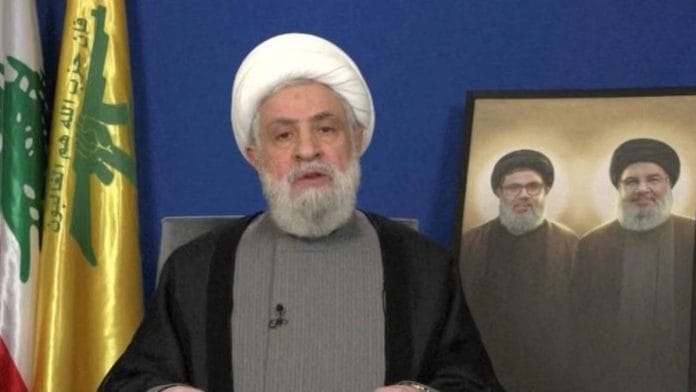


New Delhi: The fragile ceasefire between Israel and Lebanon hit a roadblock Sunday with Tel Aviv’s strikes on Hezbollah positions in southern Lebanon leaving 14 dead. Israel’s response came after the Shi’ite armed militia launched drones at Israeli military positions, killing one soldier and leaving six injured.
The ceasefire, announced on 16 April and extended by three weeks late last week, had brought hopes for a resolution to hostilities between Beirut and Tel Aviv. However, Hezbollah—which literally translates to ‘Party of God’—has continued to reject direct talks between the Lebanese government and Israel, terming them a “great sin.”
Israeli defence minister Israeli Katz threatened that the “fire will burn all of Lebanon” after Naim Qassem, the leader of the armed militia, rejected the proposed direct talks between Lebanon and Israel.
The two countries have technically been at war since 1948, with Tel Aviv occupying large parts of southern Lebanon for 18 years between 1982 and 2000. Hezbollah was formed during this occupation.
Within Lebanon, Hezbollah maintains a political and armed wing and had strong backing among the nation’s Shia community for many years, which has, however, waned in recent years.
Lebanese President Joseph Aoun Monday said that negotiating with Israel was not treason. “Treason is the one who takes his country to war for external interests,” he was reported as saying.
There is a growing sentiment in Lebanon that Hezbollah, which opened fire on Israel on 2 March this year to avenge the killing of Iran’s Supreme Leader Ayatollah Khamenei, has single-handedly dragged the country into war with Israel.
“I thank Hezbollah, because due to its stupidity and failure, the Lebanese state has moved towards the option of peace,” Saleh El Machnouk, a political activist, said in an interview with MTV Lebanon earlier this month.
The importance of Hezbollah for Iran’s revolutionary politics can be gauged by the fact that the first official contact established with a foreign entity by Iran’s newly appointed Supreme Leader, Mojtaba Khameini, was through a letter to the Hezbollah leadership. Such a close relationship has led to a perception that the group is a proxy for Iran.
Nawaf Salam, Prime Minister of Lebanon, on a visit to Paris last week said his government doesn’t seek confrontation with Hezbollah but would not allow itself to be intimidated by the group.
Salam, an independent Sunni leader (as the Lebanese system requires the PM to be), has maintained that only the state has the right to have weapons. The divide between the government in Beirut and Hezbollah has been gradual since early 2025.
Also Read: Israel-US-Iran war could go many ways for India. The dust needs to settle first
Tale of two coalitions
Since 2005, two political groups have competed for power in Lebanon, the March 8 coalition and the March 14 coalition. They got their names after the two dates during the historic rival protests, carried out in Beirut and large parts of Lebanon, between pro-Syrian and anti-Syrian camps in 2005.
The anti-Syrian camp called this the Cedar revolution. Both these coalitions have a certain mix of Christian and Muslim members, but they differ in their foreign policy orientation. According to a Council on Foreign Relation article, the March 8 coalition, consisting of primarily Christians and Shia members, including Hezbollah, favours ties with Syria and Iran; while the March 14 coalition, composed of Christians and Sunnis, prefers better ties with the US, France and Saudi Arabia.
The last general elections in Lebanon in 2022 resulted in a hung parliament, with the March 8 coalition losing majority and independents increasing their seats, denying a majority to the March 14 political coalition as well. However, the March 8 coalition was able to retain the position of the Speaker of Parliament, which in the Lebanese political system is always held by a Shia.
The hung parliament led to further complications in the election of the President of Lebanon. Then president Michael Aoun completed his term in October 2022. For almost three years, the various political parties were unable to agree on a Maronite candidate—as required by law—further disrupting the Lebanese political system.
The political deadlock ended in January 2025 when former army commander Joseph Aoun was elected as President, and he chose Salam as his Prime Minister.
Salam’s appointment was, however, not supported by Hezbollah. It highlighted how the influence of Hezbollah was waning in Lebanon after it lost its charismatic leader Hassan Nasrallah in an Israeli strike just a few months earlier in September 2024.
The fall of the Assad government in Syria in late 2024 led to further decline in the influence of Hezbollah.
Iran through the decades maintained its supply lines to the armed group in Lebanon through Syria. Even though Syrian forces withdrew from Lebanon after the Cedar revolution of 2005, Hezbollah had maintained de-facto control over the Syrian border and used the port of Beirut to transport drugs, weapons and explosive materials in and out of Lebanon without any state intervention, according to a Chatham House article.
Ahmed al-Sharaa, who spent the last few years fighting Iranian proxies, came to power in Syria in December 2024. He has already announced that Syria will remain out of the ongoing Iran-Israel-US conflict and, citing Arab sovereignty, has declared that Syria will support Lebanon on the disarmament of Hezbollah.
Not the end of road for ‘Party of God’
The Shiite militant group that came into existence after Tel Aviv’s war on Lebanon in 1982 still retains the capability to strike deep in Israel. Hezbollah also seems to have used the 15-month reprieve, set in after the ceasefire in November 2024 following clashes with Israel, to rearm itself.
Internationally, it enjoys firm support of Iran. Both the Iran side and Pakistani Prime Minister, Shehbaz Sharif insisted that Lebanon was part of the ceasefire deal struck on 8 April between the US and Iran, a claim denied by Washington and Tel Aviv.
Rallies in Beirut by Hezbollah supporters condemning “US-Israel imperialism” demonstrate the enduring influence of the Shi’ite group, despite the issues it faces.
“Hezbollah is Lebanese, its members are Lebanese, they are a political party, represented in the (past) government,” then ambassador of Lebanon to India Dr Rabie Narsh had said in an interview to ThePrint in October 2024.
“The government of Lebanon has some issues with Hezbollah when it comes to its regional role, but when it comes to defending the Lebanese border, Hezbollah is under the umbrella of Lebanon,” he added.
Jaydeep Gadhavi is an alum of ThePrint School of Journalism, currently interning with ThePrint.
(Edited by Nida Fatima Siddiqui)