





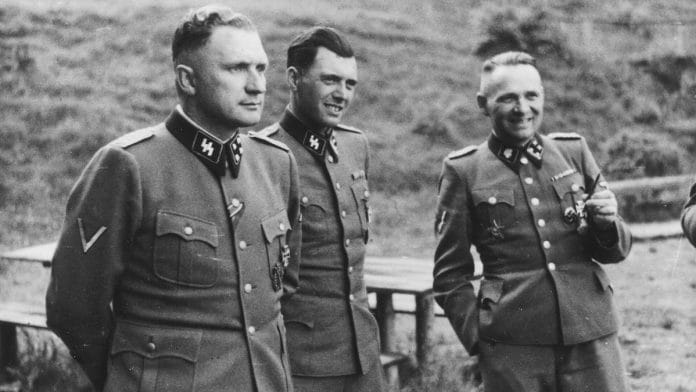

New Delhi: Switzerland’s Federal Intelligence Service (FIS) has announced plans to declassify secret files linked to notorious Nazi Josef Mengele, infamously known as “Angel of Death” for his medical experiments on prisoners at the concentration camp at Auschwitz.
The FIS is yet to specify when the files would be released.
Mengele, a German, spent most of his life in hiding post the allied victory in World War II, in South America. He died in Brazil in 1979.
It is speculated that in the late 1950s, Mengele, who fled Europe in 1949, may have returned and used Switzerland as a transit country despite an international warrant issued against him in 1959.
The files on him were sealed till 2071 on national security grounds and for the protection of his extended family. Many historians have over the decades appealed for declassification but in vain. Historian Gérard Wettstein was the latest to make the request last year.
After the request was turned down, Wettstein challenged the decision in Swiss court through crowdfunding. “It seemed ridiculous. As long as they are closed until 2071, it fuels conspiracy, everyone says ‘they must have something to hide’,” he told the BBC.
In a statement issued on 4 May, the FIS, without naming Wettstein, said the files “contain sensitive information” and it would grant the appellant access to them under still-undetermined conditions that would remain in place for future requests. However, the “conditions and requirements” have led to increased scepticism among historians.
Regula Bochsler, a Swiss historian, told the BBC: “I don’t trust (the authorities) at all. I fear it will look like the Epstein files. Why have these Mengele files been closed for so long?”
Bochsler found through her research that in June 1961, the Austrian intelligence service had warned the Swiss that Mengele was travelling under an assumed name and might be on Swiss territory, the BBC reported. She also said Mengele’s wife rented an apartment in Zurich in 1959, close to the airport and applied for permanent residency.
The evidence suggests that Mengele was planning a trip to Europe in 1959. Mengele also had a skiing holiday in the Swiss Alps with his son Rolf in 1956. That information has been known since the 1980s.
Mengele’s case has revived scrutiny of Switzerland’s wartime record, including its policy of turning away thousands of Jewish refugees at the border and the post-war controversy over dormant Swiss bank accounts belonging to Holocaust victims and their families.
Historian Jacob Tanner said the secrecy over the files reveals more about Switzerland than they would ever about Mengele. “It’s a conflict between national security and historical transparency, and the former often prevails in Switzerland,” he told the BBC.
The Swiss file on Mengele was briefly accessed by a historian part of the Bergier Commission which was formed by the Swiss government in 1996 to investigate Switzerland’s wartime conduct, including the handling of Holocaust victims’ assets by Swiss banks. But in December 2001, the government decided to restrict access to the files.
Who was Josef Mengele
Born in March 1911, Mengele was a military officer trained in medicine and physical anthropology. During his studies, he embraced the Nazi worldview of biological racism.
In 1938, Mengele joined the Nazi party to work towards maintaining and enhancing the supposed superiority of the German “race”. In July 1940, he volunteered for medical service for Waffen-SS (Schutzstaffel), a military wing of the Nazi party.
In 1943, he joined as a camp physician at Auschwitz-Birkenau where hundreds of thousands of Jews, deported from across Europe, were killed.
There, Mengele took part in the so-called “selection” process, deciding which prisoners would be used for forced labour and which would be sent directly to the gas chambers. These included children and older adults.
He also conducted inhumane experiments on prisoners, documented by survivors and historians as mass sterilisations, inflicting wounds, injecting diseases to test treatments, conducting unnecessary surgeries to train medical professionals and organ trafficking.
The experiments were carried out without the consent of the prisoners and led to their maiming and even death. Mengele drew his victims mainly from two ethnic groups: Roma (gypsies) and Jews, considered “subhuman” by the Nazis and looked upon as a threat.
After the war, using a false identity, Mengele was issued Red Cross travel documents in Genoa in northern Italy and used them to flee to South America.
The Red Cross later apologised, saying the documents were intended for thousands of people displaced across Europe after the war, but some Nazis, fleeing justice, managed to manipulate the system and acquire them.
Jaydeep Gadhavi is an alum of ThePrint School of Journalism, currently interning with ThePrint.
(Edited by Nida Fatima Siddiqui)
Also Read: Epstein files and what they mean for the American anger against elites