




In episode 1830 of Cut The Clutter, ThePrint Editor-in-Chief Shekhar Gupta explains why strategic petroleum reserves have become critical in an era of supply shocks and geopolitical conflict, tracing their evolution from post-war crises to today’s oil market disruptions, and assessing where India stands against major economies like China, the US and Japan.
Here is the full transcript edited for clarity.
It is the 50th day now of the Strait of Hormuz blockade, and we are down to counting our barrels. In fact, the whole world is down to counting its barrels.
One barrel is 159 litres of oil. I don’t know why we still measure it in barrels and not, say, in metric tonnes. Or, for that matter, why do we measure cotton in bales? Maybe it’s just because the Americans will not go metric. Nevertheless, we measure oil in barrels, and the whole world is now counting them.
The world is also now looking at a concept that some had taken seriously, but many others had not, and that is the concept of a strategic petroleum reserve, because petroleum comes out of very few places in the world. Lately, some more areas have opened up. Africa has opened up in many parts. South America has opened up in some areas. North America — the US, Canada and Alaska — has also opened up. Shale gas has come in. Some has opened up, some is a work in progress.
But large parts of the world, particularly where the biggest consumers are, are far away from the regions where oil is produced. And the same geology that gives you oil also gives you choke points. So oil supplies are then subject to choke points.
That is why many countries, particularly large consuming countries, have been thinking about keeping strategic petroleum reserves, or SPRs.
This idea was discussed in the past. It was discussed in 1944. In fact, the then US interior secretary, Harold Ickes, proposed the idea. The Second World War was winding up at that point. But then, under President Truman, a mineral policy commission proposed a strategic oil supply system in 1952.
These things always follow a crisis. The first push had come towards the end of the Second World War. The second big push came in 1956 with the Suez Canal crisis, when Eisenhower again proposed a strategic oil reserve. However, this had to wait another 17 years, until the Yom Kippur war in 1973.
After the Yom Kippur war, oil-producing countries cartelised, particularly the Muslim-Arab oil-producing countries. They came together and raised the price of oil by controlling supply. That is when the process got its biggest push, and that is when the Americans, under President Ford, passed the Energy Policy and Conservation Act of 1975 (EPCA). Under that law, the Americans set up the world’s first large strategic petroleum reserve, authorising the government to buy up to 1 billion barrels of oil and store it.
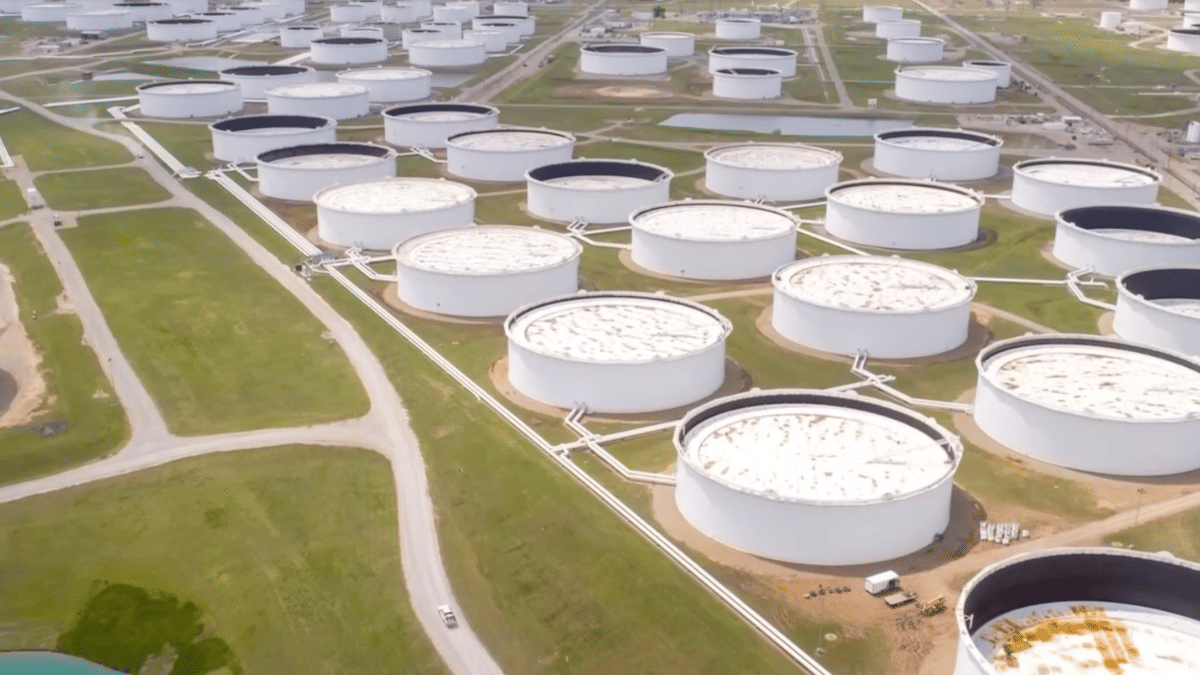
At this point, as we speak, the Americans have about 413 million barrels of oil in the government strategic petroleum reserve, which is less than half of what they can store, but still quite a bit. Most of this is stored in caverns in the Gulf of Mexico under what are called salt domes.
West and allied countries also set up the International Energy Agency, or IEA, in 1974, again following the Yom Kippur war. These are 32 developed, or OECD, countries. They got together and set up this organisation, which then said that every member must maintain 90 days of strategic petroleum reserves. In case something shuts down somewhere, you should have enough petroleum reserves for 90 days. And if there is a global crisis, some of these reserves can be released to, literally, pour oil on troubled waters.
The question that will come to your mind is whether India also keeps 90 days of reserves. This does not apply to India because India is not a member of the IEA. India is, however, an associate of the IEA and generally looks to them for guidance while setting its own principles.
What has the rest of the world done, particularly the developed world, after these multiple wake-up calls, the biggest being the Yom Kippur war? Currently, the three largest strategic petroleum reserves are with China, the US and Japan, in that order. China is bigger than the US. The US, as I said, has about 400 million barrels. It also has another 400-odd million barrels with its refineries, factories and so on. But the government’s strategic petroleum reserve itself is about 413 million barrels. That is the publicly stated figure.
The Chinese, on the other hand, were adding 1.1 million barrels per day to their reserve in all of 2025. In 2026, in the first two months, until the war began in Iran, they were buying 16% more than even that per month. So China was stocking up. They obviously had some idea that the balloon was going to go up in West Asia, so they were stocking up. In the process, therefore, the Chinese reserve is now about 1.4 billion barrels. That is almost three times the US reserve.
These graphics are from the American Energy Information Administration, or EIA, not the IEA, but they are publicly available. That is why we are using them.
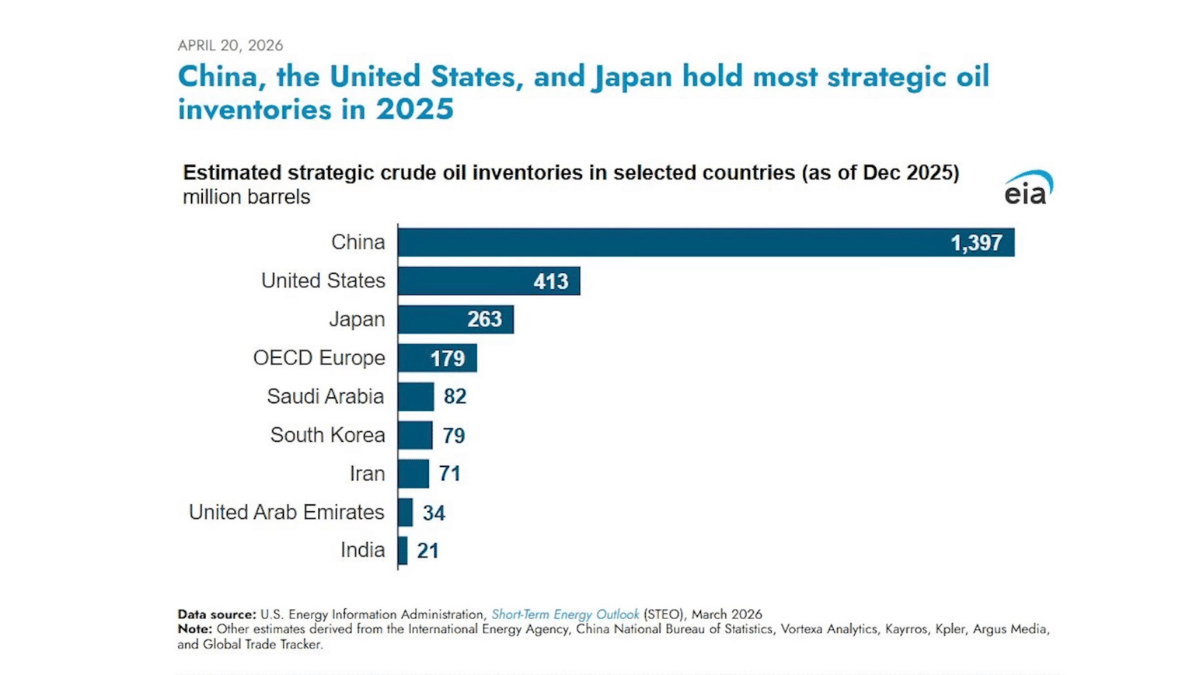
China is far ahead of America. 1.4 billion barrels is almost three times of 413 million barrels, which is what the Americans have. And I know you are taken aback by the amount of crude oil China has hoarded. China keeps reserves for everything, as if a world war is about to break out. We had done a Cut the Clutter, I think about two years ago, on how China was storing grain. They were buying up grain all over, and they had built humongous storages for grain — huge silos where they were storing all kinds of grain. China has a soybean reserve. China has a rice reserve. China has a wheat reserve. China has a pork reserve. China will not run short of anything.
If the world comes to an end tomorrow, or if everybody blacks out tomorrow, they will have enough to survive for a very long time. Or maybe, if the rest of the world has trouble, they will be able to share their surpluses if the price is right.
Japan has 263 million barrels. I know you will want to know how much India has, and I will come to that. Japan’s reserve is more than 90 days. In addition to this, Japan also has its own domestic law, the Oil Stockpiling Act, under which it must keep 70 days of crude oil with itself. That itself comes to 220 million barrels. So there is 220 million barrels under that requirement, and 263 million barrels that it keeps as part of its commitment to the IEA. Japan has the third-largest strategic petroleum reserve.
Then OECD Europe has 179 million barrels. South Korea has 79 million barrels.
How much does India have? India has about 20 to 30 million barrels. I should not give you the precise figure, but basically the reserves that India keeps under a public sector company called Indian Strategic Petroleum Reserve Limited, or ISPRL, amount to about 9.5 days of use.
Now, India has a large number of refineries, many ports along both its coastlines in the east and west, more on the west than in the east, and a very extensive network of pipelines carrying crude to refineries. For example, crude may be offloaded at Kandla and a pipeline will bring it to Panipat, just about 90 kilometres from where I sit. All those pipelines have crude sitting inside them. If you add up all the crude that is available in India in strategic reserves, that is about 9.5 days. Then what is sitting with the refineries? What is on the ports? What is on single-point moorings? That means the ship carrying oil is sitting there. If you add it all up, India has about 74 days of storage.
No one is looking for a situation, or waiting for a situation, where you start drying up what your refineries are storing. So technically, India has 74 days of storage. The Government of India has about 9.5 days of storage.
However, this is only phase one of ISPRL, the strategic petroleum reserve. Phase two is underway, and future phases will also come up.
Let me also tell you how India started the process of building a strategic petroleum reserve. As I said, it is not something we inherited at independence. It came up within this century, in fact in 2004, in the last months of the Vajpayee government. On 7 January 2004, just about a month before the Vajpayee government became caretaker after announcing elections, it decided to start setting up a strategic petroleum reserve and authorised construction of the facilities.
Then the UPA government came in, and this was one of those beautiful things in the Indian system. One government handed over the baton, and the next ran with it seamlessly, flawlessly. The UPA government set up a special purpose vehicle (SPV) called Indian Strategic Petroleum Reserve Limited, or ISPRL, on 16 June 2004.
Initially, it was set up as a subsidiary of Indian Oil Corporation. Then, within the tenure of the same government, on 9 May 2006, it became a wholly owned subsidiary of the Oil Industry Development Board. Then the construction of phase one began much later. It was only on 10 February 2019 that Prime Minister Modi dedicated the first storage of ISPRL to the nation.
Now where has the storage come up? All the data we are telling you— where the caverns are, or approximately how much oil they may store, is not secret. We only have it from the ISPRL website.
In phase one, caverns were dug using tunnel boring machines in hard mountains, closer to the coast, because it is easier to bring in crude there and because the hard mountains help ensure that valuable crude does not seep through or leak. It takes a lot of engineering to line these caverns properly and prevent seepage.
In phase one, caverns were built in Visakhapatnam in 2015, then in Mangalore on the west coast, and in Padur, also on the west coast in Karnataka.

And now we have phase two underway. A lot of work is going on in Chandikhole in Odisha. Phase two is also under way in Mangalore, and in Rajasthan some salt caverns have been identified, where surveys are on for a 5.625 million metric tonne storage. In addition, there are plans in this phase to set up above-ground storage in Mangalore and also in Bina in Madhya Pradesh.
Do not get confused. You might say, “If India consumes 5.5 million barrels a day, so how can only 5.6 million be stored in this cavern?” No. The answer is that this figure is in metric tonnes. There is a difference between metric tonnes and barrels, and that is why the oil business sometimes gets confusing.
Once again, for simplicity: one metric tonne of crude oil is a little over 7.4 barrels of oil.
OECD, which means the Organisation for Economic Co-operation and Development, is a grouping of the richest countries in the world. Internationally, what is the principle of the IEA? Why does it say that countries should keep this much oil in reserve, and how does it operate? When oil prices go up because of supply shocks, the IEA releases oil from its own stocks to cool those prices. That is literally the idea of pouring oil on troubled waters.
On 11 March 2026, within two weeks of the war beginning in Iran, IEA members released 400 million barrels of crude oil to bring down global oil prices. In 2022, when Russia invaded Ukraine, there was an oil crisis and supplies had gone down, so the IEA released about 200 million barrels. What they have released this time is twice as much as what was released during the Ukraine war.
There have been other significant releases of crude oil from strategic petroleum reserves. The US, for example, released 17 million barrels during the first Gulf War in 1991. During Hurricane Katrina in 2005, it released 11 million. During the Libyan war in 2011, it released 30 million. Then, to control overall inflation in November 2021, the Biden administration released 50 million barrels. In March 2022, during the Ukraine war, the US released 180 million barrels. Overall, it was about 200 million barrels. Then 284 million barrels were released between 2021 and 2023 because the Biden administration was trying to keep inflation down. That is something Donald Trump endlessly keeps attacking Joe Biden over.
So what is the upshot of all this? The upshot is that any country with big economic stakes but no easy access to its own oil will now maintain reserves, and maintain larger reserves. In India, you can be very sure that strategic petroleum reserves will go up — not from 10 days to 20 days, which is the current plan, but, maybe over time, perhaps to 40 days, 50 days and so on, because India lives in a very difficult neighbourhood.
From where will the money come for that? Governments will have to answer that. I was imagining, because I do not know finance, nor do I know how the fisc works, that perhaps the Reserve Bank of India keeps a lot of its forex reserves in dollar bonds, euros, pound sterling, etc, or maybe in gold or SDRs. Why can it not keep some of that in crude oil? So, when the price is right, the Reserve Bank of India buys a bunch of crude and uses it as its own reserve. And as and when money is needed, it can be sold.
Theoretically, that is possible. But I called one of the most respected former governors of the RBI, who said that, while theoretically it is possible, he would not recommend it because foreign exchange reserves give you stability and confidence in the world. If you have them stored in liquid form, they may not carry the same weight.
So that is a thought for now. But let us see how this develops, because somewhere India will have to find the money to build much larger strategic petroleum reserves than it has right now.
Also read: How Op Sindoor, West Asia war proved satellites are new instruments of war | Cut The Clutter