





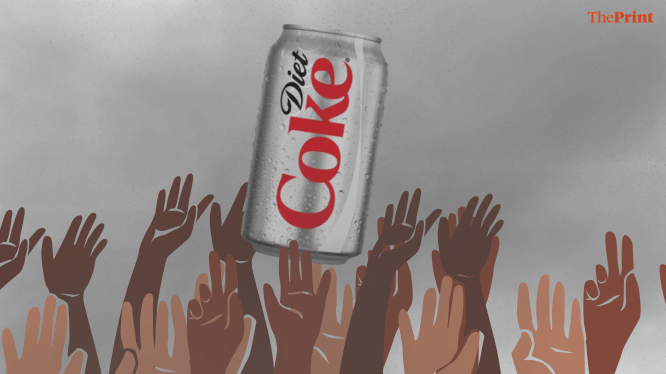

New Delhi: A few months ago, Diet Coke was just an alternative to Coca-Cola, one grabbed when one didn’t want sugar but still wanted the hit. Now, across India’s metropolises, it has become conspicuously absent from quick-commerce apps and store refrigerators alike, leading many to hoard the drink. And the reason isn’t just the supply choke due to the US-Israel war on Iran, as many assume.
“It’s not one thing that has led to this can crisis,” a senior official at the Bureau of Indian Standards, on the condition of anonymity, told ThePrint.
“There’s obviously a global supply shock, but it has also been layered on top of an ongoing domestic regulatory transition.”
On the evening of 28 March, Iranian missiles and drones struck two of the Gulf’s largest aluminium smelting facilities—the Al Taweelah complex of Emirates Global Aluminium in the UAE, and Aluminium Bahrain’s main production site. By the following Monday morning, aluminium prices had reached their highest point since April 2022.
In a single weekend, the world lost around 1.6 million tonnes of annual smelting capacity. The Gulf, which accounts for roughly nine per cent of global aluminium supply, took a direct hit; its ripples were felt far beyond.
For can manufacturers watching from India, the implications were immediate. Higher import costs had arrived precisely at a time when domestic production of aluminium was already short since the past year ue to rising demand that is majorly being attributed to rapid growth in construction and electric vehicle production. Beer, energy drinks, packaged water—the entire canned beverage industry is now reeling under the pressure.
India’s imports of aluminium and aluminium products rose significantly from $6,864.14 million in FY24 to $8,272.99 million in FY25, an increase of about 20.5%. Imports of aluminium plates, sheets and strips rose by about 34% to $810.74 million in FY25 from $605.08 million a year earlier. Aluminium foil imports saw an increase of about 14% to $847.67 million from $742.30 million, driven largely by demand from the packaging and pharmaceutical industries.
“The impact has been far and wide, all aluminium-dependent sectors have been reeling behind… Diet Coke is just the most exposed product that has quickly grabbed people’s attention,” the BIS official said.
Diet Coke in India is sold exclusively in aluminium cans, leaving no other packaging option to fall back on. The lack of aluminium has made the product vanish from many departmental stores, almost overnight. Several social media posts have since circulated online, showing mock-ups of alternative packaging for the drink.
Coca-Cola has since introduced a glass bottle version on quick-commerce platforms—the kind that once anchored its old advertising. But at Rs 100 for 200 ml, against the standard Rs 40 for 300 ml, it is less a solution than a stopgap for the desperate.
Also Read: Delhi’s Diet Coke Party started as a joke. Then 150 people turned up to drink the soda
An internal disruption
But BIS officials say that the Gulf shock might have been manageable on its own had it not occurred while a domestic regulatory transition was already underway.
In May 2025, the government issued the Aluminium and Aluminium Alloy Products Quality Control Order, also known as the QCO 2025. The order made BIS certification mandatory for a wide range of aluminium products. Large and medium manufacturers were required to comply by 1 October 2026. Small-scale manufacturers until 1 January 2027, and micro enterprises until 1 April 2027.
The goal, officials say, was straightforward: tighter safety and recycling standards for aluminium products entering the Indian market. But the certification requirements included standards such as thickness tolerances, load-bearing capacity, temperature resistance, alloy purity, and specific contaminant limits for materials like lead, cadmium, and arsenic. This further added costs and put domestic manufacturers under stress.
“The local shortage had already been building before the Gulf crisis. The 2025 regulations tightened what could be imported and sold in the domestic market. The global shock then hit on top of that. You’re seeing both effects at once,” the official added.
In March 2026, a revised order—the QCO 2026—superseded the 2025 rules, expanding mandatory certification to 17 product categories, including pharmaceutical packaging foils, aerospace-grade materials, electrical conductors, and construction panels.
The QCO 2026 also extended each of the original compliance deadlines by three months, but also limited non-commercial research imports.
Officials, however, are careful to separate the two.
“The 2026 order has not come into force yet. Whatever you are seeing on shelves right now has nothing to do with it. That picture will only become clear next year,” a BIS official said.
What the Diet Coke shortage illustrates, perhaps more cleanly than most supply chain stories, is how a single format decision, made years ago in a boardroom, can leave a product entirely vulnerable when multiple systems fail simultaneously.
A geopolitical shock that started with Iranian strikes over the Arabian Gulf ended, for many Indian consumers, with an empty fridge at their nearest stores.
But the classic red and silver can will return. Officials say that the certification backlog is clearing, and global aluminium prices, while elevated, have begun to stabilise.
The shortage has, in the meantime, done what few supply chain disruptions manage to do: it has made people think carefully about a can of diet soda — where it comes from, what it is made of, and the process behind it being cold and waiting for them.
(Edited by Insha Jalil Waziri)