


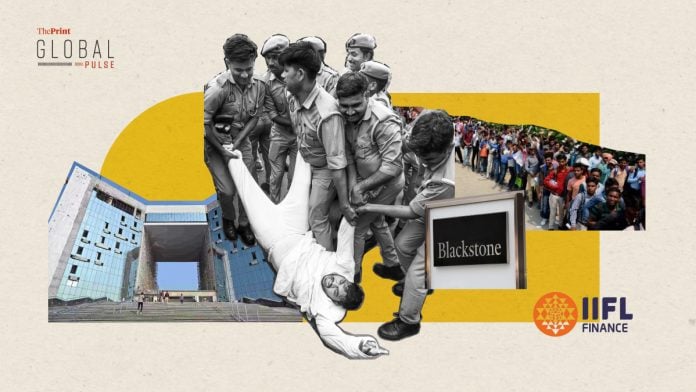
New Delhi: From restless streets, to a controversy involving a public library, the endless search for jobs and a $50-billion banking sector acquisition. This week, global media turned its gaze to the political, administrative and financial stories making headlines in India.
The Atlantic, drawing on protests in different parts of the country, argues that Prime Minister Narendra Modi is “losing his grip on dissent”. Picking up the thread, The Wall Street Journal reports on the lack of white-collar jobs fuelling anger among India’s youth.
BBC Tamil reports on the controversy involving the purchase of ‘AI-generated’ books by a public library in Coimbatore.
Meanwhile, Financial Times looks at Blackstone’s investment in IIFL and the growing foreign interest in India’s lending business, while also reporting on trouble mounting for former Videocon chairman Venugopal Dhoot.
Writing for The Atlantic, Nikita Saxena concludes that a series of protests, taken together, are challenging the Modi government’s long-standing approach to dissent. For more than a decade, she writes, the government has “relied on fear to throttle dissent in India,” jailing protesters, using a “pliant media to vilify critics” and fuelling communal tensions. But “this year, that playbook appears to have lost its efficacy”. As discontent spreads, “Modi’s power no longer seems unassailable”.
Saxena traces an important shift marked by the student-led protests in Delhi this summer, where tens of thousands took to the streets demanding the education minister’s resignation.
Modi’s Instagram appeal to protesters and the BJP’s attempts to speak their language, using slang such as “delulu” and “clock it”, only invited ridicule, writes Saxena. “These efforts just earned the BJP more mockery.”
What made these protests different, she notes, was also who was taking part. Unlike the demonstrations against the citizenship law and farm reforms, which were associated largely with Muslim and Sikh communities, many of those demanding the minister’s resignation came from “privileged Hindu families”—the very voters the BJP counts as its own.
The unrest has since taken several forms: workers in 10 states have reportedly held 275 strikes since January; tribal communities in Madhya Pradesh have protested displacement by a river-linking project; and students in Mumbai and Delhi have raised issues of caste discrimination and campus representation. In the capital, another movement has emerged around the Special Intensive Revision (SIR) of voter rolls.
“A million mutinies are now finally coming to the fore,” says Praveen Donthi of the International Crisis Group. The old labels used to discredit protesters—“anti-national, anti-development”—are no longer as effective, he adds.
Yet, Saxena does not portray the protests as an organised nationwide movement. Even so, Naureen Sabba, a 26-year-old activist with the Revolutionary Workers’ Party, sees resilience in the protests. “The harder you push it down, the stronger it bounces back.’”
Also Read: A life ‘mirroring history of modern India’—global media spotlights Sonia Gandhi’s memoir
In The Wall Street Journal, Stu Woo and Krishna Pokharel report on growing discontent among India’s youth through the lives of graduates preparing for government recruitment exams.
The report, “Degrees Lead Nowhere. Jobs Don’t Exist. Welcome to India’s Youth Revolt”, begins thus: “Understanding the youth protests rocking India doesn’t require attending a demonstration. Instead, step into a windowless room with inspirational quotes on the walls.”
The report follows Akshay Tomar, a 26-year-old with a master’s degree in political science, who says, “There’s a reason to be hopeless.” While unemployment among graduates aged 25 to 29 stands at 20 percent, it reaches 40 percent among those under 25.
“India churns out graduates but not enough white-collar jobs to absorb them,” says the report. Johns Hopkins professor Devesh Kapur points out that government jobs account for a much smaller share of employment in India than in other major economies. “Why do people buy lottery tickets? You vaguely know the house is going to win, but what is your alternative?”
The report says the “frustration threatens” Prime Minister Narendra Modi and the BJP, adding that their “slipping grip on power is clear in Uttar Pradesh”. Centre for the Study of Developing Societies (CSDS) professor Sanjay Kumar says the “youth anger will likely dent the party’s results here,” while arguing that “the real solution lies in saying upfront that the government is not in a position to create government jobs”.
The report also captures why these jobs matter so deeply to families. One aspirant says, “You have a chance for a better match and to get married to a better family.” The report links this desperation to allegations of exam fraud. “The whole system is corrupt,” says Satender, the father of an aspirant, adding, “That’s why the hardworking, genuine candidates suffer.”
Also Read: Surge in demand for PCBs putting squeeze on India’s electronics firms, says global media
In BBC Tamil, Xavier Selvakumar and Yazhiniyan report on allegations that a newly opened public library in Coimbatore purchased hundreds of books suspected of being generated using artificial intelligence (AI). The controversy centres on Periyar Arivulagam, a Rs 300-crore library inaugurated by Tamil Nadu Chief Minister C Joseph Vijay on 16 October. The Madras High Court has ordered an investigation into the purchases.
The issue surfaced after Tamil novelist Perumal Murugan raised concerns about the library’s Tamil collection. Writing in an online magazine, he alleged that “nearly 1,800 books in its Tamil section had been supplied by a little-known publisher called Agal Vilakku Pathippagam”. He said that “many of the books carried unfamiliar authors’ names, unusually high prices and questionable International Standard Book Numbers (ISBNs)”.
For instance, one 300-page book, Naladiyar Vaazhvin Vazhikatti, was reportedly priced at Rs 1,445 and described Naladiyar as a Tamil poet and philosopher, although it is a classical work comprising 400 four-line verses. Another book attributed Madurai Kanchi, an ancient Sangam literature poem, to an incorrect author. According to the report, whether AI was used to produce the disputed books “remains unclear”.
The controversy has widened beyond Coimbatore. A book on democracy and people’s rights found at a public library in Madurai carried economist Jean Drèze’s name. Drèze told The Hindu earlier this week that he had not written the book.
Tamil Nadu’s School Education Minister A Rajmohan has described it as potentially “India’s first AI scam”. The investigation will also cover purchases at other public libraries across the state. Meanwhile, more than 160 writers, researchers, artists and publishers have demanded an independent inquiry, the release of procurement records and an audit of library collections.
“BBC Tamil visited a Chennai address listed by Agal Vilakku and another publisher named in the controversy, Phoenix Publishing House, but found no signs identifying either business. A woman at the address confirmed that Agal Vilakku operated there. Its proprietor, Mohan, declined to comment, saying the matter was before the courts,” the report adds.
Also Read: The colour now compulsory in Delhi during Diwali & Mundhe’s fight against ‘chalta hai’ culture
In Financial Times’ twice-a-week newsletter India Business Briefing, Veena Venugopal writes on Blackstone’s investment in IIFL and the bankruptcy proceedings involving Videocon promoter Venugopal Dhoot.
The Rs 50-billion investment by Blackstone, the world’s largest alternative asset management company, into the NBFC IIFL hints to the growing interest of foreign investors in India’s banking and lending business. Blackstone is buying an approximately 16 percent stake in IIFL, just weeks after Canadian investor Fairfax agreed to acquire IDBI Bank in a $5.6-billion deal.
The deal comes amid “tremendous growth in India’s financial services sector, both in investing and lending”. More Indians are investing in the stock market, with retail investors becoming “a significant force” in equity markets. On the lending side, the newsletter says, “secured loans have become big business”. Gold loans, “long a staple of the southern states, have found a national market”.
As businesses expand and companies invest more, the demand for loans is expected to rise further. However, Venugopal writes that “India does not have enough well-capitalised lenders” to meet this demand. “Foreign investors are rushing in to take a slice of this growth potential,” she notes, pointing to investments by Japan’s Sumitomo Mitsui Banking Corporation, Dubai’s Emirates NBD and American institutions including Bank of America, BlackRock and Warburg Pincus. The trend, it says, “could mark the beginning of a second big wave of foreign investment in Indian businesses, some two decades after the first”.
The newsletter then looks at the bankruptcy proceedings involving Venugopal Dhoot, the promoter of “Videocon, once a prominent made-in-India brand”. The Mumbai bench of the National Company Law Tribunal (NCLT) “admitted a petition filed by the country’s largest lender, State Bank of India,” over Dhoot’s unpaid dues of Rs 127 billion. The report traces the case to 2011-12, when Dhoot provided personal guarantees for loans taken by “Videocon group companies”. His offer to repay Rs 60 lakh over three years was rejected by creditors as it covered less than 0.5 percent of the admitted dues. The report also places Dhoot’s bankruptcy against the backdrop of India’s evolving insolvency regime.
Drawing a parallel with the troubles of Zee Group founder Subhash Chandra, Venugopal points to the challenges that remain. “The next challenge for India’s insolvency framework is to speed up resolutions, improve recoveries and ensure that promoters cannot use corporate structures and court delays to evade accountability for personal guarantees.”
(Edited by Amrtansh Arora)
Global mainstream media just cannot digest the fact that the Hindu right-wing government has been able to win election after election – both at the Centre as well as the States. In their desperation to create a US mid-term election like situation, they have started imagining things like ‘mutinies’.
Speaking of ‘mutinies’, Maoist terrorism has been decisively defeated. Khalistani networks too are under severe pressure following crackdowns both in India and in Western nations like Canada.
As for Kashmir, insurgency is going on, albeit at a much lower level. The yearly casualty figures have dropped very sharply.