


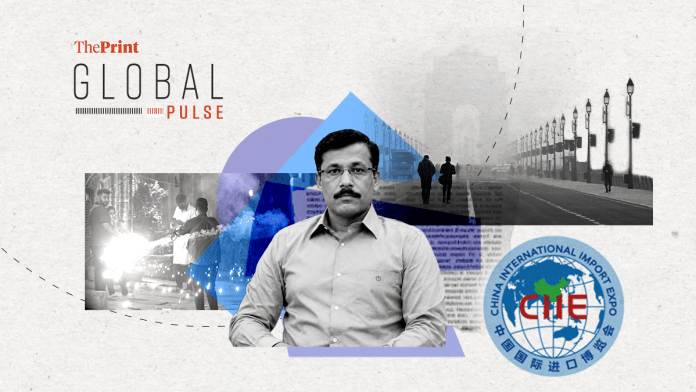
New Delhi: From the smoke hanging over Diwali celebrations in Delhi-NCR to Indian businesses pitching their products in Shanghai, global media looked at the India story from different angles this week.
Both The New York Times and BBC report on the air pollution clouding Diwali celebrations.
Global Times follows Indian companies looking for potential customers in China.
Meanwhile, The Economist turns to a civil servant’s battle against the age-old ‘chalta hai’ culture.
In a bid to balance Diwali celebrations with concerns over air pollution, the Supreme Court allowed the use of green crackers in Delhi-NCR during specified hours over the weekend. In a report for The New York Times, Jeremy W. Peters and Suhasini Raj detail the court’s decision, the criticism it has drawn from environmentalists and the worsening air quality in the capital.
The top court allowed use of firecrackers for three-hour windows on 7 and 8 October, provided they were of the “green” variety, designed to burn faster and release fewer harmful chemicals. It invoked Diwali’s “religious, social, psychological and emotional connotation”, describing the festival as one that fosters “a positive atmosphere of hope, welfare and prosperity”. The report captures the unusual prescription in a line: “there’s another color that’s now compulsory in India’s capital during diwali: green.”
Environmentalists, however, question whether the restrictions would make any difference without effective enforcement. Delhi-based activist Vimlendu Jha calls the move “a green wash”, pointing to previous court orders that had failed to curb firecracker use. He says the Supreme Court “knows very well that the government lacks the political will to enforce the rules on the ground”.
The report also documents the conditions behind the renewed restrictions. Delhi’s AQI was lingering around 400, The Commission for Air Quality Management—a statutory body—called the deterioration “a matter of serious concern” and introduced measures it described as “preventive”, including halting demolition work and ordering employers to keep half their staff home until 20 November.
The report notes that “one culprit has been wind”, with northwesterly winds carrying smoke from crop fires in northern India towards the capital.
On the ground, the restrictions have also fed into a wider argument over who bears responsibility for air pollution levels in Delhi-NCR. Some shoppers described the fireworks ban as “a smokescreen” for government inaction, while Babu Srivastava, who spent Rs 9,000 on green firecrackers, says: “Pollution was an excuse by the government to stop Hindus from going all out to celebrate their festival.”
He asks why vehicles, which contribute to pollution throughout the year, were not held to the same scrutiny. “All year round we see that vehicles are the top polluters in and around the city. So what difference does it make if we burst crackers for a couple of hours on our festival which comes once a year?”
Describing the atmosphere from a market in central Delhi on 5 November, the report notes: “Smog had enveloped the city all day and the soupy air left an acrid taste on the tongue. Almost nobody was wearing a mask.”
In “Ashoka”, his weekly India column for The Economist, Leo Mirani documents Maharashtra food-safety chief Tukaram Mundhe’s crackdown on violations at some of Mumbai’s best-known restaurants and his efforts to reform the state’s Food and Drug Administration (FDA).
The piece opens with the question: “HOW MANY cockroaches is an acceptable number of cockroaches in a commercial kitchen?” It contrasts Mundhe’s approach with the Bombay High Court’s observation that the “solitary finding” of two bugs was insufficient reason to shut down a kitchen. The court’s acting chief justice had told officials: “We are in India, we have to take a realistic stand.” Mundhe disagrees.
“These laws are Indian, not foreign,” he says. He argues that the problem is “we have a very low estimate about ourselves”. “Our thought process is ‘chalta hai’,” he says, referring to an attitude that “holds India back”.
Mirani places Mundhe’s sudden popularity in a larger pattern of Indian bureaucracy, where an officer who does his job becomes an exception rather than the norm. “The media duly elevate the official to something between a saint and an action hero,” he writes. Citizens are reminded that the state can work for their benefit, only for the officer to move on and “everything goes back to normal”. Mundhe wants his impact to outlast his tenure.
He has proposed restructuring the FDA, recruiting hundreds of additional food-safety officers, to be assisted by more laboratories and technicians, and automated surveillance. One proposal would use government data to track milk supplies “from cow to glass”. Citing a NITI Aayog report on poor official data, Mirani writes that the ‘chalta hai’ mindset “shapes everything: how platforms are designed, how staff are trained, and how performance is judged. Slowly, quietly, quality becomes optional.” He adds: “The Indian state has many weaknesses but perfectionism is not among them.”
Mundhe has also built an online complaints portal, backed by an AI co-pilot that helps officers identify applicable rules, decide on next steps and draft notices, while escalating complaints ignored by junior officials. The FDA says it is receiving more than six times as many complaints as last year.
“It doesn’t matter which government or party [is in power]. We, the people, have to take ownership,” Mundhe says. The portal, inspections and media interviews are “all aimed at reminding citizens that the state is not irredeemable”. Mirani writes that “Indians, he says, should stop tolerating bad institutions. They should demand more from the state.” Mundhe’s closing message is: “When the public itself says chalta hai, of course the system will work as chalta hai.”
In a report for the BBC, Rachita Prasad documents Diwali celebrations across India against the backdrop of worsening air pollution, particularly in the north. While homes, temples and streets are illuminated with oil lamps and colourful lights, the celebrations come at a time when use of firecrackers, coupled with stubble burning in northern states is adding to concerns over air quality.
“Seasonal weather conditions and the burning of crop residue contribute to deteriorating air quality, while firecrackers set off during Diwali can make the situation worse,” Prasad writes.
The report notes that air pollution “in the Indian capital Delhi has reached such hazardous levels that it is the most polluted Diwali festival in a decade”. Mumbai, too, has experienced high pollution levels in recent weeks.
In an effort to curb emissions, the Supreme Court permitted the manufacture, sale and use of certified green firecrackers in Delhi and surrounding areas for a limited period. These are designed to produce “20-30 percent fewer emissions than conventional fireworks”. But critics have questioned how effective they are in reducing pollution and warned that conventional firecrackers could still enter the capital from neighbouring states.
Beyond the pollution debate, Prasad captures the wider celebrations—families lighting diyas, decorating homes with rangoli, exchanging sweets and offering prayers. The report also traces how Diwali is observed by Sikhs and Jains, and by the Indian diaspora around the world.
Indian businesses are looking to expand their footprint in China, with around a dozen enterprises showcasing products at the ninth China International Import Expo (CIIE) in Shanghai. In a report for Global Times, Ma Jingjing and Wang Xiaohan speak to Indian exhibitors selling everything from Kashmir cashmere to furniture and handicrafts, as they look to tap the Chinese market.
For Shabir Ahmad Ahangar, who has attended the expo several times, the event has become an important business platform. “His booth has expanded from about 5 square meters when he first attended the CIIE several years ago to 20 square meters this year.” The expo is crucial for expanding his customer base, which now includes China, Vietnam and Mongolia.
Suyash Mehta of Sudha India International, attending the expo for the first time, says: “This is my first time here, but my father has attended many times.”
Adding, “We attend different expos, not just in Shanghai, but in different cities as well, like in Beijing, Kunming [in Southwest China’s Yunnan Province,] and [North China’s] Tianjin. We attended every exhibition this year.”
Shahzad Ahmad, CEO of Prince Trading Co, has been doing business in China since 2014, with a branch and warehouse in Tianjin. On managing his operations through China’s digital ecosystem, he jokes: “Everything is on mobile.”
He said his company adapts its products to Chinese consumers: “We modify our products according to Chinese culture and Chinese living style,” he says. “Our Chinese customers also help us make our products more beautiful. They give us ideas.” On the wider relationship between the two countries, he adds: “Business is a good way to make good relations.”
The exhibitors’ interest comes as trade between the two countries continues to rise. Imports and exports between China and India grew 25.4 percent year-on-year to $144.45 billion in the first nine months of 2026, according to China’s General Administration of Customs.
Qian Feng, director of the Research Department at Tsinghua University’s National Strategy Institute, tells Global Times that the active participation of Indian companies in the CIIE reflects their high expectations for the Chinese market. “China possesses a vast consumer market, which holds significant appeal for Indian businesses,” he says.
He also points to India’s dependence on Chinese supply chains as its manufacturing sector develops. “India is currently at a critical stage of manufacturing development and industrial restructuring. In this process, India still has strong demand for Chinese supply chains, especially in areas such as electronic components and pharmaceutical raw materials, where the development of Indian manufacturing cannot be separated from products and supply-chain support provided by Chinese companies,” says Qian.
Indian political activist Sudheendra Kulkarni, meanwhile, says the approval of a joint venture between Dixon and Vivo was only an initial step towards closer economic cooperation. “This is a small step. Much more is needed to fully normalize India-China cooperation in business and the economy in ways that benefit both countries,” he tells Global Times.
(Edited by Amrtansh Arora)