


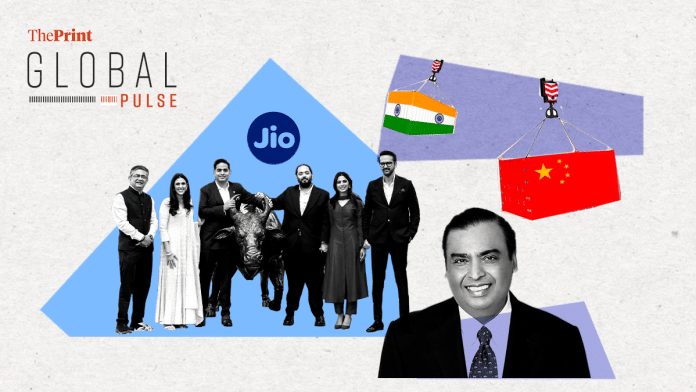
New Delhi: Reliance supremo Mukesh Ambani has reason to celebrate besides Jio’s blockbuster stock market debut.
Do the roots of India’s widening trade deficit with China lie in the country’s manufacturing weaknesses?
And the father of a six-year-old, who was assaulted inside her school, asks: “If a child isn’t safe in school, then where will she be safe?”
This week, global media looks at Reliance Industries’ diversification gains, an assault inside a school in Haryana’s Panchkula, and the India-China trade imbalance.
In its India Business Briefing newsletter, the Financial Times documented a remarkable week for Reliance. Jio made a historic stock market debut and Reliance Industries reported one of its strongest quarterly performances.
Jio’s shares, Veena Venugopal pointed out, surged 27 percent on the first day of trading, taking its market cap above $130 billion and “making it India’s second-most valuable listed company. The first is its parent, Reliance Industries.”
Reliance’s September-quarter performance was powered largely by its oil-to-chemicals business, which “benefited from the chaos in the global energy markets because of the conflict in the Middle East”. The business received a boost from stronger refining margins, while Jio added subscribers and improved its average revenue per user. Reliance Retail, however, delivered “less impressive results, with growth of a modest 6.4 percent”.
Its head, Jeyandran Venugopal, struck an optimistic note, saying “profit margins would improve from next year.” The newsletter added: “The company (Reliance Retail) is playing catch-up in India’s hugely popular quick-commerce market and investing heavily in dark stores, particularly in urban areas.”
The FT cautioned that the strong performance may be difficult to sustain. Refining margins have been elevated by extraordinary geopolitical circumstances and “may prove difficult to sustain if tensions in the Middle East ease”. The political climate in the US is another variable, with the newsletter noting that the Trump administration “has so far been friendly towards Reliance”.
For Mukesh Ambani, however, the week’s developments reaffirmed the value of the group’s diversified businesses. Ambani has spent years building telecom and retail as its future growth engines, but, as the newsletter observed, “last week was a reminder of the advantages of his diversification strategy”. “When it mattered, the group’s traditional energy business came through with a win.”
The assault of a six-year-old girl by an eight-year-old boy inside a government school in Panchkula, Haryana, has raised questions about children’s safety and supervision in schools. In their report for BBC News, Geeta Pandey, India Social Affairs Editor, and Navjot Kaur of BBC Punjabi spoke to the girl’s family and documented the hospital and police response.
The girl’s father said that the family began searching for her when she did not return after school hours, only to find that no one at the school knew where she was. Recalling the moment he found her injured in a classroom, he said, “When I saw her, I almost screamed. Looking at her condition, I thought they’d killed my daughter. If a child isn’t safe in school, then where will she be safe?”
According to the report, the girl was taken to PGIMER multi-speciality hospital in Chandigarh, where she was “brought to the hospital with critical injuries”. Hospital director Vivek Lal said the child would receive the best possible medical care and support, describing her circumstances as “deeply concerning”.
Meanwhile, police registered an FIR against the school management for “negligence” and are investigating the incident. Senior police official Aditi Singh said the boy who assaulted the girl “is being evaluated by mental experts under the Juvenile Justice Act and further action will be taken accordingly”.
In an opinion piece for the Global Times, Lü Hong, professor at the Party School of the CPC Shandong Committee, commented on India’s widening trade deficit with China, arguing that the imbalance is rooted in India’s domestic manufacturing weaknesses rather than Chinese trade policies.
“India’s trade deficit with China has long remained at an elevated level,” Lü wrote, adding that several senior Indian officials have recently pointed fingers at Beijing at international forums and multilateral summits, “attributing the trade imbalance to China”. Lü argued instead that the deficit is “essentially the inevitable outcome of its own structural economic shortcomings,” and that “unilaterally shifting the blame outward will do nothing to resolve the trade imbalance”.
The piece identified India’s manufacturing base and limited export capacity as the central problems. “India’s fragile manufacturing base and insufficient export supply capacity represent the most fundamental structural root cause of this chronic trade deficit,” Lü wrote. Manufacturing’s share of GDP has remained between 13 percent and 15 percent over the past decade, falling short of the 25 percent target under the Modi government’s Make in India initiative.
The commentary attributes the slow pace of industrialisation to “inadequate infrastructure, rigid labor markets and fragmented supply chains”.
The piece also looked at the composition of bilateral trade, describing it as a “vertical division of labor”. Indian exports to China are concentrated in primary and resource-based goods, while Chinese exports largely comprise industrial intermediates and finished products. This, Lü argued, creates a structural pattern of “importing much and exporting little”. The commentary also pointed to the rupee’s continued depreciation against the US dollar, arguing that exchange-rate movements have “further magnified the nominal bookkeeping size of India’s trade deficit with China”.
The author questioned India’s attempts to reduce its dependence on Chinese imports through administrative restrictions and alternative sourcing, arguing that such measures cannot eliminate the Indian market’s “inelastic demand for Chinese products”. Instead, the article said, “trade protectionism has raised production costs for domestic Indian enterprises, driven up consumer prices and damaged India’s long-term international business image”.
Lü argued that India needs to strengthen domestic manufacturing, upgrade its supply chains and expand exports of high-value-added products rather than blame Beijing for the imbalance.
The commentary concludes: “Politicising economic issues and blindly pursuing trade protectionism will only cause India to miss opportunities for industrial upgrading, offering zero benefit to its long-term economic development.”
(Edited by Amrtansh Arora)
Also Read: Global media writes on Modi’s two-pronged approach to protests & the flaw in RBI’s rupee rally