


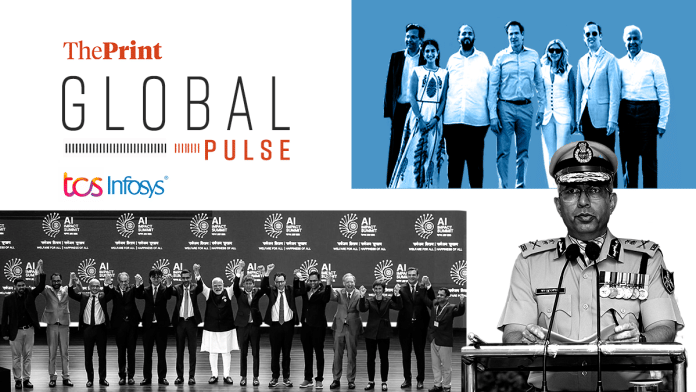
New Delhi: From how India’s IT services industry is turning the AI threat into a growth opportunity to what China’s AI wave could offer Indian software firms, and US Secretary of State Marco Rubio’s “unusual” India itinerary ahead of midterms, global media coverage of India this week explored New Delhi-Washington ties and the tech services sector, a key pillar of the country’s economy.
Amid fears that Artificial Intelligence would damage India’s $300bn IT services industry, the Financial Times captures how the sector is turning a corner by earning revenues through helping businesses adopt AI.
TCS and Infosys, two of the country’s largest IT service providers, said in their earnings reports that the AI integration work now accounts for more than 10 percent of their revenue. “AI continues to scale as a structural growth opportunity,” says TCS chief executive K Krithivasan, as quoted in the FT report.
The shift has changed expectations for the sector. “At the start of the year we were thinking that these companies may not have a role at all to play,” says Kumar Rakesh, a sector analyst at BNP Paribas. Now, “it starts looking like that they probably have a role to play”.
TCS’s AI revenue rose nearly 20 percent quarter-on-quarter, while Infosys reported a 29 percent growth, even as it lowered its overall growth forecast.
Tech Mahindra chief executive Mohit Joshi says, “The market had sort of gotten scared of the AI compression without realising the tailwinds that would go along with enterprise AI adoption.” He adds that adoption remains at an early stage, with substantial modernisation work still needed before companies can deploy fully autonomous AI agents.
That opportunity is also beginning to show up in hiring, with listed Indian IT services companies adding more than 31,000 jobs since April. But the question is how long the hiring boost will last, and whether AI-related work can compensate for the pressure on traditional IT services.
BNP Paribas analyst Kumar Rakesh cautions against assuming all the headwinds have been offset. “We probably…will start reaching a stage where we start over-expecting that…all of the issues are getting offset,” he said. “We’ll have to be careful from that perspective.”
Vallum’s analysts sum up the sector’s position. “Indian IT never stopped working.” However, the threat, they write, remains “The crocodiles are still in the water, but Indian IT has learned to swim with them.”
China’s AI wave: What’s in it for India
Continuing on the AI debate, Global Times reports Indian technology firms are exploring AI opportunities also outside the country.
“Amid the global AI boom, a growing number of Indian tech firms are utilizing Chinese LLMs to lower costs and broaden the reach of their AI services,”write Tu Lei and Li Xuanmin for Global Times. Indian firms are increasingly adopting open-weight models such as DeepSeek and Kimi to develop applications tailored to their clients.
“Because these parameters are publicly available, users can download and modify them on their own computers,” the article explains, highlighting one reason Chinese open-weight models appeal to Indian businesses: they can be adapted for specific needs at a fraction of the cost of some proprietary alternatives.
The trend is also prompting Indian firms to deepen their presence in China. ManageEngine, the Indian enterprise IT management company owned by Zoho, has rolled out more than 30 AI agents for the Chinese market, with plans to expand the number to over 100 by the end of 2026. It has also announced an investment of 425 million yuan ($63.73 million) in China over the next five years.
“In practice, some mid-sized Indian IT service providers are using AI to reshape their business models, creating new revenue streams by helping clients reduce the costs of software and AI use,” the article notes.
Indian firms including Krutrim and AceCloud have deployed DeepSeek models on their own servers to balance costs.
The article describes the two countries’ strengths as complementary. “China has solid strengths in AI R&D, real-world deployment and foundation model ecosystem development, while India has rich experience and talent in global IT services, software outsourcing and enterprise solution delivery.”
“Chinese models plus Indian services” is how Qian Feng of Tsinghua University’s National Strategy Institute describes the potential model for cooperation.
Manish Bhandari, founder of Vallum Capital Advisors, argues that India’s opportunity lies in “deploying whatever gets open-sourced”, rather than trying to match China’s spending on training large models. Indian IT firms can focus on fine-tuning models, meeting compliance requirements and integrating them into clients’ existing systems, he said.
Bhandari says realistic cooperation would involve “arm’s-length absorption of open models, not joint computer or data-sharing ventures” distinguishing the use of Chinese AI technology from deeper collaboration between the two countries.
Rubio’s India visit
A week since US Secretary of State Marco Rubio concluded his India visit, global media continues to analyse who he met and where he went.
Rubio’s return to India for a visit between October 20 and 22, his second as the Secretary of State, “signals that the country remains useful for president Donald Trump’s ambitions after all,” writes Niha Masih for The Guardian.
Rubio’s “unusual” itinerary of skipping Delhi for Mumbai and Jamnagar—home to Reliance’s oil refinery—was “intentional”, the report quotes Milan Vaishnav of the Carnegie Endowment as saying.
“Not every bilateral meeting has to take place in a national capital,” he says. “If you’re trying to drum up business deals, what better place to visit than Mumbai?”
Rubio’s Jamnagar visit assumes significance in the backdrop of the upcoming US midterm elections. With fuel prices likely to be a major issue for Americans when they go to cast their ballot on 3 November “the administration wants to show that it is doing everything it can to bring them down,” Vaishnav says, adding one of Rubio’s objectives was to encourage Reliance and, by extension, India to process more Venezuelan crude.
Despite growing trade and technology ties, Vaishnav says “there are at least three reasons for caution”, including tariffs and US visa restrictions affecting Indian workers. “This has created a real trust deficit on the Indian side, and with good reason,” he says.
For Vaishnav, India’s ability to become a global powerhouse also depends on what it does at home. “I would argue that the most important investment is political – ensuring India remains a robust, inclusive, participatory democracy,” he says.
He adds that infrastructure investment alone will not be enough without reforms to ensure “more efficient dispute resolution, an impartial legal system, even-handed tax enforcement and regulatory certainty”.
India-China border row
Outgoing Indo-Tibetan Border Police (ITBP) chief Shatrujeet Singh Kapur’s public remarks about ongoing face-off with Chinese forces in Arunachal Pradesh have also drawn global media attention.
For much of the past year, India-China relations appeared to be on a cautious path to recovery, BBC’s Anbarasan Ethirajan writes. But that thaw is now facing new questions after Kapur said at an army event that Chinese troops had returned to disputed areas in Arunachal Pradesh, pitching tents “around six-to-seven kilometres inside India’s perception of the Line of Actual Control (LAC)”.
Ethirajan writes that such “comments by serving officials are rare” on sensitive border issues. The report also mentioned the Indian foreign ministry’s comment that “the situation in the border areas gets disturbed from time to time when Chinese forces diverge from established patrolling patterns”.
Beijing, meanwhile, said it had “consistently and strictly adhered to relevant agreements” with India and described its activities as “normal patrol and management activities in the border areas to safeguard territorial sovereignty”.
Experts see the remarks as a rare glimpse into what they describe as “China’s increasingly assertive military posture along the disputed frontier”.
Former foreign secretary Shyam Saran said, “This pattern of Chinese probing at various points of the Arunachal Pradesh border has been happening for some time.” Such moves, he added, were “not enough to result in an immediate war, but enough to sort of create new facts on the ground”.
The stand-offs have also stormed a political row in New Delhi. “The prime minister and his entire apparatus remain silent on this grave issue,” Congress leader Jairam Ramesh wrote on X. The tensions also extend beyond the disputed frontier.
BBC notes India remains dependent on Chinese imports ranging from machinery and rare earth magnets to EV batteries and pharmaceutical products. “This dependence means tensions with Beijing can have consequences well beyond the border, particularly for Indian industries and infrastructure projects.”
University at Albany professor Christopher Clary told the BBC that “Chinese policy towards India is designed to complicate India’s rise, including India’s ability to master certain things in advanced technology and manufacturing”.
For people living along the frontier, the consequences are immediate. “Villagers living in some border areas tell us that they cannot access grazing lands because of Chinese intrusion and encroachment. It’s not something new, it’s been happening for a long time,” said Tongam Rina, a senior journalist with the Arunachal Times. This has created a “sense of insecurity among the people here”, she added.
Zhou Bo, a retired senior colonel in China’s People’s Liberation Army, said both countries had learnt lessons from the 2020 Galwan clashes. “The two sides should be more careful to avoid this kind of thing from happening in the future,” he said.
The fresh stand-offs underline the gap between the latest diplomatic progress between the two countries. For India, they are “a reminder that improved diplomatic ties do not necessarily translate into lasting stability along the border”.
(Edited by Ajeet Tiwari)
Also read: Global media writes on Modi’s two-pronged approach to protests & the flaw in RBI’s rupee rally