



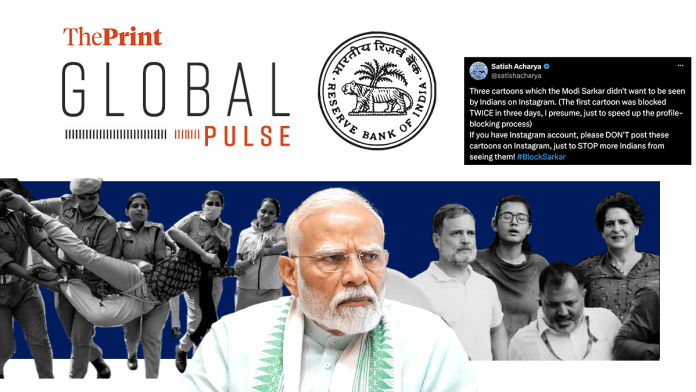
New Delhi: From attempts to erase cartoonists from India’s political sketchbook to the bid to shore up a weakening rupee, international media this week documented the pressures surrounding the Modi government.
The BBC reports on restrictions squeezing political satire, while The New York Times writes about how the youth protests have turned into a ‘headache’ for Modi, and The Economist questions the cost of defending the rupee.
Global Times, meanwhile, makes a case for improved India-China ties, arguing that turning a willingness to engage, into action, could ensure that the two neighbouring countries are no longer strangers.
Also Read: Ambanis pulling out all stops for ‘pop or flop’ Jio IPO & ‘unwanted Chinese presence’ in Arunachal
India’s Gen Z protests have presented Narendra Modi with a challenge his political playbook did not account for, says The New York Times. Katrin Bennhold, host of The World, writes of her temptation “to compare these demonstrations to the youth protests currently roiling Europe”.
But she finds a key difference: “Young people make up a much larger share of India’s population than they do in Europe—which is one reason these protests have been so powerful.” The question, she says, is why the youth movement has Modi nervous, and “whom he’d rather face off against instead”.
Drawing on reporting by Mujib Mashal, Suhasini Raj and Hari Kumar, Bennhold points to a striking contrast in the government’s response to protests.
“Modi is deliberately trying to make the ongoing demonstrations less about the youth movement that unleashed them, and more about his traditional opposition. Because that’s a fight he knows how to win,” Bennhold writes.
She adds that allowing a rally by the political opposition while cracking down on youth-led demonstrations “might seem like a puzzle, until you appreciate—as Mujib points out—that it’s part of a strategy that Modi has adopted in the aftermath of this summer’s protests”.
The distinction matters because the protests have cut across party loyalties.
The movement had already forced the education minister’s resignation, a rare political retreat for Modi. “India’s youth movement is a headache for Modi, and he’s been struggling to find a workable playbook,” Bennhold writes.
According to her, “what happens next will depend in part on the extent to which Modi continues pursuing his crackdown” and on “whether (Rahul) Gandhi and the youth movement want to stand together.”
Also Read: Global media profiles the Tata Group feud: Scion vs powerful chairman, and a ‘wild card’ govt
“THE RUPEE is back, baby!” says The Economist, opening with a celebratory note before quickly questioning the cost of the Reserve Bank of India’s efforts to stop the slide of the rupee. These steps, it warns, could limit market freedom and make it harder for the central bank to manage the currency in the future.
The RBI has taken several steps to support the rupee, attracting dollar deposits from overseas Indians with “juicy interest rates and currency guarantees,” spending “tens of billions of dollars to buy rupees in the open market” and restricting currency speculation. While these measures helped the rupee recover from just under 97 to below 95 against the dollar, the report notes that the currency has merely returned to its late-March level.
One analyst described the earlier intervention as “rolling back a decade of market liberalisation in just a few days”.
The rupee’s slide, the report adds, also carries political risks for Modi. In 2013, when he was Gujarat chief minister, he “cannily used its sharp depreciation to paint the Congress-led government of the day as corrupt and incompetent”. Now, with the rupee threatening to approach 100 to the US Dollar ahead of Uttar Pradesh elections, The Economist says a further fall would be “rather embarrassing” for Modi and deliver to the Opposition “a delicious attack line”.
The publication adds: “The words ‘hoist’ and ‘petard’ come to mind.”
Drawing on the central bank’s measures, which the RBI said were designed “to ensure orderly functioning of the foreign-exchange market,” The Economist says that “its actions argue otherwise”, raising questions about whether the bank is trying to prevent the rupee from crossing a politically sensitive threshold. Former RBI governor D. Subbarao’s warning that “a failed defence is worse than no defence” captures the risk: if markets believe the RBI cannot sustain its intervention, they may put further pressure on the currency.
The financial costs are already mounting. India’s foreign-exchange reserves fell by around $50 billion in September as the RBI sold dollars to buy rupees. Traders increasingly see 97 to the dollar as the bank’s red line to prevent the currency from reaching 100. But The Economist questions the logic of defending that level: “There is no good reason to defend that number.”
The RBI may have slowed the rupee’s decline for now, but the publication warns, “the biggest cost, though, is to the credibility of the RBI, which risks looking as if it is fighting a political battle.”
Also Read: Global media on India-US ties amid Rubio visit as Trump pauses sanctions on Russian oil
Nikita Yadav writes for the BBC on Indian cartoonists facing restrictions on social media, opening with the account of Satish Acharya, who “found himself effectively invisible on Instagram in his own country”. His account had once again been briefly blocked in India, allegedly with no explanation from the platform.
“The cases have raised concerns about the use of legal orders to restrict political satire in India, with cartoonists saying they are often given little explanation for why their work has been blocked,” says the report.
Anyone trying to access Acharya’s profile saw a message saying it was unavailable under India’s Information Technology (IT) Rules. “Meta platforms have been restricting the reach of my cartoons for some years,” Acharya told the BBC. “But when my entire profile was restricted in India, I was a little sad.”
He said he wrote to Meta, Instagram’s parent company, but received no reply and was preparing to go to court. Meta said it may temporarily restrict accounts to comply with India’s IT Rules but did not explain the specific reasons for restricting Acharya’s account or a post by fellow cartoonist Manjul.
Technology policy expert Prateek Waghre told the BBC that the government is increasingly using legal orders to regulate online content and some platforms, particularly Meta, “seem more willing to comply”, while X appears more willing to push back, though limited public data makes comparisons difficult.
Authorities have also reportedly asked Meta to ensure its systems do not steer users towards “a single or limited set of narratives” and strengthen checks on content that could “cause public disorder or incite violence”.
For cartoonists, however, challenging those in power is central to their work. “We are among the default opposition,” said Sandeep Adhwaryu, a cartoonist at a leading Indian newspaper. Before 2014, many of his cartoons targeted the Congress-led government and were shared by BJP leaders. “I never faced official restrictions on my cartoons during the previous governments, though there would be some trolling occasionally,” he said.
Social media has allowed independent cartoonists like Acharya to reach audiences without relying on newspapers or other traditional outlets. But that independence comes with vulnerabilities. Rachita Taneja, creator of Sanitary Panels, said, “My career would not have existed without the internet,” while describing social media as a double-edged sword. “At the end of the day it’s a for-profit endeavour that answers to advertisers,” she said, arguing that Meta’s compliance with Indian government requests reflects its commercial priorities rather than concern for users’ rights. Meta declined to comment.
Even cartoonists in traditional newsrooms face pressure. Adhwaryu said artists may soften captions, avoid certain subjects or think twice before submitting a cartoon. Over time, such self-censorship can become normalised, even without explicit instructions. Adhwaryu believes satire will continue to adapt, comparing cartoons and humour to a “shape-shifting virus”. “It keeps mutating in response to its environment,” he said. “It will find its way.”
Also Read: Voting rights protests putting Modi govt on ‘defensive’ & Jio IPO as ‘test of investor appetite’
In an opinion column for Global Times, Xiao Jianmei reflects on how Chinese people view India, drawing on Indian journalist Pallavi Aiyar’s recent interview about her years in China. Xiao asks: “How much of our understanding of our neighbour comes from meaningful engagement, and how much from impressions repeatedly circulated within professional circles?”
The column expresses her viewpoint of how historical memory shapes present perceptions between the two countries. Referring to India’s role in the opium trade under British colonial rule, Xiao writes: “Aiyar’s reference to India’s role in opium exports to China is a case in point. The Opium Wars are closely tied to Chinese memories of national suffering.
“Under British colonial rule, India was a major source of opium shipped to China, and some Indian merchants participated in the trade. Yet Chinese historical narratives place responsibility primarily on colonial aggression, without treating the involvement of some Indians as grounds for collectively blaming India and its people.”
Xiao calls for greater engagement between the two societies, asking: “What kind of India would you like the Chinese public to understand, and what are you prepared to do to make that possible?”
The column concludes by saying, “Many gaps remain in the Chinese public’s knowledge of India, and vice versa, leaving considerable scope for greater understanding through exchange.”
(Edited by Amrtansh Arora)
Also Read: Global media documents ‘intense crackdown’ on protests in Delhi, looks at Tata succession battle