



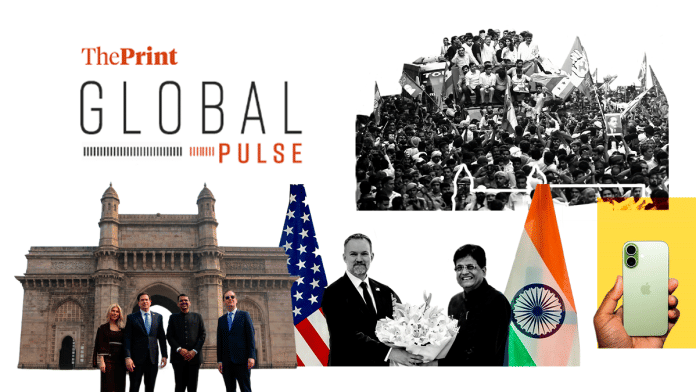
New Delhi: Today’s international media coverage looks at India through the lens of its ties with Washington, democratic tensions and its future in global supply chains.
Marco Rubio’s visit to India is as much about business as diplomacy. What Mujib Mashal for the New York Times describes as “commercial diplomacy”. In its report, “Rubio Travels to India to Strengthen Economic Ties Amid Strained US Relations”, the New York Times describes a visit aimed at strengthening commercial ties even as President Donald Trump’s tariffs, immigration policies and outreach to Pakistan have strained relations with New Delhi.
Rubio met his counterpart S. Jaishankar in Mumbai and was expected to meet executives from Indian companies with significant US operations, including two of Asia’s richest men, Gautam Adani and Mukesh Ambani.
Washington is also pushing India to reduce its reliance on Russian oil and source more energy from the US, as negotiations over a bilateral trade deal continue.
Adani, a “close ally” of Prime Minister Narendra Modi, was indicted in the US in 2024 on bribery and fraud charges, which were dismissed in August after he offered to invest billions of dollars on American soil, the NYT reports.
Trump in the past has also announced that Mukesh Ambani’s Reliance Industries will partner in building an oil refinery in Brownsville, Texas. Rubio is visiting Jamnagar, home to Reliance and the world’s largest oil refinery complex. He is also touring Vantara, the wildlife rescue centre built by the Ambani family. Asked whether he would encourage Reliance to resume production in Venezuela, Rubio said: “We’re going to go see what their holdup is and what opportunities exist.”
The visit comes as US-India ties are travelling a bumpy path over tariffs and India’s purchase of Russian oil. Rubio, “who is widely seen as a contender in the next US presidential election,” said New Delhi had made “substantial progress” in reducing those purchases. Yet Washington has itself shifted course, announcing a deal to purchase diesel from Russia. The report highlights the gap between diplomatic engagement and unresolved disagreements.
Ahead of Rubio’s trip, Trump appeared to offer India a concession. On Friday, he paused sanctions related to Russian oil sales, easing pressure on New Delhi as the war in Iran disrupted energy supplies and raised concerns over global oil markets. In “Rubio visits India seeking relief from global energy crunch”, The Wall Street Journal examines how the energy crisis has complicated an already strained relationship between Washington and New Delhi.
The sanctions pause was a “great relief” to Modi’s government, said Sadanand Dhume, a fellow at the Council on Foreign Relations. Had the sanctions gone ahead, Dhume said, it would have been a “body blow to the relationship” and seen as “humiliating the prime minister” by making him appear “more or less powerless”.
A trade deal between the two countries also remains unresolved. US ambassador Sergio Gor said last week that the “big items are done”. Despite the tensions, bilateral trade reached a record $240 billion in 2025, and the two countries maintain strong military ties.
But analysts cited by the WSJ say the visit has yet to address many of the underlying disagreements between Washington and New Delhi. As South Asia analyst Michael Kugelman put it, the earlier effort to signal Washington’s appreciation for India had not addressed New Delhi’s concerns over tariffs and US relations with Pakistan. “You can’t solve those policy differences,” he said, “with mere PR”.
That is how Yamini Aiyar opens her New York Times guest essay, “Indian Democracy Has Found New Life in the Streets”, arguing that youth-led protests over voter roll revisions have brought fresh energy to a political opposition struggling to challenge Narendra Modi in the election arena.
Aiyar, a public policy scholar and visiting professor at Brown University, describes how demonstrations led by the Cockroach Janta Party have drawn students, civil society activists and opposition politicians into a common movement.
More than 130 million names have been cut from voter rolls, according to the essay, while critics argue that the process places an unfair burden on citizens to prove their eligibility. Aiyar writes that even minor differences in the spelling of names across documents can leave voters off the rolls, with restoration requiring them to navigate a difficult appeals process. The government denies allegations that the exercise is intended to exclude minorities or groups less likely to support the BJP.
Aiyar describes the moment as “both sobering and thrilling”. After more than a decade of democratic backsliding under Prime Minister Narendra Modi, she writes, institutions across India have been so “hollowed out that public trust” in the electoral process and the Election Commission is crumbling, “while brutal state repression is all too common”. India’s democratic tradition, she argues, placed the responsibility on the state to enroll eligible citizens. The current revision reverses that principle by asking voters to prove they belong, she adds.
Her closing line captures the stakes: “But when the process itself is suspect, each victory means less.”
Apple’s growing business in India has revived a familiar question: Can the country become “the next China”? In an opinion piece, Global Times writer Hu Weijia argues that the comparison may be the wrong scale to measure India’s manufacturing ambitions.
The article quotes The Economic Times as saying that Apple’s India business surpassed Rs 1 trillion, or $10.5 billion, in fiscal 2026. Yet some international commentators remain sceptical that the expansion of iPhone production will transform India into a manufacturing powerhouse on China’s scale. Hu cites Bloomberg opinion columnist Andy Mukherjee’s argument that Apple’s iPhone factories will not make India the next China, but says the debate risks judging India against a manufacturing model built under very different global conditions.
“It is like a train gathering speed but still falling short of its destination,” Hu writes. “Perhaps the problem lies not with the train, but with the destination itself.”
The piece argues that India does not need to reproduce China’s industrial development to benefit from Apple’s expansion. Indian factories are moving beyond basic assembly into more complicated stages of production, while links with established international suppliers could help local manufacturers lower costs and build capacity.
Rather than trying to recreate China’s vast manufacturing ecosystem from scratch, Hu argues, India could benefit from integrating more deeply into global supply chains and drawing on existing industrial expertise.
The argument is also a reminder of Global Times’ own framing: India’s manufacturing success, it suggests, should be measured by the capabilities it develops and the role it secures in global production not simply by whether it can become another China.
(Edited by Viny Mishra)
Also read: Voting rights protests putting Modi govt on ‘defensive’ & Jio IPO as ‘test of investor appetite’