


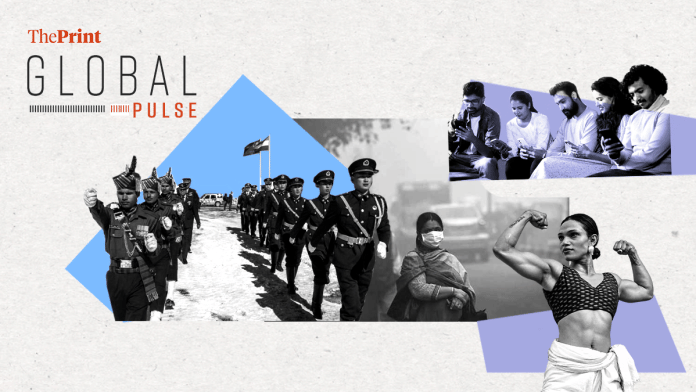
New Delhi: This week, the international media turns its attention to different facets of India.
It begins by exploring how cheap internet is shaping India’s global image, then looks at why Delhi continues to choke, before travelling south to capture how women bodybuilders in Kerala are pushing back against the trap of “log kya kahenge” (what will people say).
Meanwhile, an opinion piece in China’s state-run media outlet accuses political factions in India of exploiting the border issue by invoking the ‘China card’ in partisan disputes.
Politically motivated narratives, the commentary says, risk distorting public perceptions and narrowing the space for pragmatic engagement with China.
In ‘Ashoka’, his weekly India column for The Economist, Leo Mirani documents how India’s cheap internet revolution has transformed its global online presence, but not necessarily its reputation. Recalling the 2019 online feud between PewDiePie and T-Series, the magazine describes the Swedish YouTuber’s song “Bitch Lasagna” as “a two-word social history of the relationship between India and the internet”.
Since Jio’s 2016 launch, internet penetration in India has grown to 70 percent, the column points out. Jio’s streaming platform Hotstar now has more than 450 million monthly users, ahead of Netflix and Amazon Prime Video. But, the magazine notes, “neither Jio nor anyone else has managed to build a social space Indians prefer to Western ones”. Indians are now the largest user segment by nationality on YouTube, Instagram and Facebook, and a significant minority on X, Reddit and Snapchat. “Their influx onto these platforms has not been great for India’s image in the world,” says the column.
Citing a viral post on X, the magazine writes: “Never invade Russia in winter. Never attack India by Twitter.” It argues that while “crude men and noisy nationalists exist everywhere,” the sheer scale of India’s online population makes them more noticeable. “Because Indians use the same platforms and often post in English, the country’s flaws are more visible than those of other countries.”
The column also reports on how social-media algorithms turn outrage into a business. YouTube travel videos portraying India as “filthy and dysfunctional” attract millions of views, while Instagram has been flooded with AI-generated videos of unhygienic street-food vendors. “Ragebaiting Indians can be a sound commercial strategy,” it writes, pointing to the 300 million-plus views on “Bitch Lasagna”.
Yet, the magazine argues, these portrayals obscure “just how fun and indeed funny India’s internet can be”. It points to the global reach of memes, online humour and popular culture, including the Telugu song “Naatu Naatu”. Until more of that culture travels, however, “India’s reputation provides fodder for content”.
In “Honk if You Know Why Delhi’s Air Is So Bad”, Anupreeta Das reports for The New York Times on how Delhi’s air pollution is tied to its dependence on vehicles and the shortcomings of its public transport system. While the government has deregistered 6.6 million vehicles and introduced restrictions, the broadsheet argues that these measures only “address the problem partially”. The deeper issues, it says, include “inadequate public transit and poor transportation planning”.
The report points to a Metro rail network that “covers the city only partially” and around 6,000 public buses—half the number needed to meet demand. Electric vehicles make up just 5 percent of all vehicles in the capital, with “the lack of charging infrastructure and slow government action” holding back their adoption.
The consequences are visible on Delhi’s roads. Reporting from a central Delhi intersection, Das describes more than a mile of vehicles coming to a halt at every red light. By 9.10 am, hundreds of cars were waiting; half an hour later, a grey haze had begun to form. The report says the reporter’s chest and throat started burning within an hour of exposure.
It also explains why the pollution worsens in winter. A phenomenon known as “temperature inversion” keeps pollution trapped over the city “like a blanket”. By February, showers and stronger winds bring some relief, but, as NYT cautions, “that doesn’t fix Delhi’s pollution problem, only reduces the urgency of addressing it.”
Also Read: Global media writes on Modi’s two-pronged approach to protests & the flaw in RBI’s rupee rally
Photographer Keerthana Kunnath first came across Kerala bodybuilder Arathy Krishna on Instagram three years ago. Until then, she did not know of any woman from her home state who was into bodybuilding. A conversation with Krishna introduced her to a small community of women training across Kerala.
Kunnath tells Snigdha Poonam of the Financial Times she sensed these bodybuilders had “the power to shake up a conservative society’s views about women”.
“India has long been obsessed with the muscular body,” Poonam notes, pointing to the country’s mythology, pop culture, wrestling grounds and local gyms. “But women bodybuilders have rarely featured in the Indian imagination.” For women considering the sport, one question weighs above all: “What will people say?”
That scrutiny is often directed at their bodies. During shoots, men would become aggressive when asked to leave because their presence made the women uncomfortable. On one occasion, a man drove away on his scooter, only to return with a friend, both seemingly drunk.
The report also follows what it takes for these women to enter the sport. Some initially hid their training from their families, “as one might a lover”, turning their rooms into gyms and “appoint[ing] YouTube as their trainer”.
Bhumika Senthilkumar, who was not allowed to participate in school sports, secretly watched bodybuilders online before finding a coach in Kochi. Her parents had hoped she would follow her mother into medicine. “They would never have wanted that life for me,” she told Kunnath. Even after winning Miss India twice, she struggled for their acceptance. “She wanted them to feel proud of her. She kept going,” Kunnath says. It was her gold medal at the 2025 World Bodybuilding Championship, and the newspaper and television attention that followed, that finally changed her parents’ minds.
Sandra AS, too, could not convince her family to let her train. “They were worried about what people would say, how society would look at me,” she told Kunnath. So she ran away from home. Poonam notes that this follows “a well-established template for rebel girls in Kerala, one that often ends in a peaceful reunion”. Sandra returned after her first competition and continued training. Now 25, she is a professional weightlifting athlete and works as a gym trainer.
Others came to bodybuilding later in life. Kunnath found women in their mid-to-late thirties, including new mothers who initially took up lifting to lose weight but found confidence along the way. “For some, having well-defined muscles made them feel more feminine,” Poonam observes. They continued training until “their bodies resembled the photographs they had once saved on Instagram”.
Also Read: Ambanis pulling out all stops for ‘pop or flop’ Jio IPO & ‘unwanted Chinese presence’ in Arunachal
In an opinion piece in China’s state-run Global Times, Xie Chao, an associate professor at Fudan University’s Institute of International Studies, argues that India’s domestic political contestation and media coverage are threatening the recent thaw in relations with China.
The commentary begins with reports in some Indian media outlets alleging that the Chinese military had “changed its patrol patterns” and “undermined border stability”, accompanied by videos of confrontations that were allegedly “misleadingly captioned or taken out of context”. Xie links the renewed controversy to domestic political rivalries, writing that “certain political factions in India are exploiting the border issue by invoking the ‘China card’ in partisan disputes and accusing the ruling party of being insufficiently tough on Beijing”.
Despite China’s foreign ministry calling for both sides to implement existing understandings and maintain peace along the border, Xie says, “some Indian media outlets continued to sensationalise the issue and fuel public anxiety”. The commentary describes an anti-China stance as “an unquestionable form of political correctness in Indian party politics.” It contrasts this with earlier academic and policy discussions in India, where “more balanced and objective perspectives included proposals to resolve territorial disputes through negotiations”.
Such perspectives, Xie writes, are now “far less visible in mainstream Indian media”, “overshadowed by inflammatory and confrontational narratives”. The commentary also takes aim at claims that the two neighbours are locked in a fundamental conflict and that war is “inevitable”.
Xie further argues that the reliance of some Indian media outlets on Western coverage has contributed to distorted perceptions of China, with commentators substituting “political positioning for factual reporting and clicks for journalistic scrutiny”. The result, according to the piece, is a cycle in which domestic political narratives repeatedly threaten diplomatic progress. “Diplomatic progress can quickly be undermined when the border issue is sensationalised in India’s domestic political discourse and drawn into partisan competition,” the author writes.
The economic consequences of this, Xie argues, could be significant for India. “Ultimately, it is the Indian public that bears much of the cost.” Politically motivated narratives, the commentary says, risk distorting public perceptions and narrowing the space for pragmatic engagement with China.
The piece concludes by returning to the diplomatic progress made since the 2024 Kazan meeting and the September 2026 meeting between the leaders of both countries on the sidelines of the BRICS Summit in New Delhi. Xie calls on India to act on the understanding reached there: “For India, the time has come to reflect on and implement the consensus reached at the New Delhi meeting, exercise political wisdom to overcome domestic interference.”
(Edited by Amrtansh Arora)
Also Read: Global media profiles the Tata Group feud: Scion vs powerful chairman, and a ‘wild card’ govt