


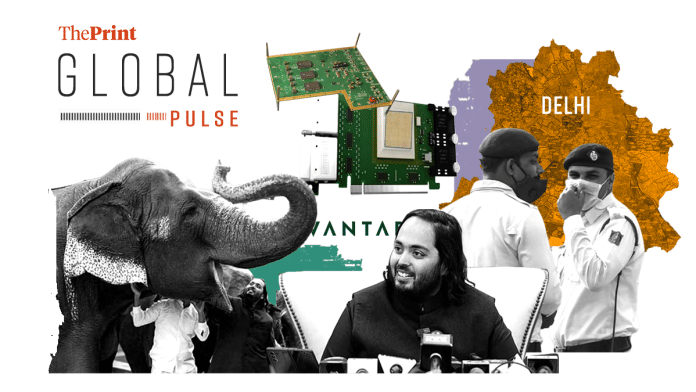
New Delhi: From India’s multi-billion semiconductor bet, to smog settling over Delhi amid Diwali season, India is making global headlines again.
A column in The Wall Street Journal asks a pertinent question: Can India establish a viable semiconductor industry?
The Guardian and Mongabay together investigate Vantara’s lobbying efforts in the UK ahead of a key inter-ministerial meeting on endangered wildlife.
And the BBC reports on Delhi’s worsening air quality.
In the biweekly column ‘East is East’ for The Wall Street Journal, Sadanand Dhume looks at India’s mega semiconductor wager after multiple failed attempts.
“If things go as planned, the country could emerge as a significant player in global supply chains,” he writes. This could generate high-quality jobs, reduce Western dependence on China and deepen US-India technology relations.
But Dhume cautions that “success is far from guaranteed”. If the effort falters, “it will likely be remembered as another example of a wasteful government program that squandered taxpayer money on a vanity project”.
The Modi government has earmarked about $23 billion over the past five years to develop a sustainable semiconductor ecosystem in India. Dhume cites a 2025 report by the Center for Strategic and International Studies, which described the effort as an attempt “to compress decades of ecosystem development into just a few years”. He notes that India’s strengths include a large pool of chip designers, links to Silicon Valley and a growing opportunity to attract manufacturers looking for alternatives to China.
Chris Miller, a Tufts University professor and author of Chip War, is quoted as saying that “the electronics industry has been looking for a home for a lot of manufacturing outside China”.
“India’s size and large domestic market give it an advantage over smaller Asian countries such as Malaysia, Thailand and the Philippines,” the piece reads.
However, India’s earlier attempts to establish a semiconductor industry have repeatedly failed. A 2023 book by Indian technology experts Pranay Kotasthane and Abhiram Manchi, When the Chips Are Down identifies India’s “poor environment for businesses” as the “common thread in these failures”. Uncertain tax and policy conditions, poor infrastructure and high trade barriers “made chip fabrication an unattractive proposition in India”.
Dhume points out that policymakers recognise India is “nowhere near the frontier of semiconductor technology”. The $11 billion Gujarat fabrication plant being built by Tata Electronics and Taiwan’s Powerchip Semiconductor Manufacturing Corp. will initially produce relatively simple legacy 90-nanometre chips. “This is far away from the high drama of the race for chip dominance between the US and China,” he writes.
Most other approved projects focus on assembly and testing. According to Miller, India’s cell phone assembly industry in Tamil Nadu offers a template: “You shouldn’t start with the hardest problem, which is advanced manufacturing.”
“For India, a lot rides on this bet.” Dhume argues that the semiconductor industry requires policy predictability, which has long been the opposite of India’s reputation for capriciousness. “If Messrs. Modi and Vaishnaw can change this reputation, they will do India a favor that goes far beyond semiconductors.”
For the US, India could help reduce dependence on China and diversify an industry concentrated in North America and East Asia. As Miller puts it: “For the US, India has been an important partner. But it could be a whole lot more.”
In a joint investigation by The Guardian and Mongabay, Patrick Greenfield, Elisângela Mendonça, Phoebe Weston and Spoorthy Raman dig into how Vantara, the mega-zoo run by Anant Ambani in Gujarat, attempted to lobby British officials and ministers ahead of a UK-chaired meeting on international trade in endangered species.
Documents obtained under the UK’s Freedom of Information Act “reveal Vantara’s efforts to lobby British officials and ministers before the meeting”.
Vantara, which spans 1,400 hectares, has “more than 150,000 animals have reportedly been amassed since 2022”, the report says. However, conservation groups have repeatedly questioned “how such a vast number of species, many of which are endangered, were gathered so quickly”.
Last year, India’s Supreme Court “cleared the zoo’s operators of any wrongdoing”. But a subsequent CITES fact-finding mission raised concerns about India’s compliance with international rules on animal imports. Its November 2025 report said: “There is a need for caution to ensure that imports of large numbers of animals by these facilities are not inadvertently creating a demand for illegally sourced animals.”
The investigation traces the lobbying efforts to a May meeting between UK Department for Environment, Food and Rural Affairs (Defra) officials, a Vantara representative and US lobbying firm Checkmate Government Relations, founded by Ches McDowell, a hunting friend of Donald Trump Jr. Before the meeting, internal briefing documents said Checkmate was “seeking to persuade the UK to take a more sympathetic view of India’s handling of imports to Vantara”. They also recorded the firm’s argument that “responsibility for verifying legality sits primarily with exporting or re-exporting parties rather than with India as importer”.
During the meeting, the Vantara representative invited UK officials to visit the zoo. However, the invitation was subsequently declined “to ensure the impartiality of the UK’s Cites chair role”.
The lobbying efforts continued after the meeting, with a representative of another firm, Atlas Strategy, approaching then environment secretary Emma Reynolds and nature minister Mary Creagh, and raising the prospect of a visit to Vantara. When a department official sought advice, an internal note recommended that ministers “did not engage formally with Vantara”.
A Defra spokesperson is quoted as saying: “The UK has strict rules in place to protect endangered species and ensure international wildlife trade is legal and sustainable, with every application assessed individually against internationally agreed and domestic requirements.”
For BBC, Abhishek Dey and Rachita Prasad report on Delhi’s worsening air pollution ahead of Diwali, with the city’s air quality index (AQI) crossing 300 and entering the ‘very poor’ category earlier this week. The report notes, “Delhi is once again battling worsening air pollution as the onset of winter brings a familiar deterioration in air quality to India’s capital.”
On Wednesday morning, the AQI stood at 377, in the ‘very poor’ category, raising health concerns for millions of residents.
Authorities have invoked Stage II of the Graded Response Action Plan (GRAP), introducing measures including more intensive road cleaning, higher parking charges and additional public transport services. The Delhi Metro has added 20 weekday train trips, while government offices have been directed to stagger their timings. Officials said “the measures were introduced after forecasts suggested air quality would remain very poor over the coming days”.
The sharp deterioration follows an unusually clean October, “when Delhi recorded its lowest average AQI for the month in eight years”. Experts quoted in the report attribute the sudden rise to “falling temperatures, slow winds and increased crop-residue burning in neighbouring Punjab and Haryana”. The report explains that “as the weather settled, northwesterly winds returned, carrying smoke from burning fields towards the capital”.
With Diwali approaching, concerns are mounting over firecracker emissions. The Supreme Court has allowed certified green firecrackers for limited hours on 7 and 8 November, but enforcement remains a challenge.
The BBC notes that “ensuring that only approved firecrackers are sold remains a major challenge”. The court also acknowledged that conventional firecrackers had continued to be sold as green alternatives even when a complete ban was in place.
The report further highlights the spread of the pollution problem beyond the capital. Mumbai’s AQI reached 322 on 24 October, in the ‘very poor’ category, although it improved to 89, classified as ‘satisfactory’, on Wednesday after nearly two weeks of smoggy conditions.
(Edited by Mannat Chugh)