


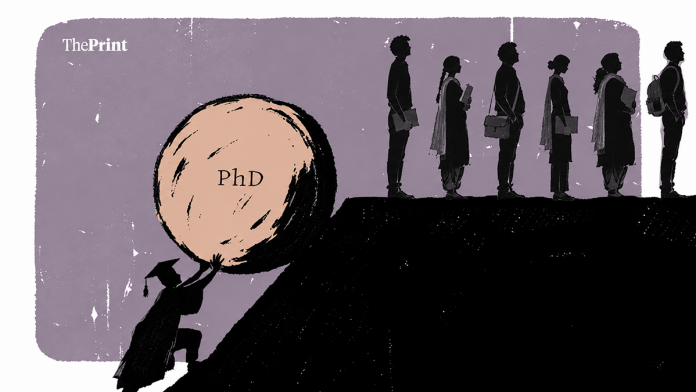
New Delhi: A 29-year-old spent more than five years pursuing a PhD in Chemistry, one of the more demanding doctoral disciplines in the natural sciences, before completing his degree from the Central University of Rajasthan in December last year. Years of painstaking research had finally earned him a doctorate. But instead of marking the beginning of a new professional chapter, the achievement has left him facing another, perhaps more daunting, challenge—finding a job outside academia.
He now finds himself caught in a paradox where he has been deemed overqualified for some positions but severely underqualified for others. Research and development (R&D) openings in his specialisation are limited, while companies seeking specialised technical skills often demand several years of industrial experience.
“After spending more than five years pursuing a PhD following my master’s degree, I am told I am overqualified for some positions, while other relevant vacancies require eight to 10 years of experience. I am struggling to understand how to navigate the industry job market. I do not want to pursue an academic career, but finding an industry role has proved equally difficult,” he said.
ThePrint reported on 24 September that PhD enrolments in India had nearly tripled over a decade, bringing into focus a growing concern—whether the country’s expanding pool of doctoral graduates has enough career opportunities to absorb them. We now examine why industry remains a difficult destination for this talent.
The challenge extends beyond individual experiences. Doctoral scholars across disciplines face a shortage of corporate research openings and a lack of dedicated recruitment pathways.
The gap is also reflected in employers’ hiring preferences. According to TeamLease EdTech, an Indian education and employability solutions company, just 2 per cent of employers surveyed in its Career Outlook Report HY2 2026 indicated an intention to hire freshers with doctoral degrees, compared with 80 per cent who planned to recruit freshers with bachelor’s degrees.
The findings suggest that mainstream entry-level recruitment remains heavily skewed towards undergraduate talent, leaving doctoral graduates with fewer opportunities to find roles that match their qualifications and research experience.
If PhD holders struggle to compete for jobs when approaching companies directly, even premier institutions where they conducted their research cannot guarantee placements suited to their expertise. At IIT Bombay, only 26 of the 135 PhD scholars who participated in placements in 2024–25 secured jobs, translating into a placement rate of 19.25 per cent. This was down from 27.35 percent in the previous year, when 32 of 117 participating doctoral scholars were placed, according to the institute’s annual reports.
Recognising this gap, some institutions have begun taking targeted steps to connect doctoral scholars with industry employers. IIT Delhi, for instance, conducted special placement drives for PhD scholars in 2024 and 2025, creating dedicated recruitment opportunities beyond conventional campus placements.
A former placement coordinator at IIT Delhi told ThePrint that such initiatives help make companies aware of the pool of PhD talent available for recruitment. “There is demand in R&D, but even when companies have openings for PhD graduates, the positions may offer lower salaries or involve industry roles that do not match the candidates’ research profiles,” the coordinator said.
Also Read: Faculty hired under reservation policies match peers in teaching despite fewer PhDs, says new study
Why industry is not hiring more PhD graduates
The limited hiring of PhD graduates in India is partly linked to low corporate investment in R&D, which restricts the number of jobs requiring advanced research skills.
Tejas Kusurkar, co-founder of Offgrid Energy Labs, a deep-tech battery startup incubated at IIT Kanpur, said too few Indian companies prioritise developing new technologies.
“The fundamental issue is that pushing the boundaries of technology through R&D and innovation is not yet a priority for enough Indian companies. When businesses do not invest in developing new technologies or solving complex problems, they naturally create fewer opportunities for PhD graduates, whose expertise is most valuable in research-intensive work,” Kusurkar told ThePrint.
Kusurkar, who holds a PhD in bioengineering from IIT Kanpur, co-founded the company with fellow IIT Kanpur doctoral graduate Brindan Tulachan. They are developing ZincGel, a zinc-based battery technology for long-duration energy storage.
India’s gross expenditure on R&D stood at 0.84 percent of GDP in 2023–24, compared with approximately 2.7 percent in China, 3.1 percent in Germany and 3.4 percent in the US in 2024, Kusurkar said.
Neelesh Gupta, Partner, Deloitte India, said corporate opportunities for PhD holders remained concentrated in select sectors like life sciences and advanced manufacturing. Although research-intensive work was increasingly becoming part of product development, advanced analytics, technology governance and clinical research, many companies were yet to create enough positions where research was central to the role.
“Academics—yes, corporate—needs significant development. Opportunities are concentrated in selected research institutions, life-sciences organisations and advanced manufacturing companies. Many employers have not yet defined enough roles in which research itself, rather than routine functional execution, is a core part of the job,” Gupta told ThePrint.
Recruitment practices present another hurdle. Gupta said PhD holders typically apply for lateral positions through recruitment portals or employee referrals rather than campus placements. They were assessed alongside other lateral applicants, including candidates with relevant industry experience.
“In frontier research like drug discovery, advanced engineering, quantitative modelling or highly specialised scientific work, doctoral depth can be a significant advantage. In roles requiring rapid execution, broad stakeholder management or established professional techniques, a master’s degree or graduate degree with relevant experience may be equally or better positioned,” he said.
Gap between doctoral training and industry requirements
Experts also pointed to a disconnect between doctoral training and industry requirements. While PhD programmes develop research and problem-solving capabilities, scholars often have limited exposure to commercial applications, prototyping, intellectual property and the challenges of translating research into marketable products.
This gap, scholars said, becomes particularly evident when they try to identify career paths beyond academia.
A PhD scholar at Delhi’s Dr B.R. Ambedkar University pursuing a doctorate in education, said the disconnect made it difficult for multidisciplinary researchers to identify suitable career opportunities. “Academic research and industry requirements are poles apart. Industry is result-oriented, whereas academic research is often open-ended. The big question is how to bridge this gap. I don’t think I will be able to find a good job after completing my PhD,” he told ThePrint.
The scholar’s experience reflects the findings of TeamLease EdTech’s survey. Doctoral graduates often end up competing for the same jobs as undergraduate and postgraduate degree-holders, with salaries of around Rs 20,000 to Rs 30,000 a month, the scholar said. “We cannot keep waiting for universities to create opportunities for us,” he added.
He also expressed uncertainty about career prospects in academia, particularly for multidisciplinary researchers, saying uncertainty over eligibility for assistant professor positions added to their employment concerns. “Even after pursuing a PhD, I am not sure whether I will be eligible for assistant professor positions, many of which require a master’s degree in a specific mainstream subject. Where do people like us, who come from multidisciplinary backgrounds, fit in? We don’t know where we will belong in the job market,” the scholar said.
While multidisciplinary scholars may struggle to identify suitable career paths, doctoral students at premier institutions have some access to industry-linked research projects. However, even these opportunities remain limited.
Nimish Joseph, who completed his PhD in management studies at IIT Delhi, worked on an analysis team for the Digital India Awards, where the head of his department was a jury member. He also contributed to a Ministry of Electronics and Information Technology (MeitY) project. Both engagements provided him with short-term funding.
However, only a fraction of doctoral scholars in his department secured such opportunities. “There were around 50–60 scholars in my department at the time, but only 10–15 got these opportunities. The rest depended on regular teaching assistantships, JRFs or other scholarship funding,” he said.
Joseph said access to such projects often depended on whether a supervisor had secured external funding. “Students sometimes join a PhD programme because a faculty member has a funded project, which is likely to be more industry-focused. But faculty members often prefer research associates or postdoctoral fellows for this kind of work,” he said.
However, some academics caution against making immediate industry employability the primary objective of doctoral education.
Suvrat Raju, a professor at the International Centre for Theoretical Sciences (ICTS) at Mumbai’s Tata Institute of Fundamental Research (TIFR), said the push to align doctoral education with immediate industry needs was misguided. He argued that the primary purpose of a PhD was to develop the ability to conduct original, curiosity-driven research and generate new knowledge.
“Such research may not be commercially oriented or immediately monetisable, but it is valuable to humanity. Many advances in fundamental research eventually play an important role in technology. Artificial intelligence and computing, for instance, have their roots in advances in fundamental physics and computer science,” he said.
Raju said universities should focus on developing independent thinkers and researchers rather than producing workers trained to meet specific industry requirements, which companies could address through short-term training programmes.
He also highlighted shortcomings in India’s education system, including rigid academic hierarchies, inadequate resources and a lack of encouragement for students to question authority, take initiative and develop a spirit of inquiry. These qualities, he said, were essential to generating new knowledge.
From AI to biotechnology: Where are the jobs for PhDs?
According to Deloitte’s campus workforce trends study, emerging roles for doctoral graduates include Real-World Evidence Scientist, Regenerative Medicine Researcher, R&D Innovation Strategist, Clinical AI Analyst, Medical Science Liaison and Precision Medicine Specialist. These positions draw on skills commonly developed during doctoral research, including experimental design, scientific evaluation, evidence synthesis and the interpretation of complex datasets.
“Highly specialist and niche roles are corporate favourites for PhDs and vice versa. Typically, this used to be the R&D department. However, research-intensive work is increasingly embedded in product development, advanced analytics, technology governance, clinical research, intellectual-property-led innovation, public policy and specialist consulting,” Gupta said.
Shantanu Rooj, CEO and founder of TeamLease EdTech, said opportunities for doctoral graduates were also emerging across fields such as artificial intelligence, semiconductors, biotechnology, pharmaceuticals, robotics, space, advanced materials, climate technology, deep-tech startups and corporate R&D.
What needs to change
Experts said improving the employability of PhD graduates required closer collaboration between companies and universities, with industry exposure and practical training becoming integral to doctoral programmes rather than something scholars encounter only after completing their degrees.
TeamLease EdTech’s Rooj said doctoral training needed to better prepare researchers to apply their knowledge beyond academia. “Employers should not view a PhD simply as a more advanced master’s degree. Its real value lies in the ability to frame unfamiliar problems, test hypotheses, work with complex evidence and generate new knowledge,” he told ThePrint.
Rooj said the biggest gap was often in translating research into practical applications, rather than in the ability to conduct research. Doctoral programmes, he added, needed greater exposure to prototyping, intellectual property, commercial constraints, multidisciplinary collaboration, industry-defined problems and technology transfer, without diluting the depth of academic research.
“Industry engagement needs to begin during the PhD rather than after thesis submission, through joint supervision, industry-sponsored research, researcher mobility, shared labs and projects built around real technology problems,” Rooj said.
Gupta, Partner, Deloitte India, suggested that companies sponsor doctoral research and offer clearer employment pathways upon completion. “Our country needs sponsored PhDs by corporates with predefined career pathways post completion for accelerated adoption,” he said.
Kusurkar echoed Rooj’s suggestions, saying companies should identify technological problems at the beginning of doctoral programmes and work with researchers throughout their studies. “Companies should work with universities to identify important technological problems at the beginning of a PhD, rather than engage with researchers only after their degrees are complete,” he told ThePrint.
He said this would allow companies to assess researchers’ capabilities during their doctoral studies and help them transition into industry roles, particularly in deep-tech sectors where developing commercially viable technologies could take years.
Rooj said India needed to establish industry research and innovation as a mainstream career destination for doctoral graduates.
“The broader opportunity is to make industry R&D and innovation roles normal career destinations for doctoral talent, not merely alternatives to academia.”
(Edited by Chingkheinganbi Mayengbam)
Also Read: Over half of India’s employed young graduates doing low-skill jobs, says EAC-PM paper