


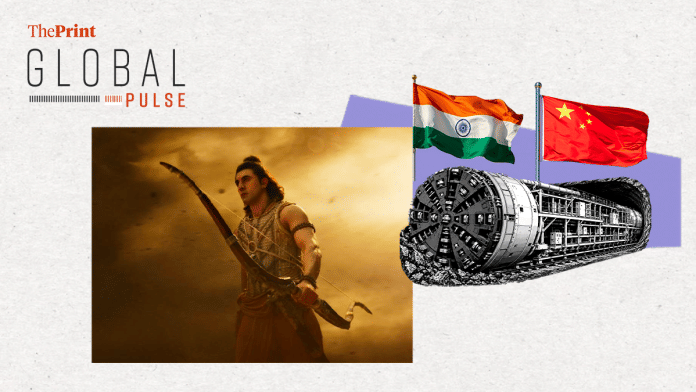
New Delhi: The epic tale of Ram and Sita is back in the spotlight in India’s most expensive film to date.
BBC delves into the enduring hold of the Ramayana as Namit Malhotra and Nitesh Tiwari bring it back to the big screen..
The film may have received mixed reviews, but has turned heads within India and outside nonetheless.
Meanwhile, China’s Global Times comments on the growing debate over Beijing’s export controls on tunnel boring machines, and the India link.
In a report for the BBC, Zoya Mateen looks at the release of Part 1 of Ramayana: Rise of a Legend, and the expectations surrounding its attempt to take one of Hinduism’s foundational epics to a global audience. Directed by Nitesh Tiwari, the film has critics divided over whether its VFX-laden visual spectacle does justice to the story.
But the film’s significance goes beyond its critical reception. In India, the film—starring Ranbir Kapoor, Sai Pallavi and Yash—has invited comparisons with earlier adaptations, especially Ramanand Sagar’s Ramayan, which “captivated the country nearly four decades ago with simple sets and special effects that now seem quaint”.
When the television series first aired in 1987, it became a national phenomenon. “Streets emptied, shops lowered their shutters and neighbours crowded around TV sets. Some viewers bathed, lit incense and garlanded their screens before the broadcast, preparing for the show much as they might for worship,” Mateen writes.
Arvind Rajagopal, a media scholar at New York University, told the BBC in 2019 that “trains and buses would stop and passengers disembark to watch the show on roadside TVs”.
The report also recalls the 1992 Indian-Japanese animated film Ramayana: The Legend of Prince Rama, which brought the epic to life through richly detailed, hand-drawn animation. The film was an Indian-Japanese collaboration, combining an Indian epic with Japanese animation techniques and storytelling traditions.
“Tiwari’s Ramayana arrives with technological resources its predecessors could barely have imagined—but also with the expectations of generations who have grown up with the story and its characters,” Mateen adds.
The expectations are not just cultural, but also political. “It also comes at a politically charged moment in India, where Ram has become a powerful symbol of Hindu identity—over the past decade and a half, even popular analyses or retellings of the epic have landed in controversy.” The 2023 film Adipurush—another big-budget retelling of the Ramayana, starring Prabhas, Kriti Sanon and Saif Ali Khan—had sparked backlash over its portrayal of religious figures, dialogue and visual effects.
Meanwhile, writing in The Guardian, Peter Bradshaw calls the newly released Ramayana a “thoroughly engaging, rousing and spectacular Indian epic melodrama”. He found echoes of Shakespeare in the royal intrigue that sends Ram into exile, and of Homer in his quest to rescue Sita, Mateen notes.
But Siddhant Adlakha of IGN was not so impressed. He scored the film four out of 10. For him, the action sequences were “clunky” and the computer-generated imagery (CGI) an “eye-sore”.
The use of AI to adjust lip movements of actors for the English version has also been criticised. For Tiwari, the idea was to make the film more accessible to international viewers, BBC report adds, but Adlakha describes it as “exaggerated mouth movements superimposed on still images for comedy sketches”.
The report also captures the weight of the roles for the actors. Ranbir Kapoor, who plays Ram, told the BBC that he was “filled with fear”, playing Lord Ram on the big screen.
How the film is received will become clearer as audiences head to cinemas. “But whatever the verdict, it marks a major cultural moment for India, bringing a story loved for generations to the big screen on an unprecedented scale,” Mateen writes.
In an editorial titled ‘A single TBM should not become a source of friction between China and India’, the Global Times responds to the debate over China’s export controls on tunnel boring machines, arguing that the issue should not become another source of tension between New Delhi and Beijing.
India’s Commerce Minister Piyush Goyal recently said that if China did not supply TBMs, India would develop them domestically, insisting that “India is not one to bow down”. The remarks received coverage in Indian and Western media, with several portraying the issue as “India refusing to yield to China’s ‘chokehold’”.
China announced the export controls on 19 October, with measures due to take effect on 18 November.
The editorial clarifies that the announcement “does not name any country”, and that the controls “are not directed at any specific party”. It stresses that “the measures centre on licensing rather than an outright export ban”. Applications for compliant exports to legitimate civilian projects, it says, will be approved provided the end users and end uses are clearly identified and meet the relevant requirements.
Global Times acknowledges, “India may have some misunderstandings or even complaints about these measures, and that is understandable”. It points out that “the country is in the midst of an intensive infrastructure-building drive”, and that, whether for metro networks, high-speed rail projects, highways or water conservancy tunnels, “India has considerable demand for large-scale excavation equipment such as TBMs”.
However, it argues that “there is little need to politicise a routine export-control matter”, let alone turn it into a question of whether India will “never bow down”, or defend its “national dignity”. Dismissing speculation that China is deliberately seeking to “restrict India’s use of TBMs in border areas”, the editorial says such claims “say more about the insecurity of those making them than about China’s intentions”.
It warns that “a confrontational mindset will only narrow the space for pragmatic consultations, ultimately jeopardising India’s own infrastructure projects and development progress”.
At the same time, it says India’s pursuit of “self-reliance” and efforts to build domestic TBM manufacturing capabilities are legitimate aspirations, while China has “an equally legitimate right to safeguard its national security and fulfill its international obligations”. Global Times adds: “China has never viewed India’s development as a threat to itself.” It also insists that “China is not that ‘petty’”.
Taking aim at Western coverage, the Global Times says certain US media outlets have shown particular “enthusiasm” for the issue. It mentions Bloomberg‘s description of the export controls as “a trade war risk to India”, while accusing The New York Times of portraying China’s industrial strengths as a “source of economic leverage” and claiming that “Beijing was building up its arsenal of economic weapons”.
The editorial further argues that such coverage seeks to “drive a wedge between China and India”, urging the two countries to address the issue through technical channels, rather than allow it to undermine broader bilateral relations.
(Edited by Mannat Chugh)