


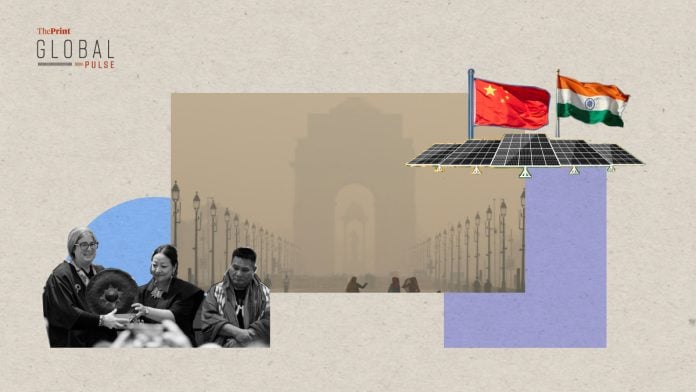
New Delhi: The skies of India’s national capital remain buried under a blanket of toxic smog, while Beijing and New Delhi look at the possibility of energy cooperation amid geopolitical troubles.
Meanwhile, 39 Naga ancestral remains begin their journey home from Oxford museum, decades after being taken during colonial rule.
Additionally, Chinese state-owned media reports on the debate in India over a Pakistani astronaut’s planned flight aboard China’s Shenzhou-24 spacecraft.
This week, the global media looks at why India-China energy cooperation matters, the Naga remains’ journey home, and Delhi’s worrying air quality.
Also Read: A life ‘mirroring history of modern India’—global media spotlights Sonia Gandhi’s memoir
In the Financial Times, Michael Stott reports on Delhi’s worsening air pollution, and the growing frustration over the authorities’ failure to tackle it.
He writes that just days ahead of Diwali, as a mix of vehicle exhaust, industrial emissions, construction dust, smoke from stubble burning and firecrackers engulfed India’s national capital, “the head of the Supreme Court sounded almost despairing”.
“No restriction is going to work, the more orders we pass, the more violations will multiply,” Chief Justice of India Surya Kant is quoted as saying last week. The crisis, Stott notes, “makes New Delhi the world’s most polluted capital city”, prompting the question: “Why a nation that can land a spacecraft on the Moon cannot provide safe air for its capital’s residents to breathe.”
At a suo motu hearing in the Supreme Court, CJI Kant described the government’s measures as “old, tried and failed”. “I won’t say there is complete failure of these measures. But the AQI is already touching 400,” he said.
Diwali night brought even worse AQI readings for most parts of Delhi.
Before being appointed the CJI, Kant had, as an apex court judge in 2023, called for “immediate emergency measures” to address the poor air quality issue.
However, this year, the “average AQI reading across the city on Diwali was the worst in five years”, Stott reports.
Only 14 of Delhi’s 59 monitoring stations provided complete data. “Many missing readings occurred when concentrations approached the monitoring instruments’ upper measurement limit,” Manoj Kumar, an analyst at an NGO called the Centre for Research on Energy and Clean Air, wrote on X, as quoted by FT.
Business consultant Suhel Seth criticises the gap between India’s ambitions and its infrastructure. “On the one hand, [Prime Minister] Narendra Modi goes out of his way to talk about Brand India and on the other hand, Brand India’s infrastructure is in the gutters,” he said, calling for authorities to “imprison some of the officials”.
“Unless there is demonstrable punishment . . . we will forget. Once December and January are over, we will go back to our normal lives,” he tells FT.
Stott also examines the health costs. Pulmonologist Ashok Kumar Raina says pollution has “gone from bad to worse”. After Diwali, he adds, “you will see everybody feeling irritation, eyes burning, emergency [hospital] visits will increase, people will get admitted [to intensive care] with severe exacerbation of chronic obstructive pulmonary disease, asthma”.
An unnamed international expert identifies the central problem: “The big issue is enforcement. We have good policies on paper, there are funds, but enforcement is a key issue.”
The city’s dependence on private vehicles compounds the crisis. Anumita Roychowdhury, executive director at Delhi-based think-tank Centre for Science and Environment, says, “Whatever we have gained from the technology improvement is getting negated by the sheer volume of traffic on the road.”
She calls for an ambitious shift: “We really now need a very ambitious plan to upscale an integrated public transport system, walking, cycling infrastructure.” Yet the Metro remains overcrowded and inaccessible in many districts.
Raina describes the stigma bluntly: “Nobody wants to go by metro. Metro is lower class.”
For 70-year-old Lodhi Garden regular Abhijeet Chatterjee, people are left to protect themselves. “People are trying to save themselves individually by masking or not coming out to walk at all, or by putting air purifiers in their rooms,” he tells FT. “But the collective effort to save the environment from pollution is not happening.”
Also Read: Surge in demand for PCBs putting squeeze on India’s electronics firms, says global media
Reporting for the BBC, Anbarasan Ethirajan and Nikita Yadav write about the University of Oxford returning 39 ancestral remains, mostly skulls, taken from the Naga community during British colonial rule. A delegation of around 30 people from Nagaland travelled to the Pitt Rivers Museum on 9 November for the handover. The remains will be brought back to India, and given what Naga tribal leaders have described as a “respectful rest”.
Museum director Laura Van Broekhoven calls the handover “a historic moment that will be part of stories told to next generations”. She says the remains are finally on their way home after overcoming “so much red tape everywhere”. They had been displayed at the Oxford museum for decades, before being removed from public view in 2020 as part of what the museum described as a “decolonisation process”.
The Pitt Rivers Museum holds more than 6,000 objects associated with Naga culture, “believed to be the largest such collection in the world”. Its website acknowledges that objects collected during the colonial period were “frequently confiscated during punitive military expeditions, rather than freely given”. Overall, the museum lists 219 items as human remains.
The return follows a visit by a Naga delegation to Oxford in 2025, when it “formally requested their return”, the report says. Thejao Vihienuo, one of the tribal leaders who visited the museum, questioned the circumstances in which the remains had been taken. “The manner in which these human remains were taken away from our land leaves much for us to speculate,” he is quoted as saying. “I suspect that nobody would have given the skull of his father or his grandfather as a gift to another person.”
The latest handover concerns only 39 ancestral remains. During their visit, the delegation also met descendants of one of the anthropologists involved in collecting them.
Also Read: The colour now compulsory in Delhi during diwali & Mundhe’s fight against ‘chalta hai’ culture
In Global Times, Deng Xiaoci reports on the debate in India over a Pakistani astronaut’s planned flight aboard China’s Shenzhou-24 spacecraft, which would be the first foreign astronaut mission to the China Space Station. The development has also brought renewed attention to an Indian scientific project selected for experiments aboard the station in 2019, but held up by political and administrative hurdles.
Jayant Murthy, principal investigator of the Spectroscopic Investigations of Nebular Gas (SING) project, tells the Chinese mouthpiece that “international cooperation in space exploration is not merely desirable but necessary”. His project was among nine selected under a joint initiative between the China Manned Space Agency and the UN Office for Outer Space Affairs, involving 23 institutions from 17 countries. But its implementation ran into difficulties over export approvals from Indian authorities.
“My experience with the SING mission is that, unfortunately, politics gets in the way of the collaboration,” Murthy is quoted as saying. He adds that much of the hesitation was “not even government policy”, but “an abundance of caution by people who don’t want to make a wrong decision”.
“Murthy also expressed appreciation for China’s willingness to open its space station to international researchers,” the article reads.
“Chinese generosity in opening the CSS to collaboration is something that we should all take advantage of in building strong scientific and cultural links between our nations and I hope that more groups come forward,” Murthy is quoted as saying.
Global Times places these remarks alongside Indian media coverage of Pakistan’s upcoming mission. The Times of India discussed the implications for regional space partnerships, while The Week quoted space analyst Girish Linganna as saying: “For India, which is building its own human spaceflight capability, it is a reminder that the region’s space race is now about international relations, not just space technology.”
Qian Feng, director of Research Department at Tsinghua University’s National Strategy Institute, says Pakistan’s planned participation prompted Indian media to “reassess the country’s own space cooperation strategy”, noting that India has “long regarded itself as a leading space power in South Asia”. He adds the political hurdles facing scientific collaboration “not only disrupt scientific research and deprive scientists of valuable experimental opportunities”, but also “undermine mutual trust in international scientific cooperation”.
“Space cooperation should not be overshadowed by narrow political considerations,” Qian further tells Global Times.
Also in Global Times, Xiao Jianmei—associate professor and coordinator at China Center for South Asian Studies, Sichuan University—argues that the conflict involving the US, Israel and Iran, along with incidents near the Strait of Hormuz, has “heightened shipping risks and added uncertainty to the global energy outlook”.
Against this backdrop, Xiao points to recent meetings between Indian ambassador Vikram Doraiswami and PetroChina International chairman Wu Junli in Beijing, and between Petroleum Minister Hardeep Singh Puri and China National Petroleum Corporation chairman Dai Houliang in New Delhi. These meetings, she writes, offered an opportunity to “better understand each other’s concerns”, underlining the value of “diplomatic engagement and practical cooperation amid growing uncertainty”.
China and India are among the world’s largest crude oil importers, and for both, “stable and affordable energy supplies are essential to economic stability and sustained growth”. Xiao cites The Indian Express report that China’s reduced crude oil imports during the Strait of Hormuz crisis were “blunting the oil shock for India and other Asian refiners”. She also highlights that Washington has “repeatedly pressured” India over its purchases of Russian oil. The shifting measures, including additional duties and exemptions, have “added uncertainty in India’s energy planning”. Cooperation with China, she argues, could “broaden their supply sources and market options”.
The article revisits the Sixth China-India Strategic Economic Dialogue in 2019, where the two sides identified renewable energy collaborations. However, the Energy Working Group has not reconvened since 2019. Xiao further cites the International Energy Agency’s observation that China has been instrumental in “bringing down costs worldwide for solar PV”. She sees an opportunity in combining “China’s supply-chain and technological strengths” with India’s expanding market for clean-energy applications.
She proposes cooperation in solar and wind power. Conventional energy, too, needs attention, with regular consultations among government departments, oil companies, refiners and shipping firms on “supply risks, transport and insurance constraints, refining needs, and emergency preparedness”.
Beyond bilateral ties, she calls for a standing dialogue among Asia’s major energy importers to ensure “fair access to global markets”. The author concludes: “Energy cooperation offers a practical entry point for broadening engagement between China and India.”
(Edited by Mannat Chugh)