


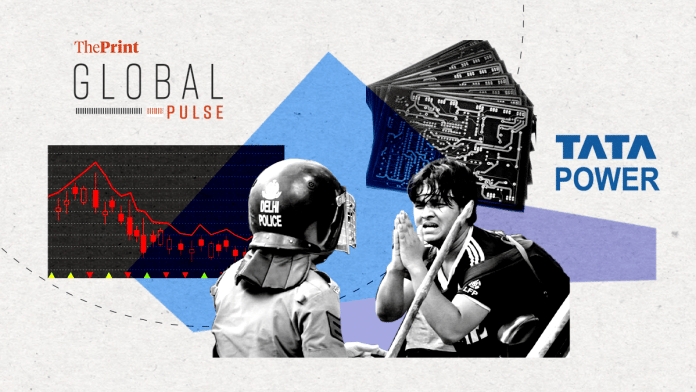
New Delhi: From Gen Z-led protests across the country and high demand for printed circuit boards (PCBs) putting the squeeze on India’s electronic manufacturers to Tata Power’s mounting legal troubles in Singapore and red candlesticks dampening Dalal Street’s Diwali trading, international media looked at India’s political, corporate and financial landscape from different angles this week.
Nikkei Asia reports on India’s electronics manufacturers facing high costs and supply constraints for printed circuit boards (PCBs) amid the massive surge in demand for AI-related hardware.
Meanwhile, The Guardian spotlights India’s viral Cockroach Janta Party (CJP) movement against the backdrop of Gen-Z protests, in a report titled: ‘A global political awakening’: how gen Z protests are sweeping the world.
And Financial Times turns to Tata Power’s $650 million legal dispute in Singapore and the uncertain outlook for Indian stocks after a fizzling Diwali trading session.
Also Read: The colour now compulsory in Delhi during diwali & Mundhe’s fight against ‘chalta hai’ culture
In a report for Nikkei Asia, Ananta Agarwal explains how India’s electronics firms are facing “PCB squeeze” as AI demand drives up costs. Rajneesh Garg, president of the Indian Printed Circuit Board Association, calls PCBs the “invisible backbone of electronics”. But, he says, “Every raw material has been diverted to that sector.”
The report notes that “India’s vulnerability is particularly acute”, even as electronics becomes “one of the country’s fastest expanding industries”.
“The shortages started somewhere in the early part of this year,” says Jasbir Singh Gujral, managing director of Syrma SGS. His company is setting up a major PCB plant, but he warns: “The real challenge will be when the whole plant goes into serious production … I hope by that point of time it (the supply chain situation) will have eased out.”
The cost of “every key raw material” has also surged “in the last nine to 10 months with no exceptions,” says Rajoo Goel of the Electronic Industries Association of India.
Industry requests for lower import duties and help securing supplies have seen “little progress”, Garg says. The pressure is showing up in consumer prices too. “In the festive season, when we expect discount structures and hyper sales and special days for bulk sales, Apple has not lowered its prices of mobile phones,” Garg adds.
In a report for The Guardian, Ashifa Kassam and Lex McMenamin look at 25 documented Gen Z-led protests around the world, driven by failed political systems. “Gen Z is rising,” says Erica Chenoweth, a political scientist at Harvard Kennedy School, adding that a significant proportion of young people are “tired of sitting on the sidelines while their political systems fail them”.
The report notes that “From Bangladesh to Belgium and Italy to India, it seems Gen Z, who account for about a third of the world’s population, have found their voice.” Chenoweth describes this as a possible “global political awakening”.
The Guardian also quotes analysts Cait Dallaire and Sebastian Dittgen who highlight protesters’ infrastructure of mobilisation. “…TikTok and X amplify and accelerate grievances; Discord servers and group chats enable decentralised planning; virtual private networks and mirrored content help organisers circumvent internet shutdowns.”
The report then turns to India, where it says a “similar note of disillusionment threads through India’s Cockroach movement,” which “swelled into a show of force against the strongman government of Narendra Modi” and forced the resignation of the education minister. On the state response, the report notes: “Authorities went to extreme lengths in October to keep them (protesters) from gathering in central Delhi,” with roads barricaded and internet and public transport shut.
Placing these protests in a wider context, the report quotes analysts Dallaire and Dittgen who say that “The reasons are different, but they (protests across the world) share the same spark: the breakdown of the social contract.” Chenoweth suggests the wave could signal a “profound generational transformation in world affairs” capable of countering the trend of “democratic backsliding”.
In Financial Times’ twice-a-week newsletter India Business Briefing, Veena Venugopal writes on Tata Power’s ongoing legal conflict in Singapore and the Indian stock market fizzling out during Diwali.
Tata Power could face a bill of more than $650 million following a legal dispute with investment firm Kleros Capital Partners, which has secured enforcement orders in Singapore. A court in Singapore has allowed seizure and sale of shares held by Tata Power in two of its subsidiaries registered there.
The dispute goes back to a 2013 agreement between the two companies to explore a coal deposit in Russia. The partnership fell apart over the proposed project, with FT noting: “Trouble started soon after, with the entities unable to decide on who would lead the bid and on the proposed $1.1bn (billion) project’s ownership structure.”
Kleros accused Tata Power of using confidential information shared under the agreement. An arbitration tribunal awarded the firm $490 million in damages in 2025. With interest and legal costs, its claim has now crossed $650 million. Tata Power has appealed, but Kleros maintains that “the awards remain final, binding and immediately enforceable”.
The dispute leaves investors looking at the possible impact on Tata Power’s finances. As FT writes, “Questions for investors are how the company might deal with the mounting liability and what implications the enforcement proceedings have for its balance sheet.”
While Diwali diyas lit homes across India, Dalal Street was lit up with red candlesticks as Muhurat trading ended in the negative. The broadsheet says it was “the first inauspicious start in nine years and is bound to have worried superstitious traders, since the usual custom is to buy at least one share and sell none.” However, the session came after a “seven-session winning streak”, during which “India’s markets signalled more optimism than they had for a couple of years.”
The FT points to renewed trust from international investors as India begins to attract attention amid a shift away from the AI share boom.
It writes that some tax-related concerns “are increasingly cited as a major reason foreign investors have given Indian markets a wide berth”. There are also signs of improving domestic demand, with GST collections, car sales and digital payments showing growth. “On Monday, HSBC analysts announced they were now overweight on India. There is a sense that things are turning.”
But the recovery remains fragile. “The underperformance of Indian markets has been a dampener for sentiment among retail investors,” the newsletter notes, while pointing to uncertainty over crude prices, the rupee and interest rates. It ends on a cautiously hopeful note: “Still, sentiment counts for a lot, and last week seemed to suggest that cautious hope is returning to the markets.”
(Edited by Amrtansh Arora)