


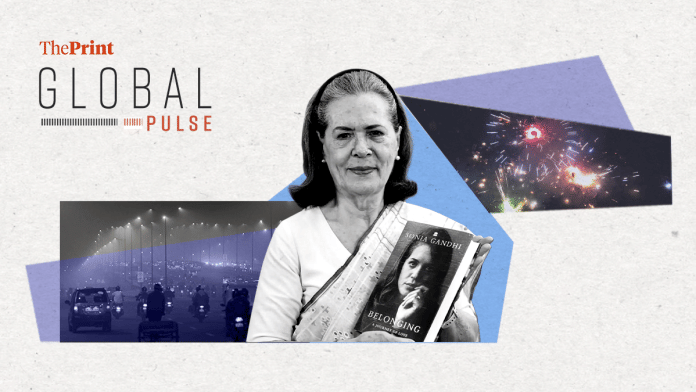
New Delhi: Sonia Gandhi’s autobiographical memoir, Belonging: A Journey of Love, has brought fresh attention to the private losses and political battles of one of India’s most influential political families.
Against this backdrop, The New York Times and The Guardian revisit the former Congress president’s life and political legacy.
Meanwhile, Global Times dissects the smog situation in New Delhi in the aftermath of Diwali.
Also Read: Surge in demand for PCBs putting squeeze on India’s electronics firms, says global media
In The New York Times, Elisabeth Bumiller writes about the memoir as well as her interview with Sonia Gandhi at her home office, once used by her late husband, Rajiv Gandhi. Recalling May 2004, when Congress leaders urged her to become prime minister after the United Progressive Alliance (UPA) won the general election, Sonia says: “It took place in this very room.” Rajiv’s tricolour Congress party shawl still hangs over his desk chair, “where it has been since his assassination in 1991,” when he was campaigning to become prime minister for a second time.
Sonia initially agreed to take the post, horrifying her children, Rahul and Priyanka, before changing her mind. “My brother and I actually thought that she would get killed, too,” Priyanka tells Bumiller, sitting beside her mother during the interview. Nearly three decades into politics, Sonia remains deeply concerned about her children’s safety. “It does worry me,” she says, referring to Rahul’s involvement in protests against the Modi government. Reflecting on her own years after Rajiv’s assassination, she adds: “Maybe subconsciously, I really didn’t care if it happened.”
Bumiller describes Sonia as the “shy young woman who was in the back seat of the car with her bloodied, dying mother-in-law as she was taken to the hospital, and whose life of love, hate, joy and tragedy mirrors the convulsive history of modern India.” Her memoir brings that personal history into focus. It took 12 years to write, and, as Rahul explains, his mother is “quite a private person”. But he and Priyanka felt “there were things that she had gone through that were important for people to know”.
The book spends nearly 400 pages before arriving at her political career. Sonia writes about meeting Rajiv in Cambridge, remembering that “he was very good looking”. When she met Indira Gandhi, however, she was so nervous that she burst into tears. “I was terrified,” she recalls. She also writes about the Emergency, saying of Indira’s decision to impose it: “It was something that should not have been done.”
The memoir’s most harrowing passages recount Indira’s assassination. Sonia describes finding her mother-in-law after she had been shot: “Her large eyes are wide open; her face wears a surprised expression. She doesn’t move. I attempt to speak to her, to call out, ‘Mummy, Mummy,’ but no word comes out.” When Rajiv arrived at the hospital and told her he would be sworn in as prime minister, Sonia burst out: “They will kill you too!” He replied: “They will kill me anyway.”
After Rajiv’s assassination in 1991, Sonia withdrew from public life. “I sort of went into myself,” she says, adding, “I think I had some sort of depression.” Priyanka remembers it differently, but no less painfully: “She was a ghost.” Sonia also writes of waking from nightmares, “drenched in perspiration, my heart in my throat, frightened and lost”. Rajiv had asked her to accompany him on the trip during which he was killed. She had declined because she was tired—a decision that haunted her.
Six and a half years later, she returned to public life, and delivered her maiden political speech at an open-air rally. She presented herself as essentially Indian: “I became part of India 30 years back, when I became Indira Gandhi’s eldest son’s bride.” She then went on a 34-day tour to pull the Congress party up. The crowds at her campaign appearances were so large that India Today, the “country’s largest newsmagazine”, described them as “unparalleled in electoral history.”
Her 1997 campaign drew enormous crowds; women, Bumiller notes, “cry unabashedly when she talks of her lonely existence”, while others gawked at the “‘white woman’ speaking Hindi”.
The BJP’s opposition to a foreign-born prime minister also shaped her decision in 2004 to nominate Manmohan Singh instead. Sonia believed the party “would have used this ‘foreigner prime minister’ to further divide the country”. She now accuses the BJP of having “destroyed” India’s secular democracy, a charge the party has dismissed as political propaganda by a foreigner. Its leader Tarun Chugh responded: “You cannot understand India with Italian glasses.”
And yet, when asked whether she would do it all over again, Sonia does not hesitate to reply: “Absolutely.”
Also Read: The colour now compulsory in Delhi during diwali & Mundhe’s fight against ‘chalta hai’ culture
In The Guardian, Niha Masih too writes about Sonia’s memoir, tracing a journey that began in a small Italian town and led to the centre of Indian politics. “Few love stories have been as closely entwined with a nation’s history as that of Sonia and Rajiv Gandhi,” Masih writes. But the memoir is also an account of personal loss, political isolation and six decades of a country’s changing political culture.
One of its sharpest observations concerns Sonia Gandhi’s equation with Narendra Modi. She writes that she has had “practically no real contact” with him in his 12 years as prime minister. When they share a space, he “tends to look away, avoiding eye contact”. Masih contrasts this with an earlier political culture in which leaders across party lines “would treat one another with cordiality”. Gandhi recalls calling Atal Bihari Vajpayee after the 2001 Parliament attack to ask about his safety. She believes that this civility has given way to attempts by those in power to “belittle and torment” political opponents.
Masih also writes about the loneliness of women in politics: “India has an illustrious history of women occupying top leadership positions, long before many other democracies. But their rise has often come at a cost.” Recalling a conversation with Hillary Clinton, Sonia says Indira Gandhi, despite her authority, felt “besieged and profoundly alone”, particularly in the months before the Emergency.
The memoir also recalls a time when journalists could question prime ministers directly. Modi, Masih notes, has not held a solo press conference in 12 years. His media interactions have largely been one-on-one interviews with “sympathetic, pro-government news anchors” or the much-publicised exchange with a Hindi film actor who asked him how he liked to “eat mangoes”.
The book’s publication has raised another question: the space for free expression in India. Gandhi says Penguin Random House India was “uneasy in general with the criticism of the government” and withdrew after she declined suggested edits. Penguin has disputed her account, saying it “does not accurately reflect the circumstances”. HarperCollins eventually published the memoir in India.
In its ‘GT Voice’ column, Global Times opens with the line: “The Diwali fireworks have faded, but the smog over New Delhi has lingered.” On Sunday, India’s capital recorded a 24-hour average AQI of 376, “its worst Diwali-day reading since 2021”.
By Tuesday morning, the reading remained above 300, in the “very poor” category.
The column argues that fireworks are only part of the problem. “To blame the air crisis on fireworks alone would be missing the larger picture.” Vehicle emissions, factory pollution, crop burning, construction dust and stagnant weather are among the recurring contributors. “Diwali is just a flashpoint in a much longer-running problem,” it says.
It then turns to the contrast between India’s renewable energy expansion and its continued dependence on coal. “The deeper question is why severe air pollution remains such a persistent challenge for a country making strides in renewable energy.”
India’s solar capacity rose but coal still accounted for 71 percent of its electricity generation. The column argues that “energy storage and stronger grids” are essential to making renewable energy a viable alternative to coal. Drawing on China’s experience, where PM2.5 levels fell 57 percent between 2013 and 2022 even as GDP grew 69 percent, highlighting the importance of stricter enforcement and industrial restructuring.
The column also warns that import restrictions could make clean-energy equipment scarcer and more expensive. “India should not turn its back on advanced clean technology and clean gears,” it argues, making a case for cooperation with China in batteries, electric vehicles and power storage. “The opportunities are concrete,” the column notes, pointing to electric two- and three-wheelers assembled in India, solar and storage systems for factories, and irrigation and crop-residue equipment for rural communities.
“Joint ventures, component sourcing and technology partnerships could create new business opportunities for Indian businesses.” Such cooperation, the column adds, could strengthen Indian companies’ manufacturing capabilities and pursuit of “greater industrial self-reliance.”
For a country trying to balance industrial growth with its pollution crisis, the argument is that access to cleaner technology could serve both ambitions. As the column puts it, “The real test is whether cleaner technologies can deliver meaningful improvements in factories, on city streets and in people’s daily lives.”
(Edited by Amrtansh Arora)
More Blah Blah Blah
This had to happen. Global media has to be brought in. Otherwise how will the illiterate, impoverished and snake-charmer Indians learn? MERA BHARAT MAHAAN!
So disgusting! Indian media stinks!