



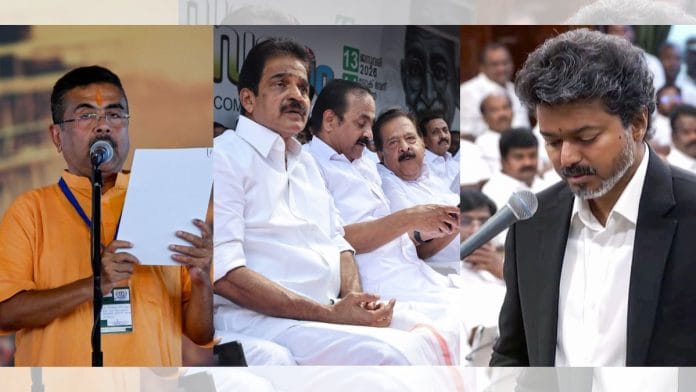

Three states. Three election verdicts. Three shocks.
In West Bengal, the electorate concluded Mamata Banerjee’s fifteen-year tenure, delivering a decisive victory to the Bharatiya Janata Party, a result that political analysts had largely deemed unlikely until the final stages of the election. In Tamil Nadu, Vijay, a film star with no prior political experience, led the Tamilaga Vettri Kazhagam, a party established less than five years ago, to a sweeping victory, thereby displacing the Dravida Munnetra Kazhagam and disrupting the Dravidian political dominance that has persisted for six decades. In Kerala, the Congress-led United Democratic Front decisively defeated the Left Democratic Front, delivering a potentially irreversible symbolic setback to Indian communism: For the first time in independent India, no state is governed by a Left party.
Collectively, these electoral outcomes represent one of the most dramatic weeks in recent Indian political history. Analysts are likely to spend months examining these results, such as anti-incumbency sentiment, identity consolidation, the allure of celebrity, and the waning influence of ideological politics. However, there exists another set of questions that often remain overshadowed by immediate electoral discourse, questions that the newly elected governments must address once the celebratory fervour subsides. These questions, not dictated by electoral mandates but rather by budget documents, pertain to fiscal sustainability, structural economic transformation, and the viability of the distinct developmental models pursued by these states. The data, it appears, offers insights that the electorate, understandably, may not have fully perceived.
An economy is not an election
The chart below reveals insights that the election results alone cannot convey. Tamil Nadu’s real per capita income has nearly doubled since 2011-12, reaching approximately 210 on an index where all three states commence at 100. In contrast, Kerala has experienced growth at a more moderate rate, broadly aligning with the national average. West Bengal has exhibited the slowest growth, with its catch-up growth being the least dynamic among the three states.
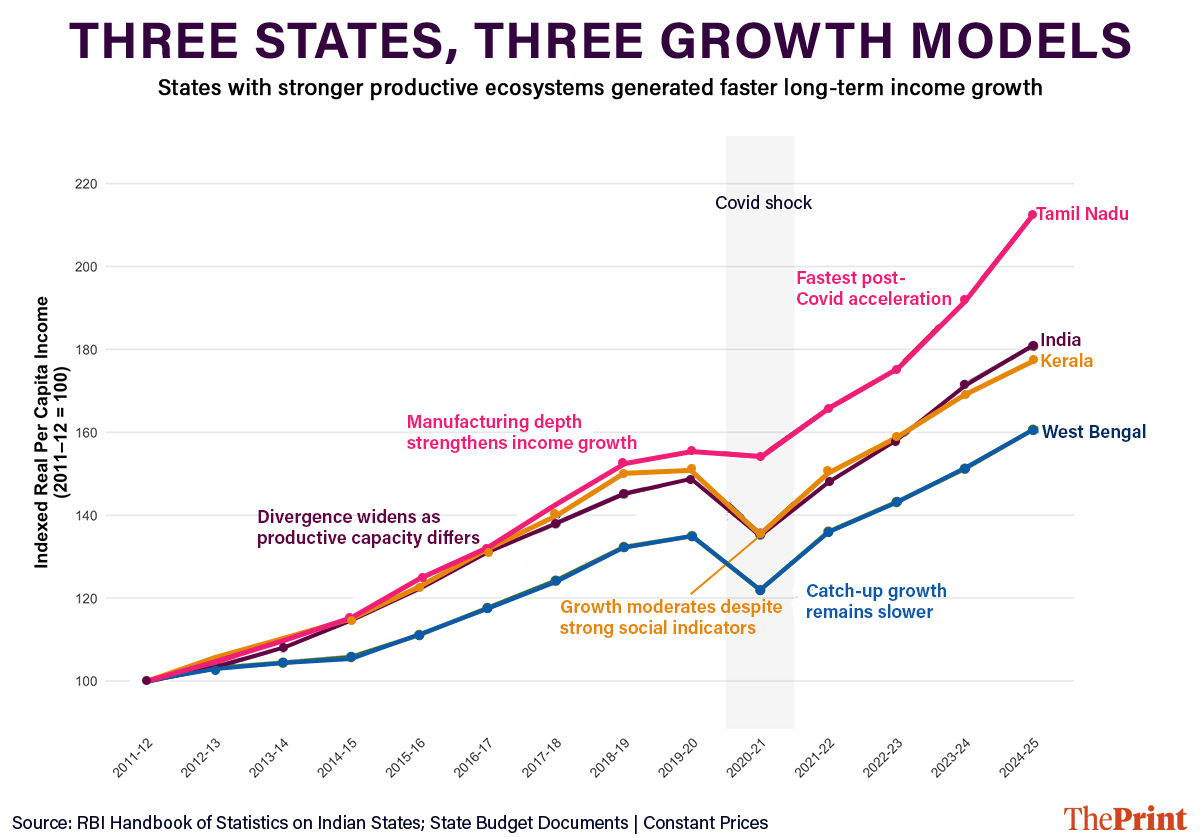
These figures are not abstract; they represent the cumulative outcomes of decisions made over a decade. These decisions pertain to the type of economy each state aspired to develop, the allocation of government expenditures, and crucially, whether such expenditures would create the productive capacity to sustain themselves over time.
All three states share a common fiscal characteristic: they engage in substantial borrowing, have progressively increased their borrowing, and carry significant debt. Thus, the comparison among them is not one of fiscal prudence versus fiscal irresponsibility. Rather, it is a comparison of what the borrowing has been for.
Also read: Full-page WB BJP oath-taking ad in CPM mouthpiece Ganashakti, editor says ideology remains unchanged
The quality of debt
This chart serves as the analytical core of the discussion, and it is worth careful examination.
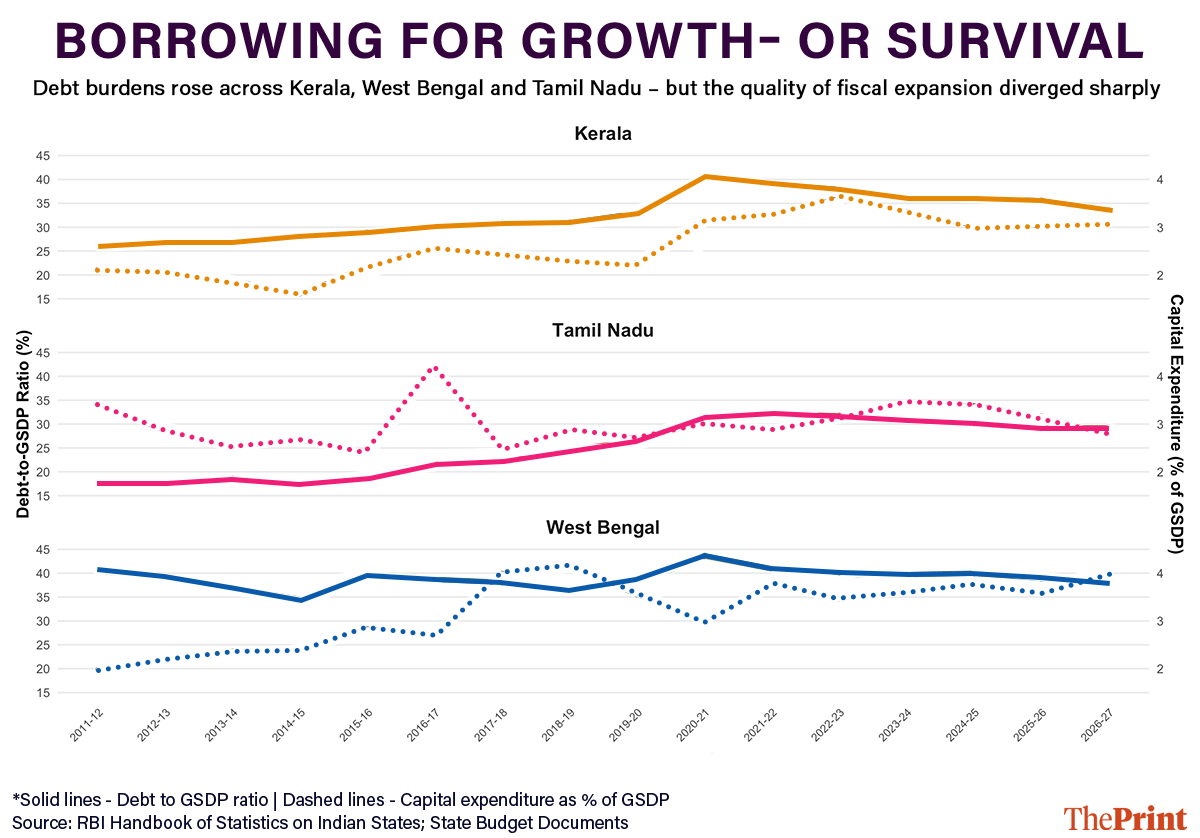
The dashed lines depict capital expenditure as a proportion of Gross State Domestic Product (GSDP), specifically the segment of public spending allocated to infrastructure, such as roads, ports, industrial corridors, power infrastructure, and urban systems and the solid lines represent each state’s debt-to-GSDP ratio.
Tamil Nadu’s debt ratio has increased but has stabilised around 29-30 per cent. Notably, its capital expenditure has also increased, with the two metrics exhibiting a broadly parallel trajectory. This indicates that the state is simultaneously increasing its borrowing and infrastructure development. In contrast, West Bengal begins the period with an already substantially high debt burden, exceeding 40 per cent of GSDP, and has progressively expanded its capital expenditure, although from a lower baseline. Kerala presents a more concerning scenario: its debt has escalated to nearly 37-38 per cent of GSDP, while capital expenditure, although present, has not increased proportionately with the fiscal expansion.
In the context of development economics, this analysis is straightforward. Tamil Nadu has engaged significantly in productive borrowing, wherein debt finances assets capable of generating future economic returns. Conversely, Kerala’s borrowing has been predominantly directed toward committed expenditures, such as salaries, pensions, welfare transfers, and increasingly, interest payments on the debt itself. West Bengal occupies an intermediate position, with rising capital spending that has yet to generate the private investment response necessary to amplify its impact.
Also read: TVK’s post-poll strategy under scrutiny as inexperience, poor communication cloud Vijay’s politics
When the debt starts eating itself
The chart below should be of paramount concern to the incoming administrations in all three states, as it delineates interest payments as a proportion of revenue receipts, arguably the single most indicative measure of fiscal stress.
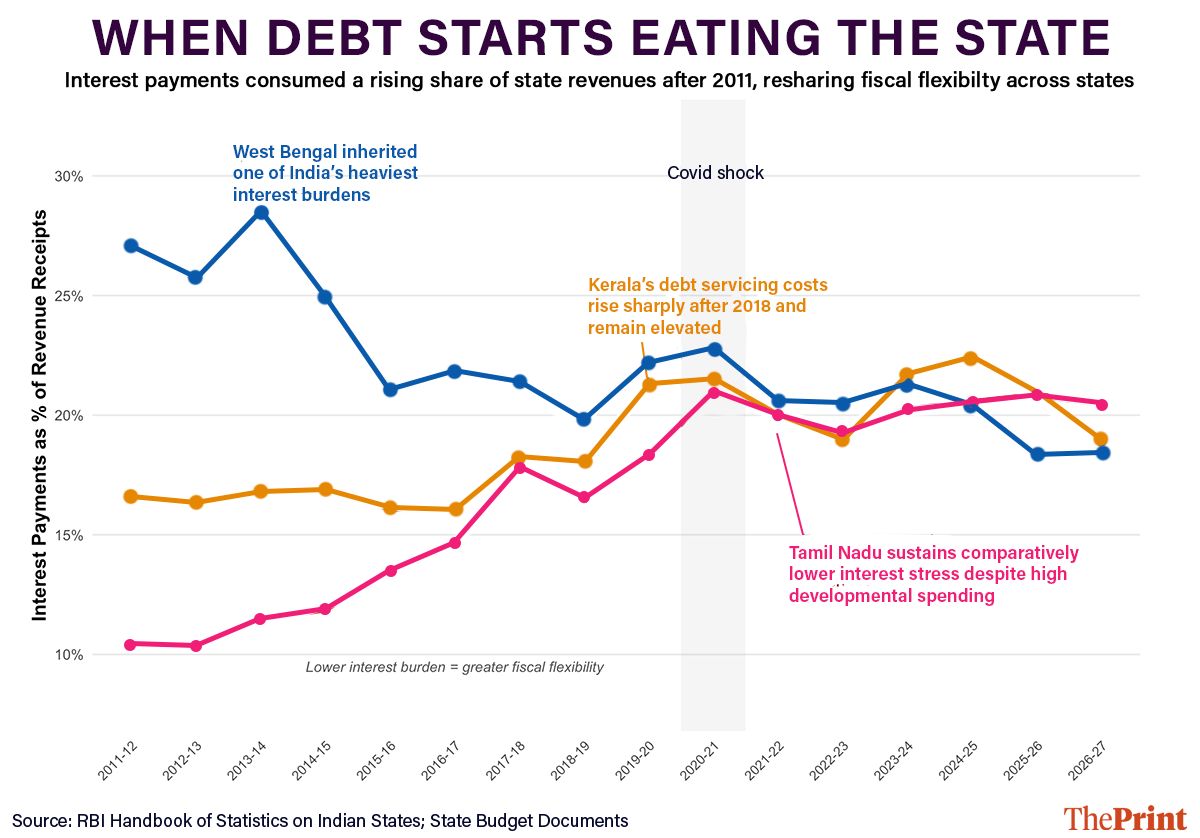
West Bengal entered this period with one of the most substantial interest burdens in India, with nearly 28-29 per cent of its revenue receipts allocated solely to servicing past liabilities. Over the past decade, this figure has declined, positioning West Bengal at levels comparable to Tamil Nadu and Kerala, a noteworthy accomplishment, although achieved at the expense of restricted developmental expenditure.
Conversely, Kerala’s trajectory has run in the opposite direction; interest payments have escalated significantly since 2018 and remain elevated above 22 per cent, indicating that an increasing share of the state’s earnings is pre-allocated before any hospitals are staffed, roads constructed, or teachers remunerated. In contrast, Tamil Nadu has managed to maintain a relatively contained interest burden despite its large developmental ambitions, reflecting the fact that its borrowing has yielded returns that partially mitigate the costs of its accumulation.
The new governments in all three states will promptly encounter this reality. Fiscal flexibility is not solely determined by the extent of a state’s borrowing; it is contingent upon the proportion of revenue available for discretionary decision-making after fulfilling prior commitments.
Also read: Delay in naming Kerala CM causes unease within UDF; ally IUML says ball now in Congress’s court
Three structures, three vulnerabilities
The structural data highlights the reasons for the divergence in fiscal patterns.
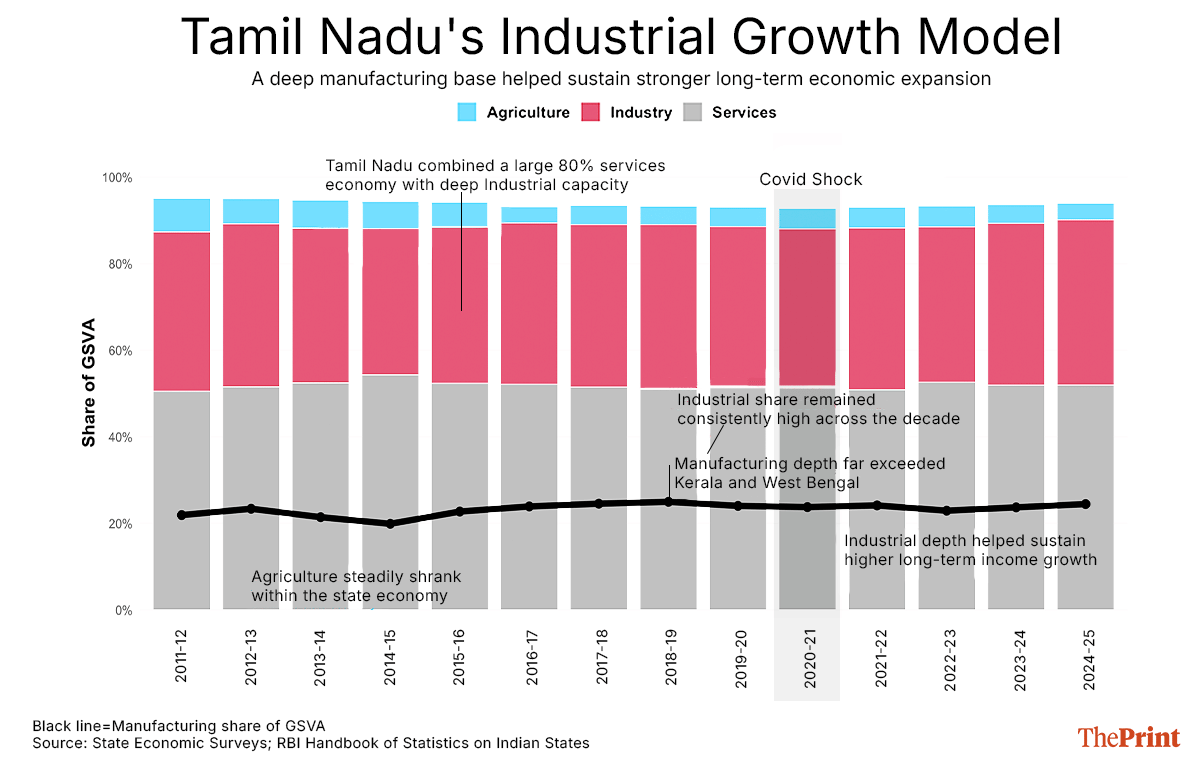
Tamil Nadu integrates a substantial services economy with a robust manufacturing base, maintaining a manufacturing share of Gross State Value Added (GSVA) consistently between 22 and 25 per cent over the past decade. This matters a great deal because manufacturing fosters stronger backward and forward linkages than most service sectors, ensures more stable tax buoyancy, and lays the groundwork for export competitiveness and the attraction of private investment. Vijay’s administration inherits an economy with genuine productive depth, notwithstanding its fiscal complexities.
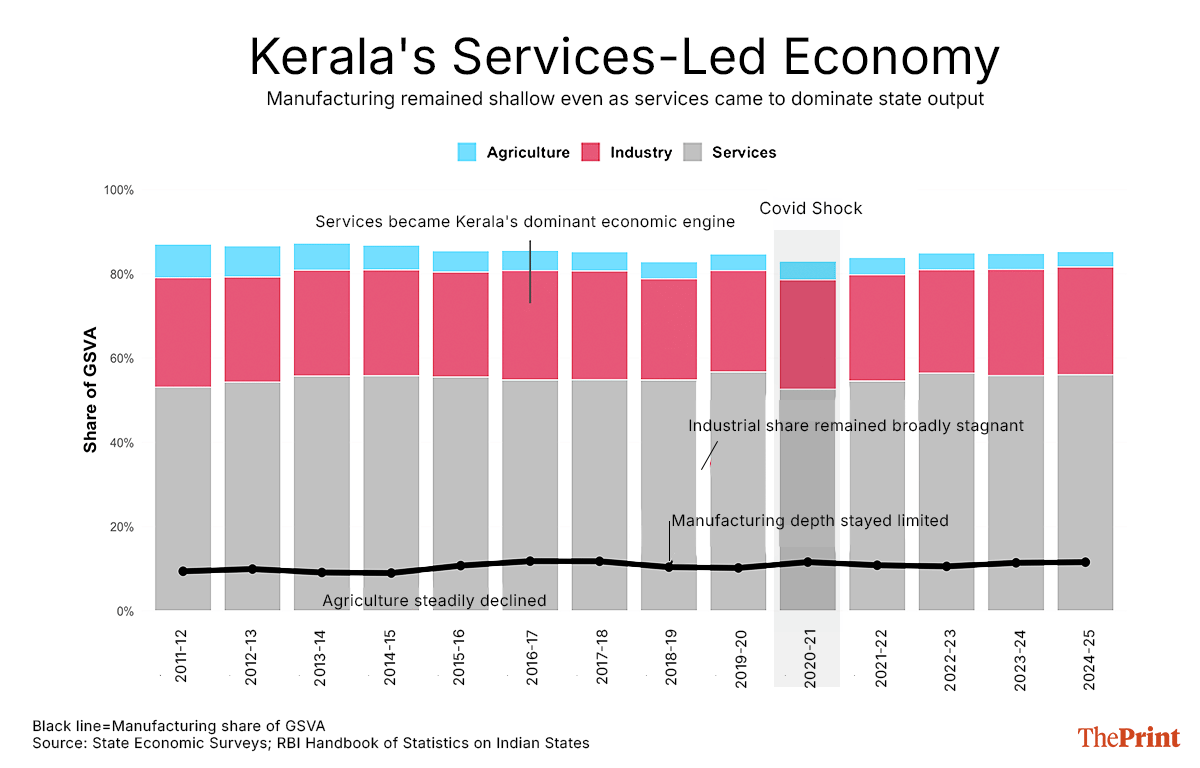
In contrast, Kerala’s economy presents a different narrative. Services dominate, accounting for over 55 per cent of GSVA, while manufacturing has persistently remained around 10-12 per cent throughout the period. The state’s growth has been driven by remittance-fuelled consumption and public expenditure rather than industrial expansion. The Congress-led government inheriting Kerala faces a challenge more complex than a mere political issue: A productive structure whose welfare commitments have exceeded its revenue-generating capacity.
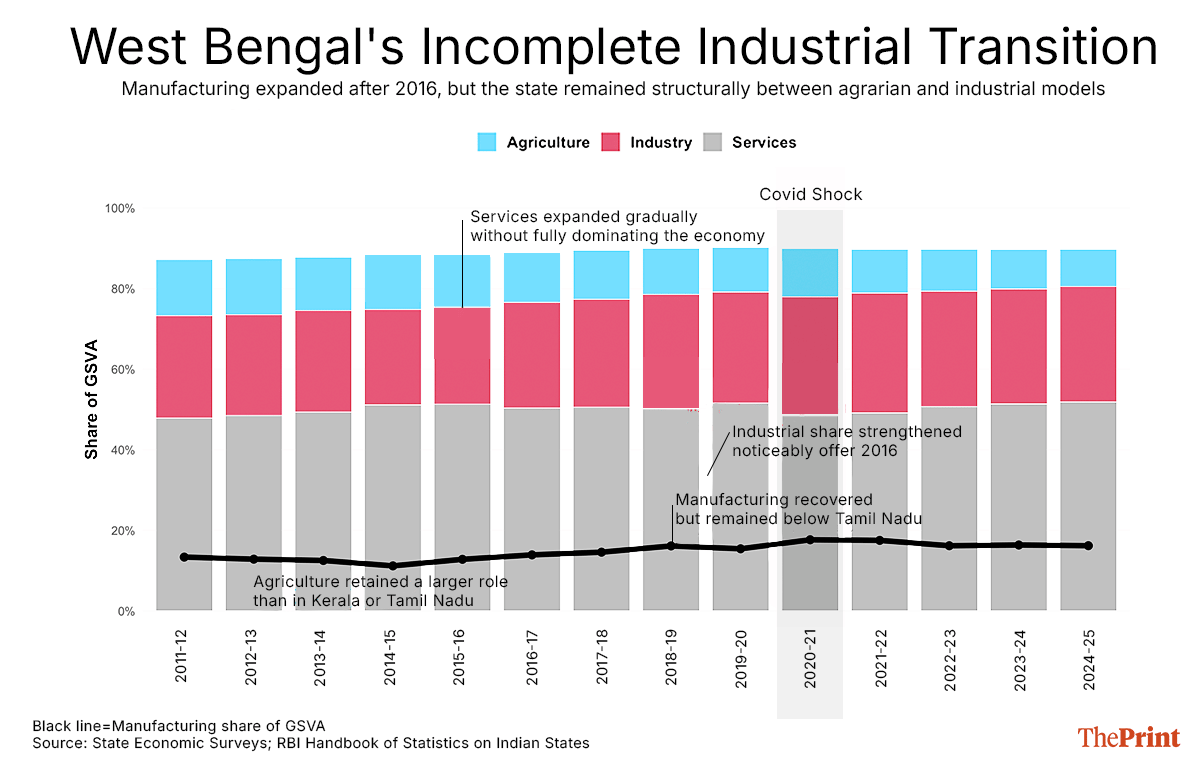
West Bengal sits between the two. Its manufacturing share has gradually increased since 2016, reaching approximately 17-18 per cent, yet it remains below that of Tamil Nadu and has not fostered the private investment ecosystems necessary for public spending to attract complementary capital. The BJP, which has prioritised economic governance and industrial investment in its national agenda, will encounter a rigorous test of whether political change can effectively reverse the path-dependent consequences of decades of industrial decline.
The subsidy trap
The final chart presents a complexity that challenges the straightforward narrative of Tamil Nadu as a model of fiscal prudence. Since 2021-22, Tamil Nadu has significantly increased its subsidy commitments, nearing Rs 60,000 crore, surpassing both Kerala and West Bengal. This trend reflects the political economy of competitive welfare prevalent in much of Indian state politics, where each election cycle introduces new entitlement commitments, thereby exacerbating the structural fiscal pressures that future governments must address.
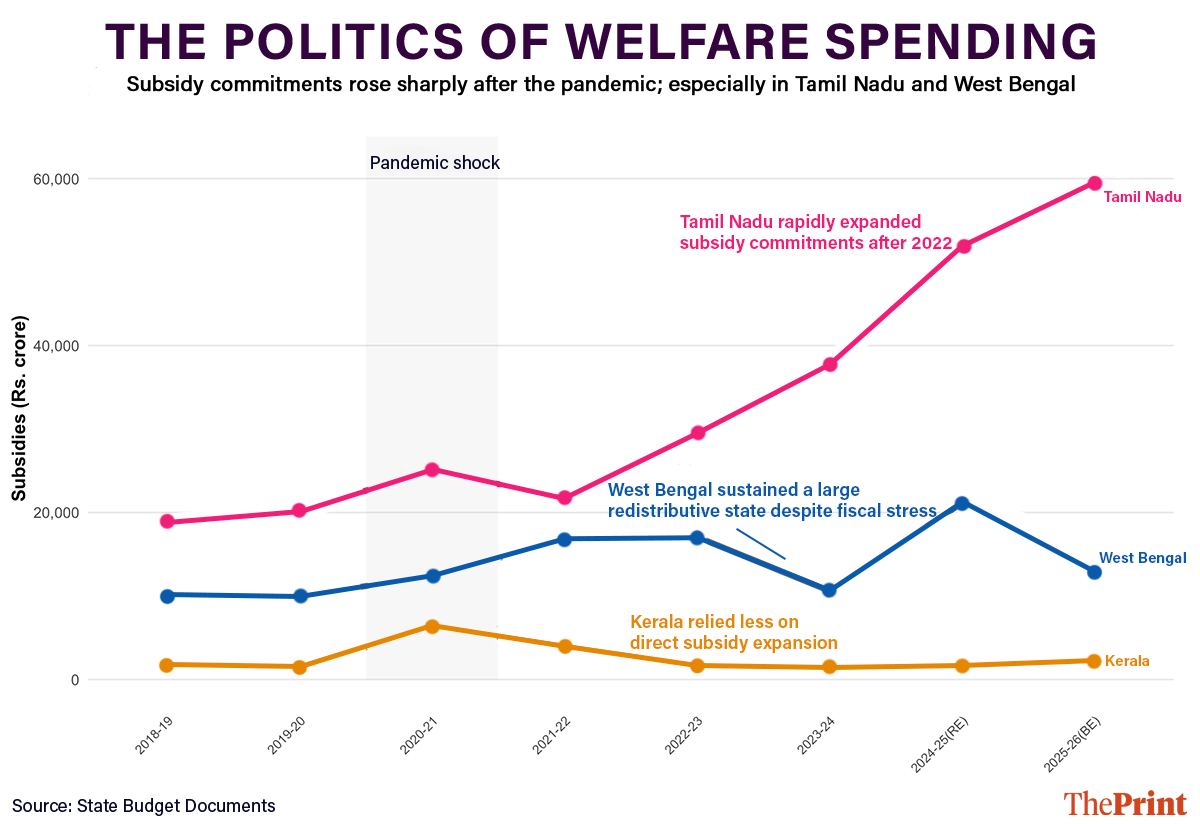
Vijay’s TVK campaigned on a notably populist platform, making it unrealistic to anticipate a reversal in the subsidy trajectory. The critical issue, one that Tamil Nadu’s robust industrial base gives it greater capacity to manage compared to Kerala or West Bengal, is whether productive capital expenditure can continue to expand alongside welfare commitments, or if escalating subsidy pressures will eventually crowd out the infrastructure investment that has been central to Tamil Nadu’s economic success.
Kerala and West Bengal confront the same challenge but with considerably less fiscal flexibility.
The morning after
The morning following an election, a state’s obligations regarding interest payments remain unchanged. Its structural economic composition remains constant, as does its debt-to-GSDP trajectory. Within days, the newly appointed Chief Ministers will convene with their Finance Secretaries, and these discussions will have nothing to do with electoral vote shares.
The fundamental insight derived from fifteen years of data is straightforward: Debt is not inherently unsustainable. What matters is the purpose for which it is utilised. Borrowing to enhance productive capacity results in eventual economic returns. On the other hand, borrowing to support consumption effectively mortgages the future.
Vijay inherits Tamil Nadu’s strong industrial base, providing the greatest fiscal flexibility among the three states, although his subsidy commitments warrant early examination. Kerala’s Congress government confronts the most structurally challenging legacy, necessitating the industrial deepening that successive governments have postponed for a generation. West Bengal’s BJP faces the most rigorous test of all, determining whether political change can indeed reverse fifty years of industrial decline.
The voters have spoken. Now the economists are watching.
(Edited by Theres Sudeep)