





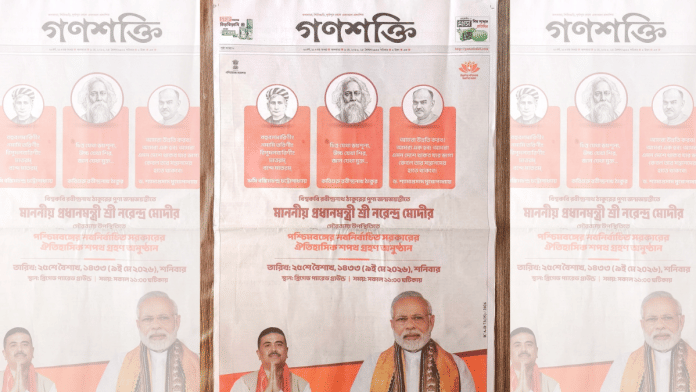


New Delhi: On Saturday morning, readers of Bengali daily Ganashakti, a CPI(M) mouthpiece, woke up to a surprise.
On the eve of the oath-taking of the first-ever Bharatiya Janata Party (BJP) government in West Bengal, the paper came out with a full, front page advertisement, heralding the historic occasion in the presence of Prime Minister Narendra Modi.
Accompanying the Bengali text were large pictures of Modi and chief minister-elect Suvendu Adhikari. The upper half of the page featured portraits and quotations of three Bengali luminaries: Rabindranath Tagore, whose birthday was whose birthday was celebrated in Bengal on 9 May (the day of the swearing- in), Vande Mataram composer Bankim Chandra Chatterjee, and Shyama Prasad Mukherjee, founder of the Bharatiya Jana Sangh, the BJP’s predecessor.
This would have raised no eyebrows in an ordinary daily paper, except that Ganashakti is an organ of the Communist Party of India (Marxist), which denounced the BJP and Modi as an “autocratic, undemocratic force” in a statement less than a week ago.
It’s not that Ganashakti had not run ads from the BJP-led Centre earlier. In March 2024, the paper’s front page carried a large picture of PM Modi alongside railway infrastructure, to advertise Metro Rail projects across the country. It ran on the day Modi was in Calcutta to address a BJP rally and inaugurate new sections of the city’s Metro.
Still, the symbolism of a BJP oath-taking advertisement appearing on the front page of one of the party’s fiercest critics has not gone unnoticed.
Not lost either is the significance of the Bengali figures chosen to mark the occasion. Bankim Chandra Chatterjee left a mixed legacy among Indian communists: Some praised his egalitarian views, while others, such as early Communist leader Muzzafar Ahmed, found his novel Anandmath ‘full of communal hatred’. Shyama Prasad Mukherjee’s reception is much less ambiguous; the CPM reviles him as a Hindu nationalist and communal agitator.
For CPI(M) leaders and Ganashakti editors, however, accepting the advertisement does not imply a shift in their ideological stance. Sujan Chakraborty, CPI(M)’s Central Committee member, described the BJP as a “fascist” force, but argued that accepting government advertisements should not be construed as an endorsement of the government’s policies.
“Whenever it is a government advertisement contract, we are supposed to accept it. That is not the news,” he told ThePrint, adding that when it comes to ideology, “we are maintaining our position”.
Samik Lahiri, a fellow Central Committee member and Editor of Ganashakti, confirmed that newspapers have no say in the specifics of government ads. “What they will publish, we cannot dictate,” he said. Nevertheless, he highlighted the distinction between the content of the ad and the editorial line of the newspaper itself. “Our editorial policy, they cannot influence.”
Lahiri pointed to the same day’s edition of Ganashakti, which carried multiple articles critical of the BJP government; dozens of such articles have run in the paper before and since the BJP’s election victory. Referring to pro-BJP media organisations, he posited that “for the money they compromise their editorial policy”. Not so with Ganashakti; Lahiri proudly affirmed: “We don’t surrender before the money.”
Neither Chakraborty nor Lahiri denied their discomfiture with elements of the advertisement. Chakraborty said he “personally did not like” the front page being occupied in that fashion, but added that “choice is not with me”. Lahiri, meanwhile, insisted that the paper’s stance towards the figures memorialised in the ad was unswayed: “Our approach to Shyama Prasad Mukherjee remains the same. Any divisive force, we oppose.”
Lahiri expressed faith in Ganashakti’s readers to understand the necessity of accepting the ad. “They understand,” he said. The controversy, he alleged, has been amplified by “the godi media (referring to pro-BJP media outlets) and Trinamool media”. When it comes to Ganashakti’s readership, “they don’t have any problem”.
Ad marks the end of a 15-year embargo
The ad is also exceptional because it marks an end to a 15-year embargo on state government advertising in Ganashakti. After their 2011 victory over the CPM-led Left Front, the TMC instituted a semi-official ban on ads in opposition-controlled newspapers, part of a larger campaign that included the removal of these newspapers—including every English daily in the state—from public libraries.
Ganashakti took the TMC government to court in protest, and in 2015, the Calcutta High Court ruled that the state government could not deny them ad revenue for political reasons. Nevertheless, the situation persisted. ThePrint was unable to find mention of Ganashakti in the periodic lists of empanelled (approved for advertising) media that the state government used.
According to both Chakraborty and Lahiri, the TMC government continued to deny the paper advertisements “even after the directive of the honorable court”.
As Indian audiences turn towards digital media, revenue from government advertisements is an increasingly indispensable source of support for newspapers. Last year, the government hiked its print advertisement rates by 26 percent. This dependence has given the government a cudgel to wield against newspapers it wishes to punish for unfavourable coverage.
In 2019, ThePrint reported that the central government internally banned several major papers from receiving government ads, allegedly in retaliation for their critical stances. A Reuters report at the time said that government ads accounted for 15 percent of revenue at The Times of India, the nation’s most widely circulated English daily.
According to the state’s budget documents, the Information & Cultural Affairs department of the West Bengal state government spent over Rs 100 crore on advertising and publicity in the financial year 2024-2025.
Lahiri noted that newspapers have little practical choice in such arrangements. “All the newspapers have to print state and central government advertisements according to the DAVP rule,” he said. Refusing them, he suggested, could effectively jeopardise future access to government advertising altogether: “Once you’re out of this, you’re not going to get any advertisements.”
Under the rules of the government’s Directorate of Advertising and Visual Publicity (DAVP, now merged into the Central Bureau of Communications), a newspaper may have its empanelment suspended if it refuses to run government ads. While the policy does not specifically apply to state governments, they often choose to adopt DAVP norms.
Chakraborty framed the choice not as a decision to accept this particular ad, but to accept any at all: “Probably we did not have any other option, other than to say we are not going to accept any advertisement from the government”. Lahiri corroborated in stronger terms: “You cannot refuse.”
In the end, Lahiri sees the advertisement not as an ideological move but as a return to “minimum democratic norms” after years of exclusion under the TMC government. On whether the BJP government will continue to buy ad space in his paper, he remains uncertain: “Only the future will say if this government will follow the path of the TMC.”
Sahaj Sankaran is an alum of ThePrint School of Journalism, currently interning with ThePrint.
(Edited by Viny Mishra)
Also read: Writings on the wall: Bengal’s epitaph for Left is, I let doctrine become dogma, ideology obstacle
One must appreciate the large hearted Ed’s of Bengal BJP leaders. Despite being arch-enemies ideologically, such state funds would ensure at least the survival of Leftist outlets.
The Left can still make vital contributions to this society and nation. Eradicating it completely from India would make our society utterly vulnerable to capitalist vultures.
India has embraced capitalism wholesale – and that’s fine. But we must ensure dignity of labour and labour laws must be enforced with an iron hand. Otherwise, what happened in Noida recently will repeat across the nation.