


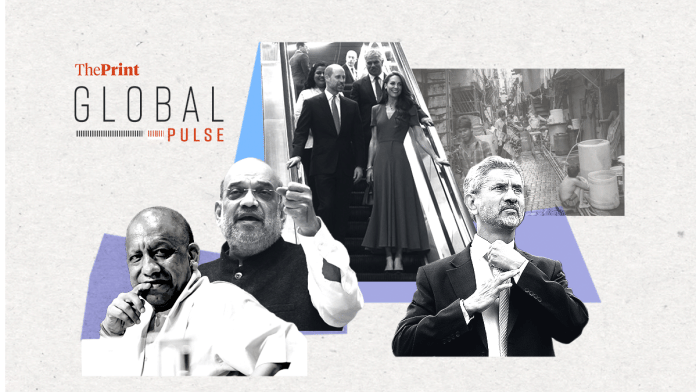
New Delhi: The Economist looks towards Uttar Pradesh’s 2027 assembly elections, where a contest for the state could also shape the BJP’s post-Modi future.
The Wall Street Journal reports on how India has moved away from its long-standing image as a land of mass poverty, while questioning whether the gains can translate into wider prosperity.
The BBC reports on Prince William and Princess Catherine’s India visit, highlighting the country’s growing environmental ambitions even as the star-studded ceremony draws attention to who gets to represent India’s environmental movement.
And Global Times revisits S. Jaishankar’s admission that India “missed the bus” on industrialisation, arguing that closer cooperation with China could offer the country another chance to find its place in the global manufacturing order.
Also Read: Global media questions India’s investment appeal, climate record and Olympic aspiration
In its The World Ahead series, The Economist looks ahead to Uttar Pradesh’s 2027 assembly elections, presenting the contest as a test of Narendra Modi’s continuing political influence and a possible turning point in the BJP’s succession politics.
“One-sixth of humanity lives in India, and one-sixth of India lives in Uttar Pradesh,” writes Tom Sasse, the magazine’s South Asia bureau chief.
The focus is on Yogi Adityanath, who has governed the state for a decade. Sasse describes him as “a firebrand Hindu priest who has built roads, crushed crime and targeted the state’s Muslim minority.”
“Diminutive” and almost always dressed in saffron, Adityanath is a “big figure” in the BJP, “second in star power only to the prime minister himself”. But after two terms, he faces a difficult electoral contest, with the Samajwadi Party-led opposition coalition, says the report.
The election also comes amid questions over Modi’s own political standing. While his “electoral prowess has proved durable,” Sasse writes, recent protests alongside other controversies, have revived questions about whether his influence is “finally on the wane”.
Adding another dimension is the reported rivalry between Adityanath and Union Home Minister Amit Shah, both seen as possible successors to Modi. Sasse describes Shah as Adityanath’s “main rival to succeed Mr Modi”. As the Prime Minister’s right-hand man he is “impatient for the top job”. In Uttar Pradesh, Sasse notes, rumours are already circulating about Shah interfering in Adityanath’s campaign.
The stakes, then, extend well beyond who governs UP. A BJP victory would strengthen Modi’s position while allowing Adityanath’s political stature to grow. A defeat, however, could cost Adityanath his chief ministership, bring the succession debate forward and leave Shah “in a stronger position”.
Sasse notes that Adityanath could “put money straight into the bank accounts of millions of voters, or resort to ugly rhetoric to divide the opposition vote”. Whatever happens, he concludes, “the outcome will reverberate for years”.
Also Read: Global media profiles ‘strategic’ environment minister whose political pragmatism could prove useful
In the biweekly column ‘East is East’ for The Wall Street Journal, Sadanand Dhume writes that India’s transformation from a country once synonymous with mass poverty has largely gone unnoticed as all the eyes were on China’s rise. “India, the world’s most populous nation, has all but eliminated extreme poverty,” he writes, citing World Bank data that puts the share of Indians living in extreme poverty at around 2 percent, down from more than 27 percent 15 years ago. “It’s a big story,” says Indermit Gill, a Hoover Institution fellow and former World Bank chief economist.
For decades, Dhume notes, India had “some of the worst poverty on the planet”. Its children featured in Western charity campaigns, while predictions of mass starvation shaped the country’s image abroad. That picture has changed: around 2012, sub-Saharan Africa replaced the “Indian subcontinent as the global centre of extreme poverty,” and the gap has since widened. India now has around 33 million people living in extreme poverty, fewer than Nigeria, the Democratic Republic of Congo, Pakistan or Ethiopia, despite its much larger population.
Dhume credits much of this turnaround to the economic reforms of 1991, when India ended industrial licensing, cut tariffs and opened up to foreign investment. He also credits Modi with part of the achievement, writing that though the Prime Minister “hasn’t been the aggressive reformer that many pundits had hoped for,” he “nonetheless deserves some of the credit for India’s successful assault on poverty”.
But Dhume draws a line between reducing extreme poverty and creating widespread prosperity, he writes “Growth has slowed on Mr. Modi’s watch compared with the mid-2000s boom, while government welfare spending has soared”. The share of Indians receiving government benefits rose from 19 percent in 2015 to 64 percent in 2025, according to figures cited from the International Labour Organization (ILO). The government now distributes free grain to around 800 million people, Dhume notes.
Gill warns that the model of providing subsidised essentials “has its limits”. Such support can help reduce poverty, Dhume writes, “but it isn’t clear that it can help the country become wealthy”. Dhume points out that around 216 million Indians still live below the lower-middle-income poverty threshold, while 1.14 billion remain below the upper-middle-income benchmark.
He also highlights the structural challenges holding back prosperity: 45 percent of the workforce remains on small, unproductive farms, and the divide between prosperous coastal states and the poorer Hindi-speaking heartland continues to widen. While the peninsular southwest has seen “a Chinese-style economic miracle,” the more populous northern and eastern states lag behind.
Reducing extreme poverty is a significant achievement, but widespread prosperity remains a bigger task. “New Delhi will need to go much further in embracing free markets,” he concludes.
Also Read: Modi’s dissent playbook has lost its efficacy, ‘million mutinies coming to fore’—global media
The BBC’s Henry Moore and royal correspondent Daniela Relph report on Prince William and Princess Catherine’s meeting with Prime Minister Narendra Modi as they wrapped up their three-day India visit. The meeting centred on the “strength and importance of the UK–India bilateral relationship,” with both sides reflecting on the “deep and enduring ties” between the countries.
Modi called it a “pleasure” to meet the royal couple and said he looked forward to “further strengthening” ties for the “shared prosperity of the people of our nations and the wider world”. He also thanked William for bringing the Earthshot Prize to India, with The BBC noting the country’s “growing leadership in environmental innovation” as one of the reasons behind the choice of host.
The report also captures a personal moment from Catherine’s visit to a Mumbai maternity hospital, where she comforted a mother who had lost one of her premature twins, telling her: “Stay strong. Well done. You’ve clearly been very, very brave.”
The BBC notes that the couple’s first official overseas trip in four years combined personal projects such as Earthshot with diplomacy. As the future king and queen, it says, they are viewed as a “valuable diplomatic asset” by the UK government.
In an opinion piece for Global Times, Qian Feng, director of the Research Department at Tsinghua University, writes on India’s economic trajectory through External Affairs Minister S Jaishankar’s remark that the country had “missed the bus” on industrialisation nearly four decades ago.
Feng points out that India still has an opportunity to catch the next wave of global development, with deeper cooperation with China “as one important option”.
Comparing the two economies, the author notes that China’s GDP has grown from just over $300 billion in the late 1980s to more than $19 trillion, while India’s has risen from around $290 billion to nearly $4 trillion. He attributes the divergence partly to India’s “institutional barriers, infrastructure shortcomings and an unfavorable business environment”.
Yet, Feng argues, India has considerable advantages as companies diversify global supply chains, including “widespread English proficiency, a substantial pool of engineering talent and a well-established information technology services sector”. He also takes aim at what he describes as an unnecessary mindset of competition in India, where China is seen as a country to be “surpassed” or “replaced”.
Feng argues that India need not dwell on the bus it missed or expend its energy on the idea of replacing China. Instead, he writes, the two countries should recognise that they are “partners rather than rivals, and sources of development opportunities for each other rather than threats”. India, he concludes, “can still find its own fast track to development”.
(Edited by Amrtansh Arora)
Also Read: A life ‘mirroring history of modern India’—global media spotlights Sonia Gandhi’s memoir