


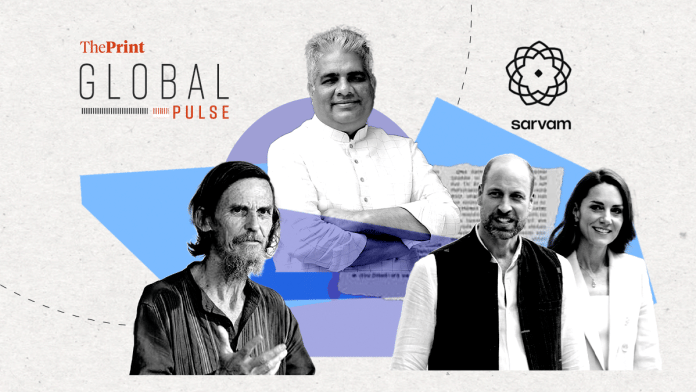
New Delhi: The “strategic” minister representing New Delhi in global climate negotiations, the Belgian-born activist working with India’s poorest communities, the Indian company that wants to compete with global AI giants, and a royal visit.
This week global media looked at the India story through different prisms.
First, The Economist profiles Bhupender Yadav, describing him as “India’s strategic environment minister”.
Next, Financial Times shifts its attention to the AI company that does not want India to become a “digital colony”. FT also profiles economist and activist Jean Drèze, highlighting his work with India’s poorest communities.
The BBC, meanwhile, reports on the Prince and Princess of Wales’ visit to India.
Also Read: Modi’s dissent playbook has lost its efficacy, ‘million mutinies coming to fore’—global media
Referring to his controversial intervention at COP26 in Glasgow in 2021, The Economist takes a closer look at Indian environment minister Bhupender Yadav, who is jointly leading negotiations on climate mitigation at the ongoing COP31 in Antalya, Turkey, presenting an interesting contrast.
At COP26, the Indian delegation led by Yadav had helped replace a proposed commitment to “phase out” coal with the less ambitious language of “phase down”. This intervention drew criticism from climate campaigners, with conference president Alok Sharma visibly emotional as the amendment was accepted.
Five years after the COP26 in Glasgow, Yadav finds himself in a position to help shape international climate negotiations, writes The Economist, adding that his appointment is less surprising when viewed through the lens of his political career. A long-serving BJP strategist and parliamentary operator, Yadav entered politics as a law student before becoming a national secretary of the BJP in 2010.
He has built a reputation for meticulous organisation and political pragmatism. His experience in Narendra Modi’s electoral machinery has made him an important figure within the ruling party, says the report.
Environment minister since 2021, he has consistently argued that developed countries should support greater responsibility for climate mitigation. He also insisted that India cannot abandon coal before its economy is fully developed.
Yet, the country’s renewable energy expansion tells a different story. India is now the world’s third-largest holder of renewable capacity, behind China and the United States.
The report points to the contrast between international climate negotiations and economic realities, suggesting that Yadav’s political pragmatism could prove useful in bringing the two closer.
In the Financial Times, Chris Kay profiles Jean Drèze, the Belgian-born economist who has spent decades working with India’s poorest communities. His detention during a crackdown on the CJP-led protests in Delhi last month brought fresh attention to his extraordinary career and commitment to social justice.
Drèze is a naturalised Indian citizen since 2002 and has worked alongside Nobel laureate Amartya Sen, besides contributing to the thinking behind landmark welfare initiatives, including the rural employment guarantee and food security legislation.
For him, India’s economic growth has not sufficiently addressed the inequalities experienced by its poorest citizens, writes Kay.
Drèze says that caste bias, gender disparity, and limited spending on public health and education still limit large parts of the Indian populace. “Policymakers are very focused on the more capital-intensive sectors,” Drèze tells FT, questioning whether investments in large corporations are generating enough employment in the country.
He also highlights the concerns of young Indians, many of whom get an inadequate education and finish with degrees that do not result in better jobs.
Drèze believes that growing aspirations, combined with limited job opportunities, have contributed to the recent youth-led protests. He also expresses concern about the shrinking space for dissent and civil liberties, arguing that while living standards have improved in several respects, India’s democratic institutions are facing setbacks.
Also Read: A life ‘mirroring history of modern India’—global media spotlights Sonia Gandhi’s memoir
Daniela Relph reports for BBC on the largely ceremonial yet diplomatically significant arrival of the Prince and Princess of Wales in India for a three-day visit. This is their first official overseas engagement together in four years.
According to the report, the itinerary includes a meeting with PM Narendra Modi. The planned interaction was added to the schedule after the Prime Minister confirmed he would return from the Philippines in time to meet the Prince and Princess.
Their visit to Mumbai, the report adds, brought them together with cricket legend Sachin Tendulkar, who joined them for a game of gully cricket in Ballard Estate. Tendulkar, who supports the Earthshot Prize, praised the royal family’s commitment to the environment, describing it as an opportunity to encourage positive changes for future generations.
Much of the royal couple’s visit revolves around the Earthshot Prize awards, which recognise five solutions to major environmental challenges, with each winner receiving £1 million. Among the nominees are projects aimed at increasing the number of e-rickshaws and a technology that can detect wildfires faster than NASA.
Also Read: Surge in demand for PCBs putting squeeze on India’s electronics firms, says global media
The Financial Times, meanwhile, examines the Indian firm locked in a race to build an indigenous AI model. Sarvam, the Bengaluru-based start-up, is positioning itself as an alternative to American and Chinese AI companies.
The company completed a $300 million funding round involving Nvidia, and has received considerable attention as India seeks to reduce its dependence on foreign technology, the report adds. Sarvam co-founder Vivek Raghavan warns of the danger of India becoming a “digital colony”, if its businesses remain dependent on technologies developed and controlled by foreign companies.
The company claims that its AI agents can handle up to three million calls a day across 12 Indian languages at a fraction of the cost of international competitors.
According to the report, Sarvam hopes to capture 20 percent of India’s AI usage within three years after receiving government support for its ambitions to push towards sovereign AI, although its dependence on American semiconductors underlines the difficulties of achieving technological independence.
(Edited by Amrtansh Arora)
Also Read: The colour now compulsory in Delhi during diwali & Mundhe’s fight against ‘chalta hai’ culture