


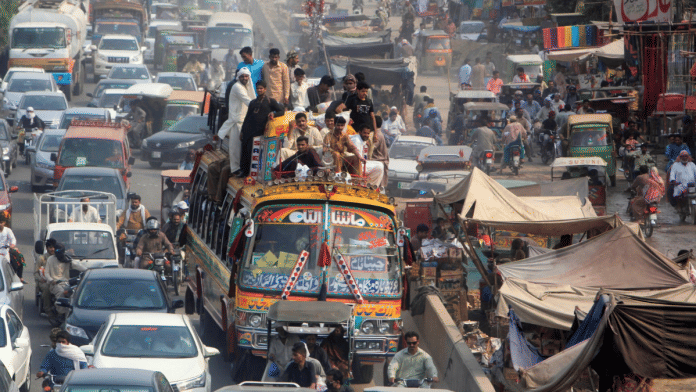
New Delhi: Pakistan is projected to overtake Indonesia and become the country with the world’s largest Muslim population by 2070, with the number expected to more than double to 461 million, according to a Pew Research Center report.
The projections released Tuesday estimate that Pakistan will have a population of about 476.4 million by 2070, of whom 461 million—or 96.8 percent—will be Muslim. This would account for 12.7 percent of the world’s Muslim population, up from 11.2 per cent in 2020.
Indonesia, which has the world’s largest Muslim population, is expected to fall to fourth place while India is projected to have second-largest Muslim population, at 334 million, while Nigeria is expected to rise to third spot, with 282 million Muslims.
In 2020, Indonesia had 239 million Muslims, followed by Pakistan 227 million, India 213 million, Bangladesh 151 million, and Nigeria 120 million.
The shift in rankings reflects differences in projected population growth and fertility rates. Pakistan has an estimated fertility rate of 3.6 children per woman, compared with 2.1 in Indonesia. The report identifies natural increase—births outnumbering deaths—as the principal driver of the growth in Muslim populations globally.
Also Read: Muslims to replace Christians as world’s largest religious group by 2035, Pew survey finds
Hindu population also to double
The report also projects a substantial increase in Pakistan’s Hindu population, which is expected to grow from 5.03 million in 2020 to 10.29 million by 2070—an increase of 104.6 percent, or roughly five million people.
The growth is expected to be driven primarily by natural increase, rather than religious conversion or migration. Pakistan is projected to remain the country with the fourth-largest Hindu population in both 2020 and 2070. Its share of the global Hindu population is expected to rise from 0.4 percent to 0.7 percent.
Pew identifies Pakistan, alongside the US, as one of the largest sources of Hindu population growth outside India.
The share of Christians, meanwhile, is expected to decline from 1.3 percent to 1 percent. Buddhists, Jews, the religiously unaffiliated and followers of other religions are each projected to account for less than 0.1 percent of the population.
Pakistan is among 54 countries and territories expected to have Muslim majorities in 2070. All 53 countries and territories that had Muslim majorities in 2020 are projected to retain that status, while Ivory Coast is expected to become Muslim-majority over the period.
Despite the large number of Muslim-majority countries, most are expected to have small or midsize populations. Only seven of the 54 countries are expected to have populations of at least 100 million: Pakistan, Nigeria, Indonesia, Bangladesh, Egypt, Sudan and Turkey. Twenty countries worldwide are projected to cross that population threshold.
Dividend, or curse?
Javed Hassan, former chairperson of Pakistan’s National Vocational and Technical Training Commission (NAVTTC), told ThePrint that the economic consequences will depend heavily on the pace of fertility decline if the population doubles by 2070.
“Slower decline means more dependants and greater demands on public services. Faster decline, through education, healthcare and voluntary family planning, would give the country a better opportunity to invest in the capabilities of each individual,” he said.
Pakistan has a population of 252 million, growing at an annual rate of 2.07 percent, according to an article published in The Dawn, in June.
Around 56.9 percent of its people are of working age, while 26.6 percent belong to the 15–29 age group. These figures point to the country’s potential demographic dividend: a large and expanding workforce capable of driving economic growth, provided it has access to education, healthcare and productive employment.
“Earlier estimates placed the close of the demographic dividend around 2045; the slow pace of fertility decline has pushed that to roughly 2055, adding a decade to the opportunity. But this is not good news,” Durre Nayab, director at Islamabad’s Socioeconomic Insights and Analytics, wrote in the article.
“A slower fertility transition means a larger, longer-sustained dependent population, more pressure on already strained services, and a dividend that can only be realised if investment in human capital accelerates, not defers, to match the extended timeline.”
Meanwhile, Hassan noted that Pakistan’s demographic dividend window is already open, but little was done to tap it. “A growing working-age population is an opportunity, not an automatic dividend. Without education, women’s economic participation, investment and productive job creation, a potential demographic dividend can easily become a demographic burden,” he told ThePrint.
An additional 200 million people, according to him, would place enormous demands on jobs, schools, healthcare, water and public finances. “Pakistan is already struggling to provide adequate services to its existing population. Unless it expands its productive capacity, broadens its tax base and strengthens public institutions, population growth will magnify the weaknesses of the economy rather than its potential.”
Pakistan’s population could approach 400 million by 2050, according to official Pakistani projections. Its labour force has already expanded from 71.8 million to 85.6 million in four years, adding roughly 3.5 million people annually.
The country ranks 168th on the Human Development Index, while its expected years of schooling stand at just 7.9, the lowest among the South Asian countries listed in the 2025 Human Development Report (HDR) released by the UN Development Programme (UNDP).
Given the circumstances, the neighbouring country also features in the Pew report’s analysis of Muslim migration. It is identified as one of the main countries of origin for Muslim migrants to North America, alongside Bangladesh, Afghanistan and Egypt, and to Europe, alongside Morocco and Afghanistan.
More than 700,000 Pakistanis left the country through legal channels last year, according to local reports. Remittances reached a record $41.6 billion in the latest fiscal year, with Saudi Arabia and the UAE accounting for nearly half of it.
(Edited by Tony Rai)