


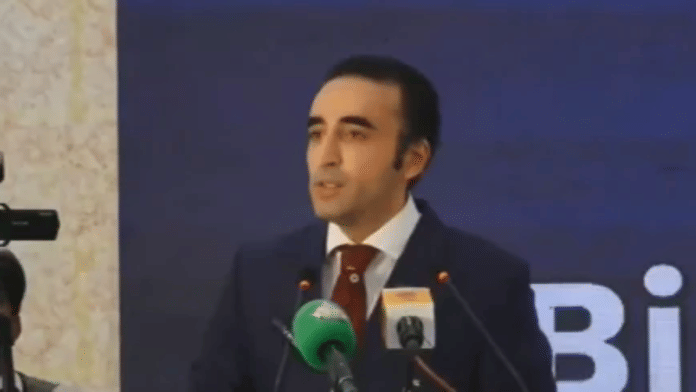
New Delhi: A rift opened up in Pakistan’s ruling coalition after Pakistan Peoples Party leader Bilawal Bhutto on Tuesday called for a “political reset”, including a dialogue with rival party Pakistan Tehreek-e-Insaf. Delivering a fiery speech during a ‘Meet The Press’ programme at the Karachi Press Club, Bilawal said the 27th Amendment was forcibly done, and that the creation of new provinces will lead to “bloodshed in Karachi”. Calling for a political dialogue with the PTI, Bilawal said the party is “a political reality” and that “Pakistan cannot function without it”.
The 27th Amendment to the Constitution of Pakistan, enacted in November 2025 introduced structural changes to the country’s judicial system, defence command framework, and executive immunities. It rewrote Article 243 of the Constitution, creating the post of Chief of Defence Forces and abolishing the long-standing office of the Chairman of the Joint Chiefs of Staff Committee (CJCSC).
Bilawal’s remarks sparked up a fresh confrontation with his party’s coalition partner, the Pakistan Muslim League-Nawaz (PML-N). Defence Minister Khawaja Asif questioned the PPP chairman’s moral authority to criticise the political system while his party has governed Sindh for 18 years, asking, “Are your hands clean? Do you have the right to lecture or threaten?”
The exchange comes amid a renewed debate over proposals to redraw Pakistan’s provincial boundaries, including a possible referendum on the creation of new provinces. Bilawal opposes any attempt to divide Sindh without the consent of its people, warning that it could trigger ethnic tensions and violence. He also rejected the idea of bypassing constitutional procedures through a referendum.
“The system needs a reset, but it must be a political reset,” Bilawal said, arguing that the country’s political and institutional breakdown had not happened on its own but had been deliberately brought about.
In an unusually broad appeal for political reconciliation, Bilawal also acknowledged his own party’s responsibility for past political mistakes, described jailed former prime minister Imran Khan as a political prisoner, and argued that Pakistan’s political system could not function effectively without recognising the PTI’s place in it.
“Whether one likes it or not, Pakistan cannot function without PTI as it is a political reality,” he said, calling on the government to restore the confidence of both the PTI and Jamiat Ulema-e-Islam-Fazl (JUI-F) chief Maulana Fazlur Rehman.
“The most patriotic job is to be opposition. This is the power of democracy. We need to discuss every issue in Parliament. Fazlur Rahman has the right to argue and dissent. You will have to learn to take Imran Khan’s name too. This country cannot run without its political stakeholders, whether I like or do not like them. There are wars with India, with Afghanistan, look at Iran, at Israel, at least reform things back home so we can fight against global issues in a united manner,” he said.
Bilawal further said that Pakistan should not have any political prisoners. “It should be entirely stopped, then this system can run. Anyone who is in jail becomes the PM, then goes back to jail and since 1947 this system has continued and then you say, ‘system has collapsed’—you are responsible for it. We have to free political prisoners, it has to happen sooner or later.”
Bilawal called for a grand dialogue or an all-parties conference involving the government, its coalition partners and Opposition parties to develop a consensus on Pakistan’s political and democratic challenges. The PPP, he said, would first seek agreement within its own ranks before taking the proposals to its central executive committee and approaching other political forces.
The appeal is significant because the PPP is part of the federal coalition government led by the Pakistan Muslim League-Nawaz (PML-N) that also includes other regional and national parties.
Also Read: Imran Khan’s ‘secret’ hospital visit sparks row over his health. ‘New normal’, say Pakistanis
‘Are your hands clean?’
Asif’s response came on Wednesday, questioning whether the PPP chairman was in a position to lecture other political parties about governance and accountability. In a long post on X, the defence minister said that if politicians were discussing the collapse of the system, they also needed to examine their own responsibilities.
“Your press conference was certainly very bombastic and focused on criticising the current government and system, but with respect, I would say that we politicians should not call the process of consulting the public a backdoor. We politicians derive our legitimacy from public opinion,” he wrote.
Asif pointed at the PPP’s 18-year rule in Sindh, sarcastically describing the province as a paradise and saying Karachi’s condition was something the world looked upon with envy. “Bilawal Sahib, your party has been in power in Sindh for 18 years. Sindh has become paradise. The world envies the state of the city of Karachi. You in the PPP have been partners in the business of government since 2022. The profits are yours, and the losses are the PPP’s—or Pakistan’s,” Asif said.
“He who claims equity must come with clean hands. This is a centuries-old maxim of equity. Are your hands clean? Do you have the right to lecture or threaten?” he said, adding that the question of a system reset would be debated in Parliament, but that this should not deprive citizens of their fundamental rights.
“Certainly, there will be a debate in Parliament on the issue of a ‘system reset’, but the public cannot be deprived of their fundamental right in the process. If Parliament also takes public opinion into account, I believe that would be the pinnacle of legitimacy,” he said. “Our goal is only one—to change the lives of the people of Pakistan so that ordinary people can live with dignity. Make public participation in governance a reality,” Asif said.
Referring to Pakistan’s diplomatic and military achievements, Asif said the next challenge was to transfer governance to the street and neighbourhood level. “In Pakistan’s history, in which era did we receive honour and respect on the diplomatic and military fronts by the grace of God, and in which era did our homeland’s name shine? After victories on these two fronts, the battle now is to bring governance down to the street and neighborhood level, where public opinion and Parliament’s role are entirely democratic and constitutional. Governance is not anyone’s monopoly; God has granted this right to 250 million people,” he wrote.
Dialogue with PTI
Bilawal said restoring public confidence in Parliament, the Election Commission of Pakistan, the judiciary and the media was essential to repairing the political system. He argued that political leaders had become more interested in deepening divisions than addressing inflation, unemployment, poverty and other problems facing ordinary Pakistanis.
He described the Opposition’s role as fundamental to parliamentary democracy, calling it the most patriotic responsibility within Parliament. Criticism of the government, he said, should be answered politically rather than through administrative action or accountability proceedings. He also asked the federal government to end the governor’s rule in Khyber-Pakhtunkhwa, arguing that it could not be a permanent solution.
The PPP chairman also called for the release of political prisoners, including PTI leader Imran Khan, and acknowledged what he described as injustices against the Opposition over reserved seats and the removal of PTI’s electoral symbol.
Bilawal also called for an end to the use of the National Accountability Bureau (NAB) against political opponents. Parliamentarians, he said, should not fear accountability cases for delivering speeches or voting on legislation.
Bilawal’s criticism also extended to constitutional changes, particularly the 27th Amendment, which he said had been passed through numerical strength rather than broad political agreement. He contrasted it with the 26th Constitutional Amendment, saying efforts had been made to build consensus through consultations with Opposition parties.
He argued that any further constitutional amendments should be preceded by consultations with the PTI, other Opposition parties, lawyers and the judiciary. Judges themselves, he said, needed to have confidence in the process.
His comments prompted a response from the Prime Minister’s Adviser on Political Affairs Rana Sanaullah, who said Bilawal’s statement about the amendment being passed under pressure could provide grounds for his disqualification as a lawmaker.
Battle over new provinces
The immediate backdrop to the political confrontation is the debate over creating new provinces in Pakistan and the possibility of holding a referendum to establish public opinion on the issue.
Bilawal said the PPP supported the creation of new provinces where people wanted them and where constitutional and legal procedures were followed. However, he categorically rejected any attempt to divide Sindh against the wishes of its people.
He said the Sindh Assembly had repeatedly expressed its position through resolutions and warned that forcibly dividing the province could revive ethnic tensions and violence, particularly in Karachi. “The people of Sindh do not want Sindh’s division. If it is divided forcibly, there will be bloodshed in Karachi, which could spread to Hyderabad, Mirpurkhas, Tando Allahyar and Nawabshah,” he warned.
He said provinces could not be created at gunpoint in areas where people did not want them and rejected attempts to bypass constitutional procedures through a referendum. In a pointed remark, Bilawal said: “If tomorrow, my software is updated and I direct my party to vote for Sindh’s division, there will be a revolt against me.”
He also mocked those aspiring to become chief ministers of newly created provinces, saying some people dreaming of becoming chief ministers of their respective areas might not even be able to remain the chief ministers of their own homes. Bilawal, however, clarified that the PPP was not opposed to a South Punjab province if the Punjab Assembly adopted a resolution reflecting public wishes. He also supported the constitutional and democratic rights of people in Gilgit-Baltistan.
Interior Minister Mohsin Naqvi had floated the idea of a referendum on the creation of new provinces, arguing that it could help establish public opinion and settle the debate. Information Minister Attaullah Tarar defended the proposal, describing a referendum as a constitutional and legal way of ascertaining public opinion. He questioned why political parties should object to asking citizens what they wanted.
Bilawal linked the debate over provincial boundaries to the larger question of federalism and provincial autonomy. He criticised the federal government for failing to fully implement the 18th Constitutional Amendment and the National Finance Commission (NFC) Award.
At the same time, he alleged, Sindh was not receiving its rightful share of the petroleum levy and other financial resources, affecting the provincial government’s ability to provide roads, schools, healthcare and other public services.
Discussing Balochistan, Bilawal said terrorism had reached alarming levels but could not be addressed without tackling poverty, unemployment and inflation. Disruptions to trade with Iran and Afghanistan had further compounded economic difficulties for residents and the business community.
Bilawal also expressed concern about restrictions on press freedom, saying the PPP was prepared to raise laws restricting freedom of expression in parliament.
JUI-F spokesperson Aslam Ghauri welcomed his remarks, saying the PPP chairman had endorsed the party’s position that a referendum was unnecessary when the Constitution already provided a mechanism for resolving the question of new provinces. The PTI, meanwhile, said the PPP could not absolve itself of responsibility for Pakistan’s economic and political situation while remaining part of the ruling coalition.
PTI spokesperson Sheikh Waqas Akram criticised Bilawal for supporting the 26th Amendment, demanding that the PPP help secure the return of the party’s reserved seats if it was serious about democratic representation, Express Tribune reported.
(Edited by Nardeep Singh Dahiya)
Also Read: Pakistan’s elected PTI govt in KP is gone. Critics say democracy has been buried again