



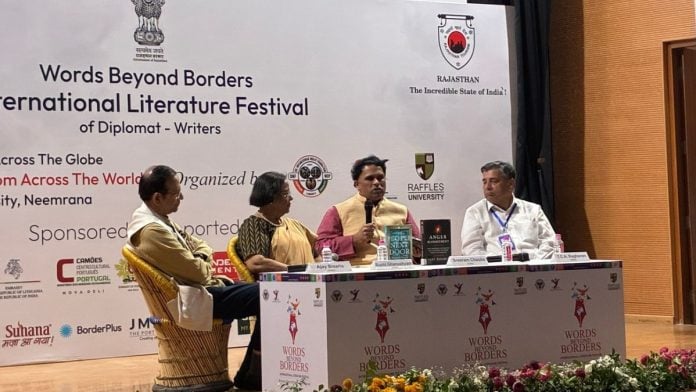
Neemrana: India needs to “creatively engage” with Pakistan to reduce the possibility of being “surprised” by its actions, said Ajay Bisaria, the last Indian High Commissioner to Pakistan.
Speaking at the Words Beyond Borders International Literature Festival in Neemrana, Rajasthan Monday, Bisaria noted that ”severing all linkages with Pakistan puts us at a disadvantage”.
“One can lapse into a policy of strategic neglect,” he said. “This is where one hopes that nothing will happen, but that leaves you with the possibility of being surprised by the neighour…I think these [military/security responses] need to be accompanied with creative engagement with this abnormal neighbour.”
Bisaria was on a panel discussing India-Pakistan ties, along with T.C.A. Raghavan—who has also previously served as High Commissioner to Pakistan—as well as Ruchi Ghanashyam, the former Indian High Commissioner to the United Kingdom, who served in Islamabad in the late 1990s. The session was moderated by Sreeram Chaulia, Dean of the Jindal School of International Affairs at O.P. Jindal Global University.
Raghavan was clear that as a part of the normal course of diplomacy, one must “talk to everyone”, including the military in Pakistan, and that India has “paid way too much attention on who controls or appears to control the reins, rather than looking at the structural reality” in Islamabad.
He added: “For neighbours, we have to be realistic. We must not be sentimental in either a positive or a negative sense. Both the hawks and doves in India, think that some sort of policy package from our side can change in Pakistan…It is not up to us to change them.”
India-Pakistan relations hit its nadir following the abrogation of Article 370 of the Indian Constitution. Bisaria, who was serving as India’s envoy in Islamabad at the time was expelled by then Pakistani government headed by Imran Khan, as Pakistan downgraded diplomatic relations with India. Bisaria returned to New Delhi by 11 August, a mere five days following the abrogation of Article 370.
India launched Operation Sindoor in May 2025, targeting terror complexes across Pakistan in retaliation for the Pahalgam terror attack that had occurred in the Union Territory of Jammu and Kashmir in April 2025, which had left 26 people dead.
New Delhi had also announced a raft of diplomatic actions, including holding the Indus Waters Treaty in abeyance, and cutting off almost all avenues for people-to-people ties between the nationals of the two countries.
Raghavan highlighted that military pressure alone may not be the answer to the issue surrounding Pakistan, highlighting that the Pakistani military “thrives” on being put under pressure. The former Indian envoy highlighted that what worries the military in Pakistan is India’s cultural and economic heft, and that New Delhi must look at using these strengths to deal with Islamabad.
Also Read: Jaishankar talks cross-border terror, common threats with Azerbaijan counterpart
‘Full embrace sets off insecurities in Pakistan’
Ghanashyam, who served in Islamabad between 1997 and 2000, and later served as Director (Pakistan) in the Ministry of External Affairs warned that a “full embrace” of Pakistan by India, has always set off “insecurities” within Islamabad resulting in a response.
“When it comes to Pakistan, we saw one of the best gestures by Prime Minister Atal Bihari Vajpayee, who sat on a bus and crossed into Pakistan via the land border… Within three months or so, we witnessed the Kargil War happen,” she explained.
“Thereafter, we saw the Agra Summit held in 2001, which was followed by another attack [2001 Parliament Attack] within a few months. When we try to fully embrace Pakistan, it reveals several insecurities within the country.”
Ghanashyam highlighted that India should focus on keeping Pakistan “at a distance”, but that this does not mean “no engagement”. Bisaria, agreeing with the cycle, highlighted that Indian leaders always “take the initiative”, which usually is followed by a terror attack emanating from Pakistan.
“I was explaining this to a former head of the ISI [Inter-Services Intelligence]… Prime Minister Narendra Modi went to Lahore, and I expected it to be understood as a great gesture. But the former chief said that the Indian Prime Minister had gate crashed into Pakistan,” Bisaria said. “Prime Minister Modi was invited by Prime Minister Nawaz Sharif, which the Pakistani military had an issue with as they were not consulted. The military made it clear that the civilian leadership does handle the Indian policy”.
Saying that Pakistan is a “bizarre country” because it has “structurally been captured by a rogue army”, Bisaria said that there must be engagement with the Pakistani army.
“We must be tough on terrorism, but also engage the adversary, understand the adversary, so that the probability of being surprised by that adversary is less,” he added.
(Edited by Mannat Chugh)