



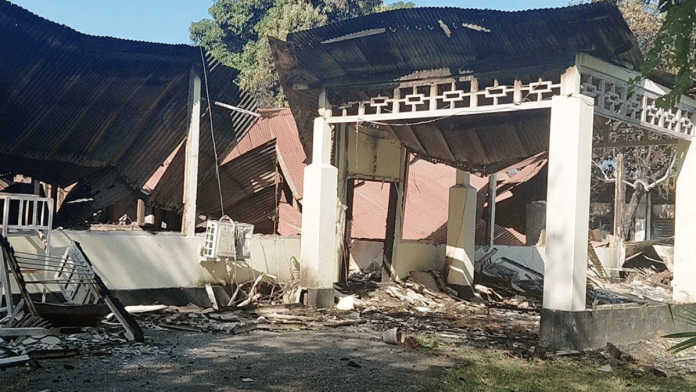
New Delhi: Late Friday night, a mob comprising over 150 youths torched the office of National Hydroelectric Power Corporation (NHPC) in Arunachal Pradesh’s Pasighat to protest against the proposed 11,200 MW Siang Upper Multipurpose Project (SUMP).
The NHPC has been tasked with carrying out surveys at three potential locations in the Siang and Upper Siang districts to zero in on a site for the proposed project.
Friday’s incident has put a fresh cloud of uncertainty over the project’s future, which is envisaged as India’s counter to China’s 60,000 MW mega hydropower dam coming up in Medog County on Yarlung Tsangpo. Flowing through Tibet, the Yarlung Tsangpo enters India in Arunachal Pradesh, where it is known as Siang, the main tributary of the Brahmaputra. It joins other tributaries, including Dibang and Lohit, before joining the Brahmaputra in Assam.
Marred by frequent protests from the local Adi and Galo tribal communities, the Siang project has not moved much on the ground since 2008, when the then Manmohan Singh-led United Progressive Alliance (UPA) government declared it a national project.
The NHPC has so far not been able to even identify the exact location where the Siang dam will come up. Moreover, India’s largest hydropower developer, tasked with readying the pre-feasibility report (PFR) for the proposed project, has been unable to complete the survey work required to finalise the report.
Apart from local residents, today the Congress is also opposing the project.
Also Read: An indigenous community in Arunachal bans 4 scholars. Why it’s pushing back against research
Dam site not identified yet
The NHPC had identified three potential sites in Siang and Upper Siang districts—Uggeng, Dite Dime and Parong—in the draft pre-feasibility report that it submitted to the Jal Shakti ministry and the Central Water Commission on 30 December, 2022. Government sources said that NHPC was told to conduct core drilling and geophysical studies at the three locations and compare them before finalising the dam site.
But work has been almost at a standstill since 2022 because of the protests by the locals, who say the dam will not only destroy their ancestral land, livelihood but also the ecology of the region. Villagers, a majority of whom are from the Adi tribe, are peeved that not all of them were consulted and told about the extent of damage to their fertile land and the project’s impact on their livelihood.
An NHPC official involved with the project told ThePrint that only the exploratory core drilling work, which is the last leg before submitting the pre-feasibility report, is left. “But we have not been able to move ahead much with the survey,” the official added.
“Until the survey is complete and the pre-feasibility report is ready, we will not be able to zero down on the exact location where the dam will come up.”
Prior to 2017, NHPC had divided SUMP into two phases—Siang Upper Phase I and Siang Upper Phase II. It was only in 2017 that federal thinktank NITI Aayog proposed to club the two phases into one single storage project. The project got some momentum again when in April 2022, the Centre told NHPC to conduct a pre-feasibility study to finalise the dam site.
Local residents force them to retreat whenever they attempt to begin drilling, according to officials. Since Friday, close to 15 NHPC officials involved with the Siang project have been forced to operate from their homes in Pasighat. “The NHPC office at Pasighat has been gutted completely. There is nothing left there,” a second NHPC official said.
This is the second time in over a year that NHPC officials have faced the brunt of protesters. On 21 May 2025, residents of Beging, a small village downstream of Siang, stopped an NHPC team from conducting pre-feasibility tests at Parong village. The villagers damaged the equipment, including drilling machines brought by the NHPC team, and forced them to retreat.
The senior NHPC official told ThePrint that since May 2025, when protesters burnt their vehicles near Parong, the team has not been able to make any headway on survey work for the project. “We have not moved an inch on the ground as far as survey work is concerned.”
Going by the current situation, NHPC officials said it would be a long way before the project actually takes off.
“Even the PFR is not complete yet. It will be based on the PFR that a Detailed Project Report will be made. This will be followed by approvals from different agencies. All this will take years. I don’t want to hazard a guess,” one of the officials said.
Importance of project
The Siang project is important not just from a strategic point vis-à-vis China’s proposed mega dam. Senior officials in the Jal Shakti ministry told ThePrint that the total annual yield at Siang Upper Multipurpose Project is around 109 Billion Cubic Metres (BCM). The project is proposed for storage and flood moderation purposes. Power generation is its byproduct.
The reservoir will improve water table depletion but more importantly will be able to absorb any sudden changes in river flow in case of a breach of the mega dam China is building.
Ever since China announced plans to construct one of the world’s largest hydropower dams at a cost of $170 billion, there have been concerns about its likely impact in downstream areas in India, including Arunachal Pradesh.
Locals unmoved by Centre’s gesture
Last June, the Centre came up with a Rs 350 crore Special Development and Livelihood programme, along with the Arunachal Pradesh government, to win over the local residents’ trust before going ahead with the pre-feasibility study.
The Development and Livelihood programme was to cover 26 villages in Siang and Upper Siang districts that will be partially or fully affected by the dam. As part of this programme, the residents were to be trained in horticulture activities, animal husbandry, handicraft and bamboo crafting, and honey bee keeping, and so on. Some of the villagers will also be assisted in converting their homes into homestays for tourists.
The programme will cover approximately 10,000 people, half of them women. The Arunachal Pradesh government was to help construct hospitals and schools in the areas where these villagers will be resettled. But, officials said that the programme had barely started rolling when the protests started again.
This is an updated version of the report.
(Edited by Tony Rai)