



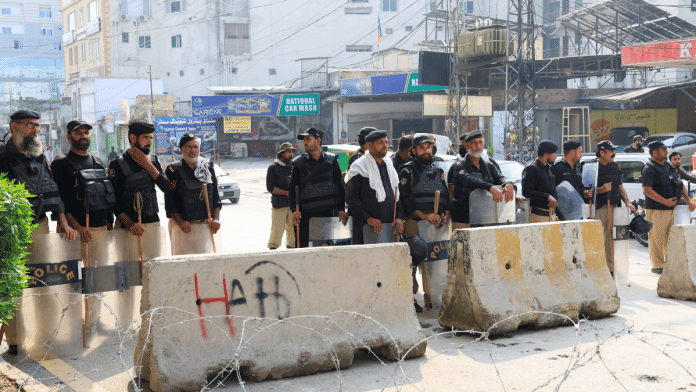
New Delhi: Pakistan on Sunday imposed emergency rule in Khyber Pakhtunkhwa, a province governed by the PTI, citing counterterrorism measures. With that, the curtains fell on 13 years of PTI rule in the region.
The decisions coincided with a PTI protest march demanding access to former prime minister Imran Khan, who has been in jail for over three years, and his eventual release. Organisers had initially planned to take the demonstration to Islamabad. The federal government warned that it would not allow protesters to enter the capital.
The move has not gone down well with Pakistanis, especially members of civil society, including journalists, analysts, lawyers and others who have called it the ‘darkest chapter in Pakistan’s history’.
There are editorials, social media debates and widespread anger over what is being called an unconstitutional move. Dawn, the nation’s newspaper of record, called it ‘a perilous misstep’.
“There is no political justification for governor’s rule. If the authorities felt terrorism was increasing in some tribal districts and adjoining areas, they could have limited themselves to imposing a targeted emergency under Article 232, as they have already done. To deprive an entire province of its elected government is not only undemocratic; it can also be severely counterproductive,” it wrote in its editorial.
“The PTI government may have faltered on several fronts, but in a democratic society, those failings are supposed to be addressed through the electoral process, not through executive fiat…Islamabad must extricate itself from this quagmire before it deepens, and leave KP’s governance to those its people have elected to oversee it,” it added.
Among the four major English-language newspapers — Dawn, Express Tribune, The Nation and The News International — only The Nation took a different position. In its editorial, it blamed the PTI squarely for choosing to escalate tensions between the federal and provincial governments.
“This was the foreseeable conclusion to repeated marches on the capital and an escalating confrontation between province and Federation. No government can indefinitely tolerate such interprovincial conflict, particularly when governance itself becomes hostage to political agitation. The PTI might have secured greater room for manoeuvre had it governed KP more effectively. Instead, escalating terrorist violence, deteriorating law and order, and its unwillingness to cooperate fully with federal counterterrorism efforts exhausted the Centre’s patience. Its obsession with confrontation left the province increasingly exposed,” it wrote in its editorial.
Express Tribune chose not to comment. The News International, however, also questioned the logic behind the move.
“This is hardly a good precedent for any civilian government and raises questions about the circumstances under which an elected provincial administration can be removed from power. Concerns over the possible suspension of fundamental rights in areas where an emergency is proclaimed are equally valid. What safeguards will be in place, how long will any restrictions last and who will ensure that extraordinary powers are not abused? The more pertinent question is whether the circumstances justify these measures and whether they will deliver what the government claims they are intended to achieve,” it wrote in its editorial.
Then came civil society. There was widespread opposition to the move. Most agreed that Pakistan refuses to learn lessons from history.
“Displacing a duly elected assembly with a two thirds majority, in favour of a council of the usual, rootless suspects, will only harm Khyber Pakhtunkhwa and its people. Emergency doesn’t ‘build consensus’, or anything else,” barrister and professor Asad Rahim Khan wrote on X.
In an article for Dawn, Khan also pointed out that when Asif Zardari imposed governor’s rule in Punjab in February 2009, then-deposed chief minister Shehbaz Sharif had taken a ‘much poorer view of the issue’.
“The same president is now doing it on the same man’s advice in Khyber Pakhtunkhwa: the unity regime has imposed both emergency as well as governor’s rule,” he wrote.
Members of other provinces also joined in. Balochistan National Party chief Akhtar Mengal was blunt in his criticism. He wrote: “To expect democracy from those whose nature and existence are steeped in the vilest forms of dictatorship is sheer folly. Today once again, PPP and PMLN have grandly buried democracy with pomp and show, thereby proving it has returned to the very dust from which it was kneaded.”
The idea that Pakistan’s history repeats itself with every passing decade became a recurring theme on social media, as Pakistanis debated the latest developments. Pakistani journalist Mazhar Abbas noted how October tends to bring ‘bad news’ for Pakistani democracy.
“Why Oct. often bring ‘bad news’ for democracy from 1958 to 2026. Saddest part is that each time one party or the other welcomed such moves. On Oct 12th, 1999 when PM Nawaz was sacked PPP welcome the move. Now, PPP and PML(N) agreed to get rid of PTI KP Govt. No lesson learnt,” he noted on X.
Husain Haqqani, Pakistan’s former ambassador to the US, also joined the debate with a history lesson.
“The provincial government elected in Khyber Pakhtunkhwa was first dismissed on August 22, 1947, on the orders of Governor General Muhammad Ali Jinnah. Then, on October 16, 1975, February 25, 1994, and today, elected governments were dismissed on the orders of the federation. In Pakistan’s brief history, what has happened repeatedly is something that does not occur in the long histories of other countries,” he wrote on X.
His comment, however, sparked a debate over the historical accuracy of such comparisons. Asad Rahim Khan responded by calling Haqqani ‘a pro-Congressite’.
“Utterly disingenuous comparison (usually trotted out by pro-Congressites unreconciled to Pakistan’s independence). Mr. Jinnah neither declared governor’s rule, nor imposed emergency…Dr. Khan Sahib’s ministry had lost its majority in the assembly, even forgetting he had publicly promised he would resign if he lost the pro-Pakistan referendum (thus forfeiting the public mandate), and then did not resign after he did lose. Whether or not Mr. Jinnah should have done it is a separate argument: comparing it to today’s disaster is getting it completely backwards,” he argued.
Journalist Ali Arqam offered a lengthy counterargument.
“Dishonest and cherry picked history. The claim that Dr. Khan Sahib had definitively “lost his majority” in the assembly was made by the butcher of Babarra & Liaqat Bagh (Qayum Khan). In constitutional law and parliamentary practice, a government’s legislative majority is proven exclusively through a floor test, a motion of no-confidence (not claims by a lousy Qayum Khan) which was never conducted in the 50-member NWFP Assembly, where the Congress party still officially held 30 seats on paper despite the shenanigans of Muslim Leagues,” he added.
Others chose to focus on more recent history. Prominent journalist Hamid Mir, in a column for the Bangladeshi outlet Prothom Alo, noted that while Imran Khan had jailed many of his political opponents, including Shehbaz Sharif, and maintained a ban on an insolent journalist like him, there was still a difference.
“In the Global Democracy Index, Imran Khan’s government was classified among Hybrid Regimes, but today Shehbaz Sharif’s government has been classified among Authoritarian Regimes,” he said.
Imran Khan’s son Kasim also joined in, writing on X: “Khyber Pakhtunkhwa’s democratic mandate must be restored. My father, our detained family members, PTI representatives and all political prisoners must be released immediately. The people’s right to peaceful protest must be respected. Pakistan belongs to its people, not its military.”
Former president Arif Alvi called the move “the final nail in the demolition of democracy” in a lengthy post on X.
“I nominate these despicable usurpers for a Nobel Prize, not for peace, but for the fastest effort to demolish a country and its people,” he added.
(Edited by Prashant Dixit)