


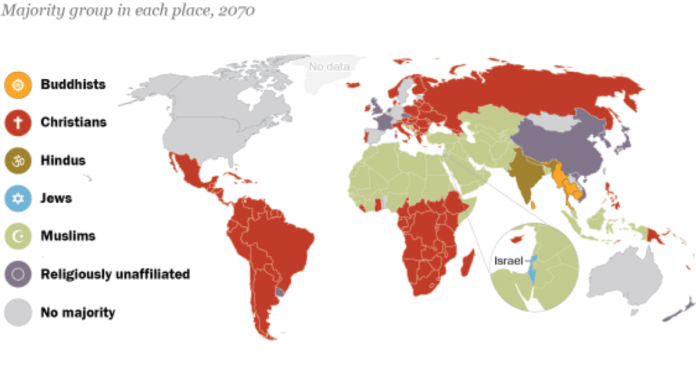
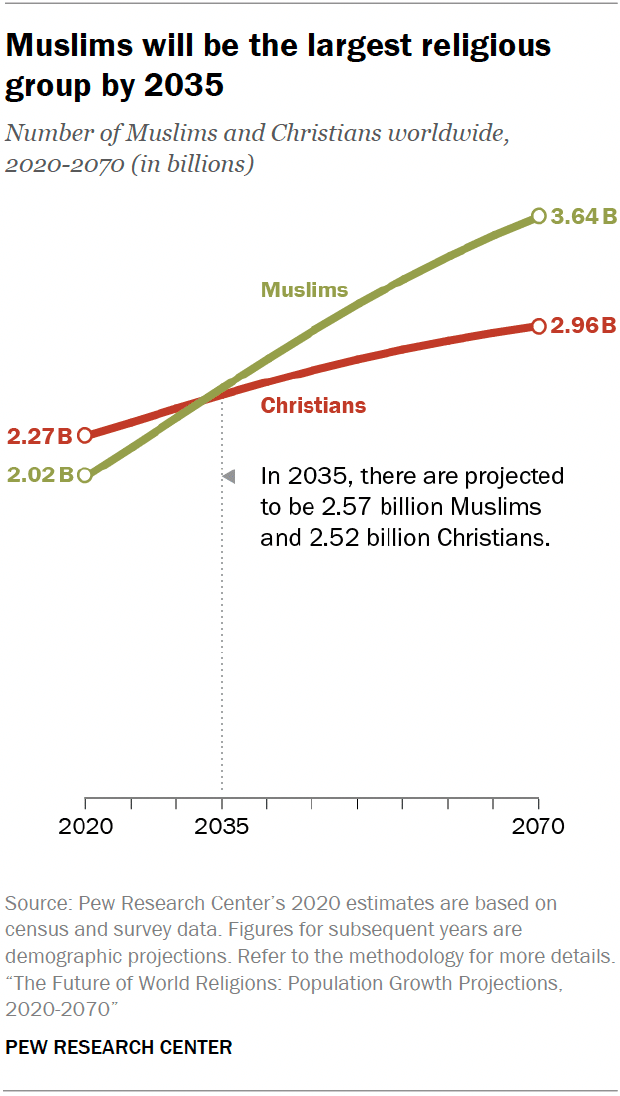
New Delhi: Muslims will overtake Christians as the world’s largest religious group by 2035, with their population expected to reach 3.64 billion by 2070, according to a new Pew study.
Christians, who currently make up the world’s largest religious group, are projected to number just under 3 billion by the same year.
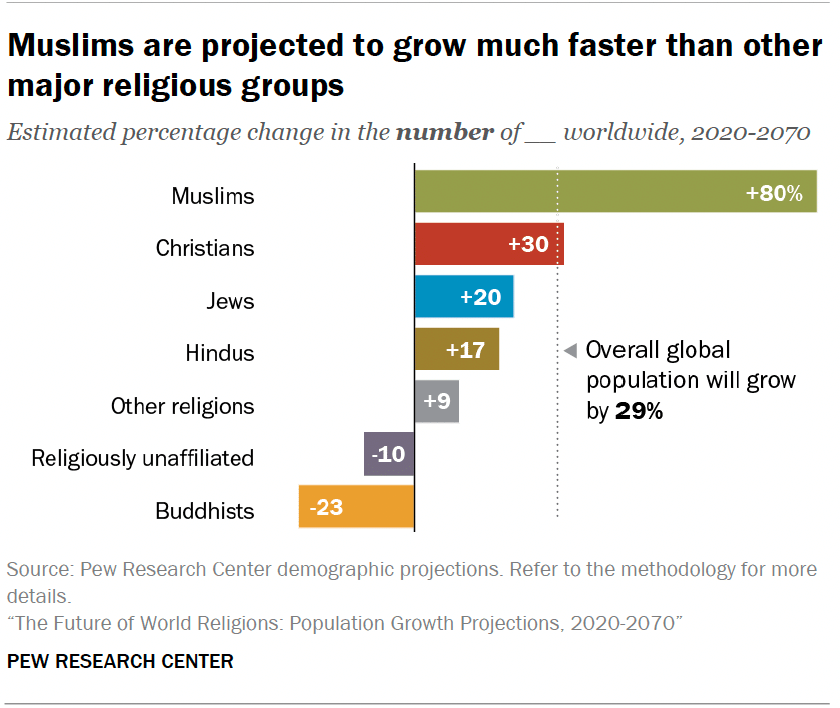
The projections point to a significant shift in the global distribution of religious populations over the next five decades. While the number of Muslims is expected to rise by 80 percent, the Christian population is projected to grow by 30 percent.
The Hindu population will increase, by nearly 200 million, but its share of the world’s population is expected to fall from 15 percent to 14 percent.
The study, ‘The Future of World Religions: Population Growth Projections, 2020–2070’, released Wednesday, examines changes in seven religious groups across 201 countries and territories, which together account for 99.98 percent of the world’s population. Its projections are based on demographic trends which include age profiles, fertility, mortality, migration and religious switching.
Between 2020 and 2070, the global population is projected to grow by 29 percent. Muslims and Christians are the only two religious groups in the study expected to keep pace with this global growth.
The Muslim population is projected to rise from 2.02 billion in 2020 to 3.64 billion in 2070. Christians are expected to increase from 2.27 billion to 2.96 billion over the same period. Hindus are projected to increase from 1.18 billion to 1.38 billion. However, their share of the global population is expected to decline.
The study also projects a decline in the share of the world’s population that is religiously unaffiliated, from 24 percent in 2020 to 17 percent in 2070. Buddhists are expected to decline both in absolute numbers as well in their global share.
The projections point to a changing global religious landscape, with population growth increasingly concentrated in regions where Muslims and Christians make up large parts of the population. Muslims are expected to become the world’s largest religious group by 2035, while the Christian population’s centre of gravity shifts towards sub-Saharan Africa.
The Hindu population is also expected to grow, largely driven by India, but at a slower pace than the global population as a whole. The study’s findings underline how differences in age, fertility, migration and religious switching are expected to shape the size and distribution of religious groups over the next five decades.
Religious change in America
The US is projected to lose its Christian majority by 2070, with Christians expected to account for less than half of its population.
But, Christians are expected to remain the largest religious group, even after falling below the 50 percent mark. Christians tend to lose more followers than they gain through religious switching, according to the report.
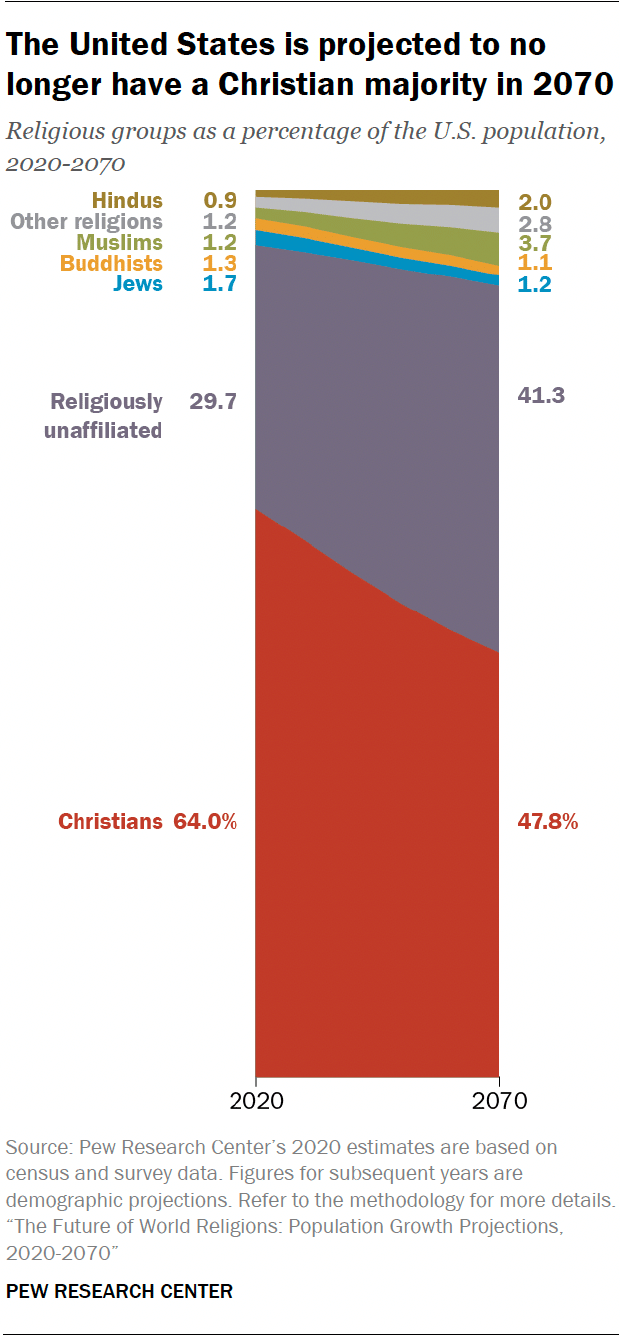
Jews, who were the country’s third-largest religious group in 2020, are projected to be outnumbered by both Muslims and Hindus by 2070.
The Muslim population is projected to grow by 9 million between 2020 and 2070.
Global population growth
The global Muslim population is projected to grow by nearly 80 percent between 2020 and 2070, reaching 3.64 billion. The report attributes this growth largely to the population’s younger age profile and high fertility rates.
In 2020, the median age of Muslims worldwide was 24, compared with 33 among non-Muslims. The total fertility rate for Muslims was 3.1 children per woman between 2020 and 2025, compared with 2 among non-Muslims.
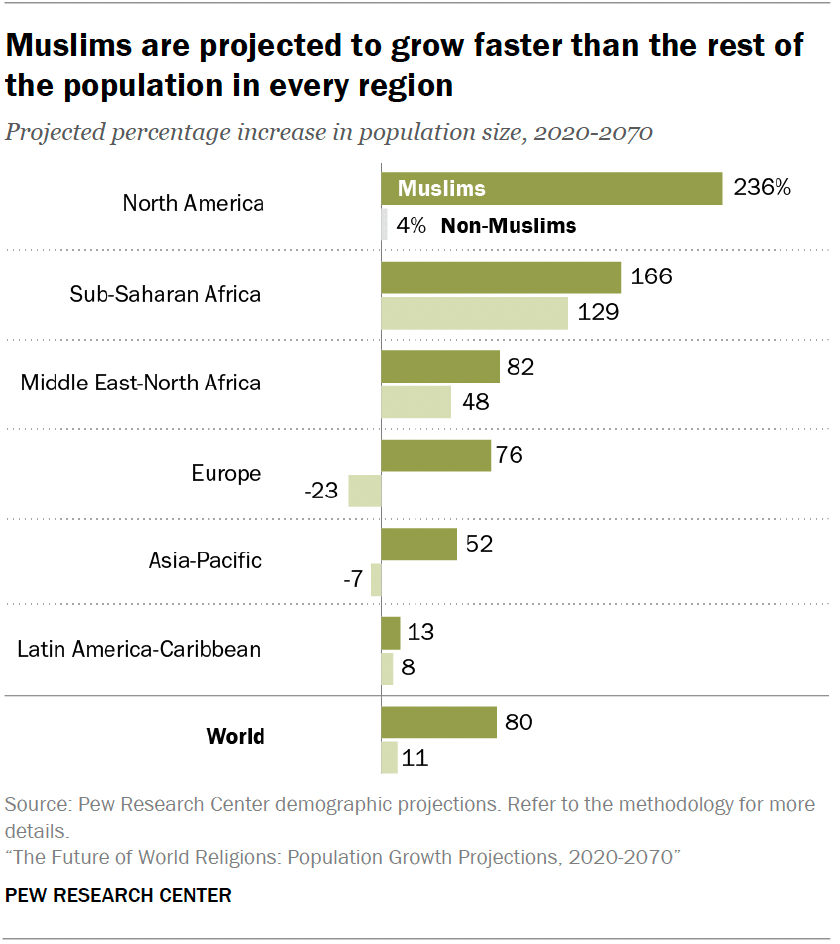
The Pew study projects that Muslims will grow faster than non-Muslims in every major geographic region. The fastest growth is expected in North America, where the Muslim population is projected to more than triple, from about 6 million in 2020 to nearly 20 million in 2070. The primary reason behind this is expected to be migration.
Sub-Saharan Africa is projected to see the second-fastest growth. Its Muslim population is expected to rise from 369 million to 980 million.
The Asia-Pacific region will continue to have the largest Muslim population in absolute numbers—up from 1.19 billion to 1.81 billion—even as its share of the global Muslim population falls.
Christian population
Christianity is projected to remain one of the two largest religious groups globally, with its population increasing by about 687 million between 2020 and 2070. However, the growth will be unevenly distributed across regions.
Sub-Saharan Africa will account for most of this increase. The region’s Christian population is projected to grow by nearly 896 million, reaching about 1.59 billion by 2070. The report points to the relatively young age profile and higher fertility rates of African Christians as factors behind the projected growth.
Similarly, the Christian population is expected to increase from 269 million to 291 million In Asia-Pacific.
In contrast, North America is likely to record a decline of 20.8 percent, with its Christian population falling from 238 million to 188 million. The report projects that Christians’ share of the population will decline by at least five percentage points in 61 countries and territories.
Also Read: AI can answer opinion polls. But can it be trusted to speak for people? Pew study says not yet
Hindu population
The global Hindu population is projected to increase by nearly 199 million between 2020 and 2070, reaching about 1.38 billion. However, its share is expected to fall from 14.9 percent to 13.6 percent, as the non-Hindu population grows at a faster rate.
India will continue to account for the vast majority of the world’s Hindus. It had an estimated 1.11 billion Hindus in 2020, representing 94.5 percent of the global Hindu population. By 2070, this number is projected to rise to 1.29 billion, although India’s share of the world’s Hindu population is expected to fall slightly to 93.6 percent.
The report projects that 99 percent of the world’s Hindus will continue to live in the Asia-Pacific region. Outside India, some of the projected growth will come from Pakistan and the US. Pakistan’s Hindu population is expected to rise from 5 million to 10.3 million, while the US population is projected to increase from 3 million to 7.4 million. Immigration, according to Pew, will primarily boost the projected growth in America.
The India story
India’s Hindu population is projected to increase from 1.11 billion in 2020 to 1.29 billion by 2070, a rise of 176 million. However, Hindus are expected to make up a smaller share of the country’s population as non-Hindus grow at a faster pace.
The Pew Research Center attributes this projected shift partly to differences in fertility rates and younger age profile of Muslims. Hindu fertility is estimated at 1.9 children per woman, down from 3.3 three decades ago. Despite the decline in their share, Hindus are projected to continue accounting for more than three-fourths of India’s population in 2070.
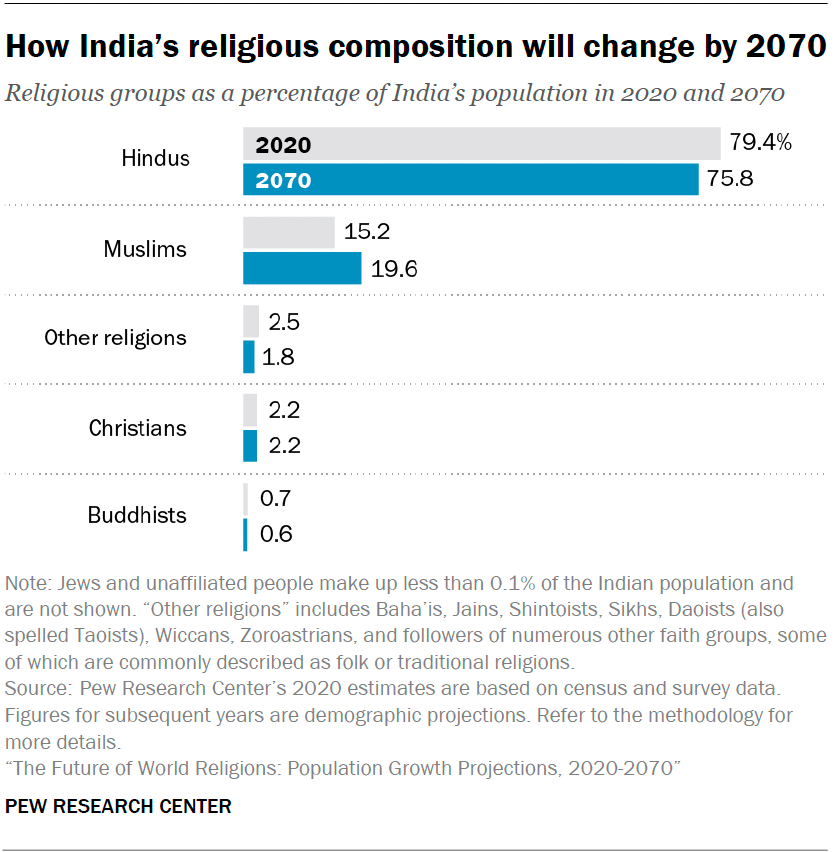
Meanwhile, Muslims are projected to rise from 213 million in 2020 to 334 million by 2070, moving India up from third to second place among nations with the largest Muslim populations.
Pakistan is expected to remain at the top with 461 million Muslims, while Nigeria is projected to rank third. India is expected to account for 9.2 percent of the global Muslim population by 2070.
Largest Muslim & Hindu populations
The rankings of countries with the largest Muslim populations are projected to change considerably by 2070. Indonesia, which had the world’s largest Muslim population in 2020, is expected to be overtaken by Pakistan.
In 2020, Indonesia had an estimated 239 million Muslims, followed by Pakistan with 227 million, and India with 213 million. Bangladesh and Nigeria completed the top five.
By 2070, Pakistan is projected to have 461 million Muslims, accounting for 12.7 percent of the global Muslim population. India is expected to rank second with 334 million, followed by Nigeria with 282 million. Indonesia is projected to move to fourth place, with 274 million. Bangladesh will rank fifth with 218 million.
Ethiopia and Afghanistan, which are not in the 2020 list, are likely to make it to the list of the top 10 countries. No country in North America, Europe or Latin America and the Caribbean is projected to enter this list.
The global population of followers of smaller religious groups including Sikhs, Jains, Bahá’ís, Shintoists, Daoists, Zoroastrians, Wiccans and several folk and traditional faiths is projected to rise from 172 million in 2020 to 188 million by 2070.
The biggest geographical shift is expected to be in sub-Saharan Africa, whose share of the global population in this category is projected to rise from 16 percent to 29 percent. In contrast, Asia-Pacific, which was home to more than six in 10 followers of these religions in 2020, is expected to account for 47 percent by 2070. The region is also projected to see a decline of nearly 25 million people in this category.
(Edited by Tony Rai)
Also Read: While the world grows wary of social media, 66% Indians feel positive about its role in democracy