



New Delhi: Social media may have become one of the most powerful ways for Indians to enter the political conversation but a majority of them also believe the same platforms have made people easier to manipulate with false information and rumours.
That apparent contradiction sits at the heart of a new Pew Research Center survey across 37 countries.
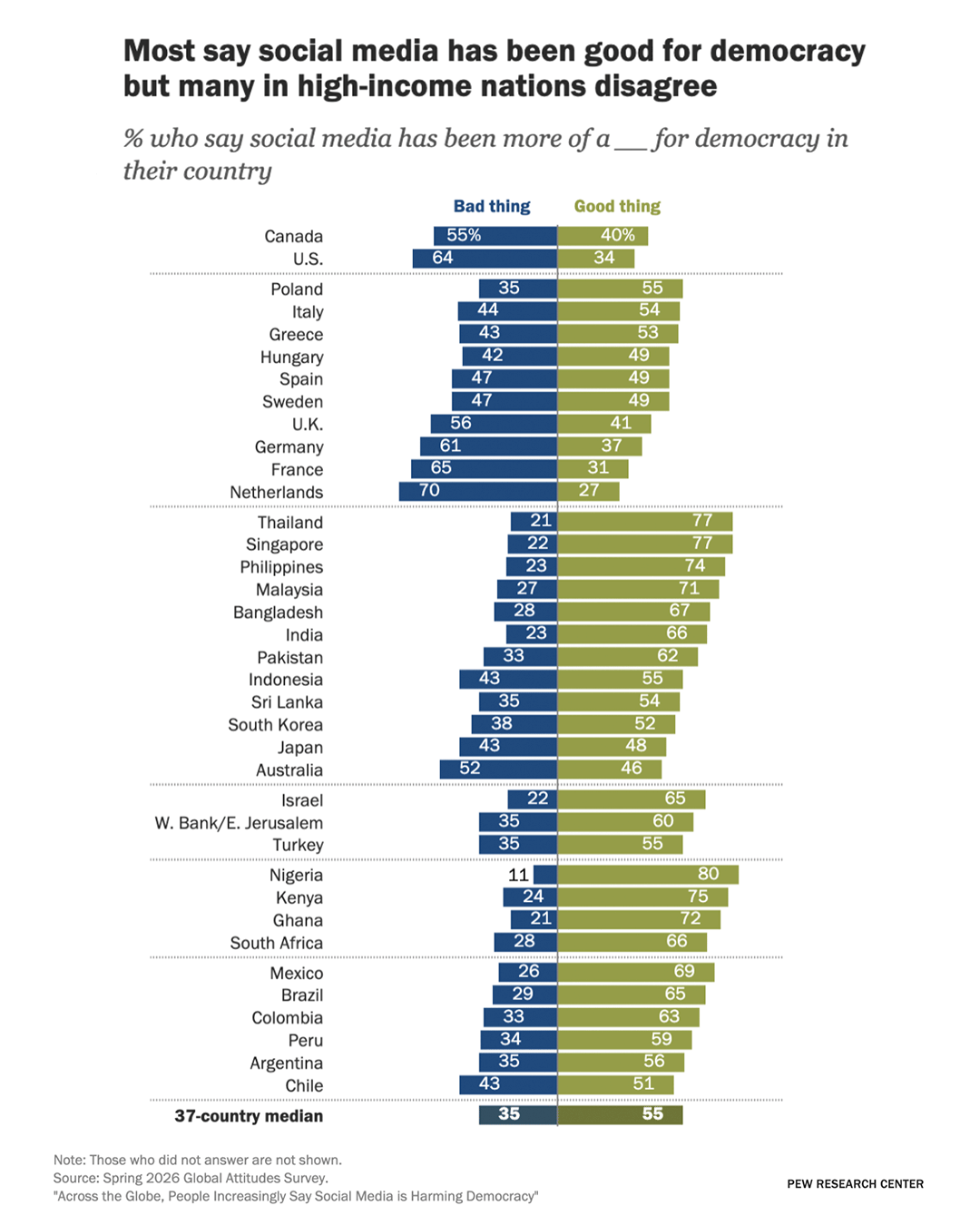
Two-thirds of Indian adults surveyed, or 66 percent, said social media had been more of a good thing for democracy in India. Only 23 percent called it more of a bad thing.
But when Pew asked what social media was actually doing to politics and the information environment, the answers became considerably more complicated.
For instance, 62 percent of Indians said access to the internet and social media had made people easier to manipulate with false information and rumours. Fifty-one percent said it had made people more divided in their political opinions.
At the same time, 66 percent said social media had made people more informed about current events and 55 percent said it had made people more able to have a meaningful voice in politics.
In other words, the Indian respondent does not necessarily see these as competing propositions. Social media can inform people and give them a voice while, at the same time, making them more vulnerable to misinformation and political polarisation.
That is broadly the tension identified by Pew in its latest report Thursday, titled ‘Across the Globe, People Increasingly Say Social Media is Harming Democracy’. The report says people see social media as able to “manipulate and divide, but also inform and empower”.
The survey took place between 8 February and 13 May covering 42,151 people in 36 countries. The report’s larger analysis of social media use includes a total of 45,658 people, across 37 countries when the extra US survey is added.
India vs West
India’s overall assessment of social media is notably more positive than that in several wealthy democracies.
In the US, only 34 percent said social media had been good for democracy, while 64 percent said it had been bad. France recorded 31 percent positive and 65 percent negative views; Germany 37 percent and 61 percent; and the Netherlands 27 percent and 70 percent.
By contrast, India was at 66 percent positive and 23 percent negative. The gap is not unique to India. Across the 37 countries surveyed, a median of 55 percent said social media had been good for democracy, compared with 35 percent who said it had been bad.
Pew found that people in wealthier countries were generally more negative about social media’s democratic impact. Australia, Canada, France, Germany, the Netherlands, the UK and the US were the seven countries where at least half of respondents said social media had been bad for democracy.
The pattern reverses in several lower-income countries. In Ghana, Kenya, Nigeria, the Philippines and Thailand, roughly three in four or more respondents said social media had been good for democracy.
But the distinction is less clear once people are asked to move beyond the broad question of whether social media is “good” or “bad”.
Also Read: Pakistan govt sees US as ally, Pakistanis don’t. Only 15% hold favourable view, 83% trust Xi
The India puzzle
The strongest positive response in India was not about democracy itself, but information. Sixty-six percent said social media and internet access had made people more informed about current events.
That was matched by an almost equally large concern: 62 percent said the same technologies had made people easier to manipulate with false information and rumours.
The other two findings point in opposite directions as well. Fifty-five percent said social media had made people more able to have a meaningful voice in politics. Yet 51 percent said it had made people more divided in their political opinions.
Taken together, the numbers suggest that Indians see social media less as a straightforward democratic force than as an increasingly important political infrastructure with competing effects.
It can widen access to information. It can allow people to participate in political debate. But it can also make false information easier to spread and deepen existing political divisions.
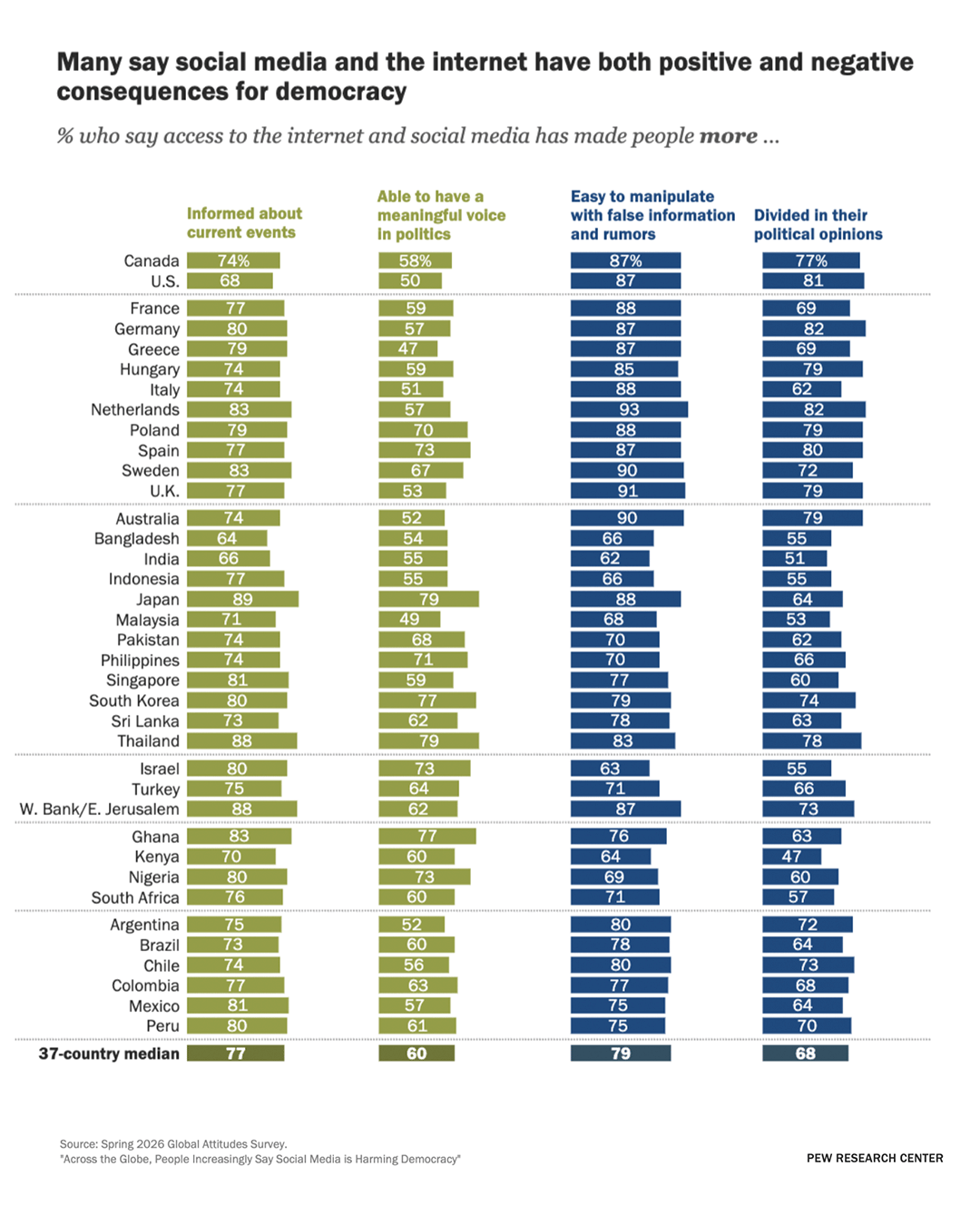
And this is not just an Indian perception. Across the 37 countries, a median of 77 percent said social media had made people more informed about current events. A slightly larger median of 79 percent said it had made people easier to manipulate with false information.
Sixty-eight percent said it had made people more divided politically, while 60 percent said it had increased people’s ability to have a meaningful political voice.
Pew found that in 29 countries, at least one-third of adults believed social media was producing all four effects simultaneously — making people more informed, giving them a more meaningful political voice, making them easier to manipulate and increasing political divisions.
The world is becoming more wary
The more striking global finding is not simply that people recognise social media’s downsides. It is that, in many countries, the negative assessment is becoming more common.
Pew found that in 16 of the 26 countries for which comparable trend data was available, the share of people saying social media was bad for democracy had increased significantly since 2022 or 2023.
The Netherlands provides the clearest example. In 2022, 54 percent of Dutch respondents said social media was bad for democracy. That has now risen to 70 percent.
The US, meanwhile, has not moved. It was already the most negative country surveyed by Pew in 2022, with 64 percent saying social media was bad for democracy. The figure remains exactly 64 percent in 2026.
That means the US is no longer an outlier to the same extent it once was. In several other wealthy democracies, negative assessments have moved closer to the American level. A case in example is France (65 percent) and Germany (61 percent). In the UK, 56 percent say social media has been bad for democracy, while Canada is at 55 percent.
India sits much further towards the positive end of the spectrum.
There is, however, an important caveat to any comparison with India’s 2023 result. In 2023, 74 percent of Indians said social media had been good for democracy and 21 percent said it had been bad. But, Pew says some of its 2023 India data is not directly comparable with the current survey because of large differences in item non-response.
So while the current Indian figure is lower than the 2023 figure, the report does not provide grounds for treating the six-percentage-point difference as a straightforward measure of changing Indian opinion.
Also Read: America is divided, new Pew study shows. Healthcare, housing worries rise
Young users are not simply cheerleaders
Age adds another layer to the picture. Across countries, young adults are generally more likely than older people to view social media positively. In the UK, for instance, 60 percent of adults aged 18 to 34 said social media had been good for democracy, compared with only 31 percent of those aged 50 and above.
But Pew’s findings suggest that younger users are not simply more enthusiastic about social media. They are also more likely to recognise its problems.
Young adults are more likely to say social media makes people more informed and gives them a greater political voice. At the same time, they are more likely to say it makes people politically divided and easier to manipulate.
The report finds a similar pattern around education. In some countries, people with higher levels of education are more positive about social media’s effect on democracy — but are also more likely to identify both its positive and negative consequences.
One explanation is exposure. Young people and those with higher levels of education are generally more likely to use social media and, in many countries, to use several platforms.
Those who use more than three of the platforms included in Pew’s survey are generally more likely to say social media has been good for democracy.
India’s SM landscape is changing, too
The survey’s platform data provides some context for the Indian responses. Facebook remains widely used, with 43 percent of Indian adults saying they use it in 2026, compared with 39percent in 2023.
But, the bigger movement has been on Instagram. Its use among Indian adults rose from 26 percent in 2023 to 38percent in 2026. Pew notes that this rise is notable among the middle-income countries it has tracked since 2023.
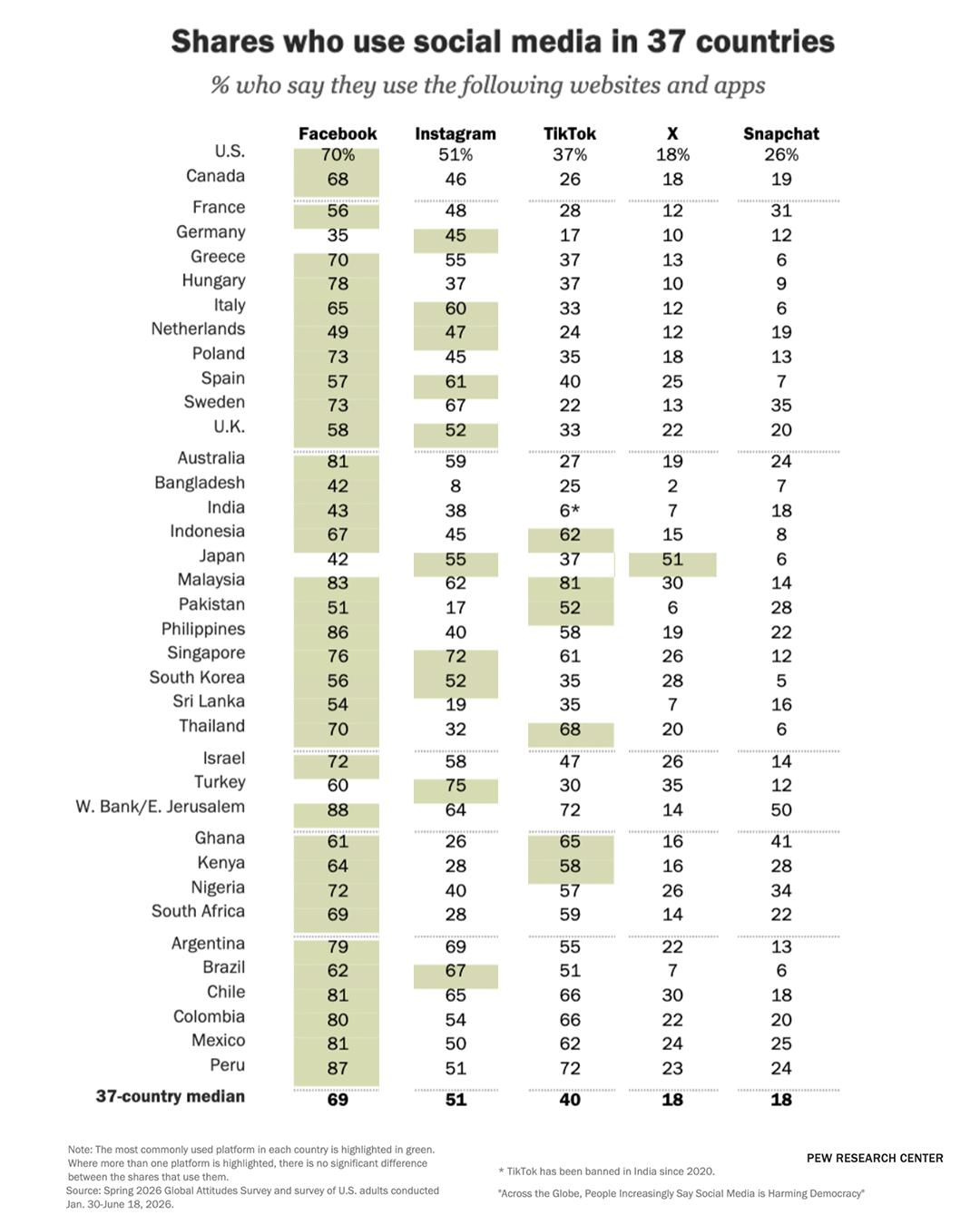
The Elon Musk-owned X, meanwhile, was used by 7 percent of Indian adults, marginally down from 8 percent in 2023. Banned in India since 2020, TikTok’s figure fell from 13 percent in 2023 to 6 percent in 2026.
India is also among the countries where at least one-third of adults say they use none of the five platforms Pew asked about — Facebook, Instagram, TikTok, X and Snapchat. The numbers, therefore, describe an information environment that is broadening and changing even as perceptions of its political consequences remain divided.
What Indians are really saying about SM
The Pew survey does not ask Indians to choose between seeing social media as a democratic tool and seeing it as a political threat. Instead, its findings show that many Indians appear to hold both views at once.
The 66 percent who say social media is good for democracy are not necessarily dismissing concerns about misinformation: Sixty-two percent percent also say it makes people easier to manipulate with false information.
Nor does seeing social media as a source of political participation rule out concern about polarisation: 55 percent say it gives people a more meaningful political voice, while 51 percent say it increases political division.
That duality is central to the global findings as well. Pew’s survey shows that people now realise that the same platforms that help information move faster and let political voices be heard by people can also make false information spread quicker and make arguments more intense.
The outcome isn’t an answer about whether social media is good or bad for democracy. In India, at least the interesting point is both sides of the situation have become common opinions: social media is seen as a way to learn more and share ideas more loudly. And as a place where people can be tricked more easily and become more divided.
(Edited by Tony Rai)
Also Read: China beats US in global popularity as confidence in Xi rises, US ahead in India—Pew survey