



New Delhi: Has China’s global image overtaken that of the US? How do people around the globe perceive China and the US on issues like influence, interference in the domestic affairs of other countries and personal freedom of their citizens?
A survey conducted by the Pew Research Center between February and May this year found that China is being seen as a country more favourable when compared to the US. For instance, median favorability for China has risen from 32 to 46, while for the US it has fallen from 58 to 36.
The most notable finding is a flip in how China is now perceived globally. There was a time when public opinion for China was very negative, but now favourability towards it has increased in more than a third of the 36 countries surveyed for this study. One of the biggest changes that can be seen is in Italy where the positive view of the country has increased from 31 percent in 2022 to 51 percent in 2026. This has happened for the first time in nearly two decades where more than half of Italians now see China positively.
Another country where the positive views have increased for China is Spain with 54 percent having favourable views of the country, a first since 2011.
But this is not happening in all the countries as there are some where a sharp decline has been noted in the favourable views of China. Israel is one such example, where the views dropped from 33 percent last year to just 19 percent this year.
Meanwhile, the US has a clear popularity advantage over China in just six countries, four of these in the Asia-Pacific region: Poland, India, Israel, Japan, the Philippines and South Korea.
India is one of the few major countries where the public opinion still remains strongly for the US, while 54 percent Indians have an unfavourable view of China; just 23 percent see it favourably.
Xi beats Trump
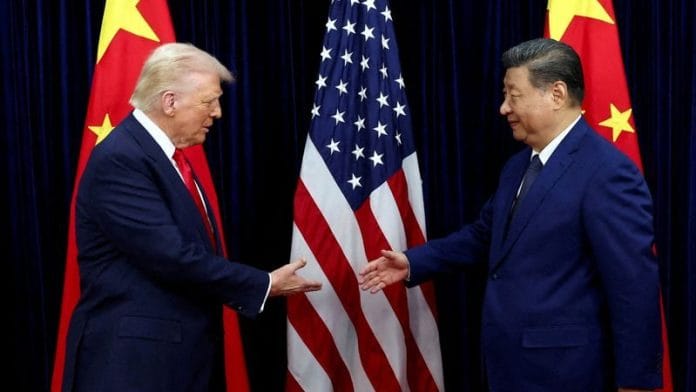
There has also been a shift in the confidence in world leaders. More respondents have shown confidence in Chinese President Xi Jinping than in US President Donald Trump to do the right thing in world affairs. This marks a reversal from the later years of Joe Biden’s presidency, when he generally enjoyed higher confidence ratings than Xi.
In terms of confidence for Xi to do the right thing, support is coming in from countries across Asia, Europe, Latin America and also from the Middle East. The countries included in this are Pakistan, Malaysia, Indonesia, Thailand, Bangladesh, Turkey, Spain, Italy, Mexico, Canada, France, Germany and the United Kingdom; all have more favourable views of China than of the US.
Moreover, Xi has the strongest support coming in from Pakistan, Malaysia, West Bank/Jerusalem, Indonesia, Singapore, Thailand, Sri Lanka and Bangladesh, with Pakistan being the biggest supporter at 83 percent.
In Europe, neither Trump nor Xi have majority confidence, but the latter received more confidence than Trump in most countries. In Germany, Greece, Italy, the Netherlands, Spain, Sweden and the UK, Xi’s ratings are more than 10 percentage points higher than Trump.
Also Read: Americans say staying informed is important, but few are well informed themselves, finds Pew
Personal freedom
Despite China’s leading gains in popularity, the Pew survey found the US still leads in respecting the freedoms of its people. “More say the US government respects the personal freedoms of its people than say the same of the Chinese government,” the report said.
According to Pew, this perception of the US respecting peoples personal freedom has now started to decline in multiple countries. At the same time there has also been a modest rise in people now saying that China respects personal freedoms. One such example is Mexico where around 35 percent now say that the Chinese government is respecting personal liberties while only 20 percent say that about the US.
Countries, including Sweden, Canada, France, Germany, Italy, Spain and South Korea, recorded declines of more than 25 percentage points in the share of people saying the US respects personal freedoms. At the same time, perceptions of China on this question have improved modestly in several countries, narrowing the long-standing gap.
Countries like Israel and Japan are the ones where overwhelming majorities believe the US respects freedoms more than China. In contrast, respondents in Bangladesh, Indonesia, Malaysia, Thailand and the West Bank and East Jerusalem say China respects the freedoms of its people more than the United States.
Middle-income countries and China
The Pew report also analysed 17 middle income countries where the US was seen as a more intrusive power, with a median of 75 percent saying that the US interferes with other countries from a great deal to a fair amount; this figure was 45 percent for China. The report also added that there was no single country which says that China has more interference than the US.
A median of 69 percent in these countries have also said that China is a reliable partner for their country while the US got 49 percent for the same. Furthermore, for peace and stability around the world, 58 percent said China contributes to this while just 40 percent said the same for the US. The report further added that 57 percent believe that China takes their countries interests into account when they make international policy decisions and 42 percent for the US.
South Africa is one such example where 72 percent have described China as a reliable partner and only 46 percent have done that for the United States. Also, around two-thirds of South Africans believe that China contributes to global peace and stability.
The Latin America shift
The Pew survey also reports that in Latin America, the US has become less favourable with the opinions about China still remaining largely stable. China is also now being viewed largely positively compared to the US in Argentina, Chile, Mexico and Peru, while opinions about Brazil and Colombia are about even.
Although majorities across the region are more likely to say the US interferes in other countries’ affairs than China does, the two powers are seen similarly when it comes to being reliable partners and contributing to global peace and stability.
The survey also found political and generational differences. In Brazil and Colombia, people on the political right are more supportive of the US, while those on the Left tend to have a better opinion of China. Younger adults in Brazil, Chile, Mexico and Peru are also more likely than older people to have favourable views of both countries.
(Edited by Nardeep Singh Dahiya)
Also Read: Pew’s religious diversity study is producing perverse results