



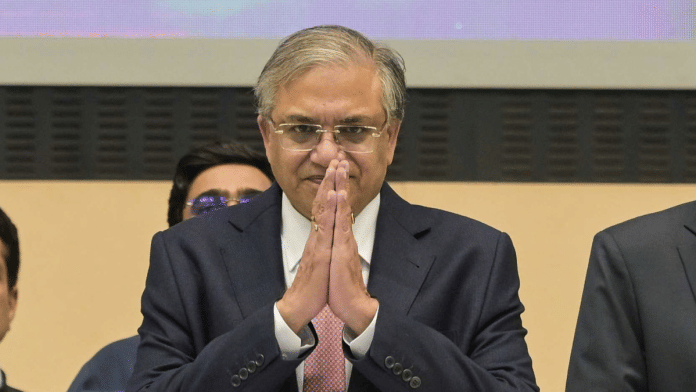
New Delhi: The Opposition parties came all out against Chief Election Commissioner (CEC) Gyanesh Kumar to seek his removal and suspension, after an Indian Express investigation that two Election Commissioners objected to various decisions taken by the poll panel.
The reports have given ammunition to the Opposition to link the findings to its wider ‘vote chori’ campaign against Kumar and the Modi government.
Leader of the Opposition in Lok Sabha Rahul Gandhi said the developments would “catch up with Gyanesh Kumar”, while his sister and Congress MP Priyanka Gandhi Vadra described the episode as an “assault on democracy” and “an act of treason”.
Congress Rajya Sabha MP Abhishek Manu Singhvi said the two commissioners were reduced to “dummies”, citing their 14 written objections over 10 months as mentioned in the reports.
“The CEC considers the people who are supposed to be his colleagues as ‘dummies’. They have recorded written objections and dissent 14 times in 10 months,” Singhvi said Wednesday.
He cited the Supreme Court’s judgment in the landmark 1995 T.N. Seshan v Union of India case, arguing that the other Election Commissioners must have a meaningful role in decision-making.
“All ECs are equal. The Chief Election Commissioner is not above the ECs. He is the first among equals,” Singhvi asserted.
Congress MP Manish Tewari said the disclosures, if correct, pointed to an ‘invisible hand’ running the Election Commission.
“If rules were not allegedly followed and decisions were taken that were not unanimous or by majority then all the decisions of @ECISVEEP are per-se arbitrary and capricious if not completely illegal,” the Chandigarh MP posted on X.
Congress MP and general secretary in charge Jairam Ramesh also slammed the CEC, and demanded that he be sacked.
“The CEC has proved to be an absolute disgrace to the Constitutional post he holds. His integrity of purpose, impartiality of intent and independence of action have always been extremely dubious. 73 Opposition MPs had moved an impeachment motion against him on April 24, 2026. That is still pending. Meanwhile, today he stands brutally exposed by his own two colleagues. And undoubtedly, Opposition MPs in both Houses now will be moving impeachment motions if there is a special session, since the Monsoon Session has not been prorogued for an unprecedented 43 days,” he posted on X.
“Mr. Gyanesh Kumar has functioned as a hatchet man for the Union Home Minister who, in turn, is the designated executor of the PM’s wishes. What the CEC has been doing is with the full knowledge, support and, in fact, at the instigation of the PM and HM themselves. #Gyaneshgate has been orchestrated by G2. Of that there can be no doubt.”
Aam Aadmi Party (AAP) national convenor Arvind Kejriwal went a step ahead to demand that the entire Special Intensive Revision (SIR) exercise be cancelled, all changes made through it be reversed and the earlier voter lists restored.
“The authority to add or remove names from the voter list lies solely with the ERO (Electoral Registration Officer), so how are people sitting in Delhi altering the voter lists of the entire country?” Kejriwal said at a press conference.
Meanwhile, Rajya Sabha MP John Brittas wrote to President Droupadi Murmu seeking urgent constitutional intervention in the matter.
“Two of the three Election Commissioners have reportedly objected, at least fourteen times over last ten months, to decisions taken without their approval, alteration of statutory Form 6, centralised control of electoral-roll data, and appeals filed in West Bengal on behalf of the ECI, without their approval, against the inclusion of voters by judicial officers,” the CPI(M) MP wrote.
Another Rajya Sabha MP Kapil Sibal demanded Kumar’s suspension and called for halting the SIR process. “Majority is not with the CEC,” he said.
The Indian Express investigation found that Election Commissioners Sukhbir Singh Sandhu and Vivek Joshi had put their objections on record at least 14 times over the past 10 months, including on decisions relating to new voters, deletion and restoration of names from electoral rolls, appeals against voter-related orders and the system through which electoral-roll data is maintained.
The two ECs also raised concerns about communications being issued in the name of the Election Commission without their approval and warned about what Joshi described as the “gradual centralisation of the electoral roll database”.
One of the clearest disagreements was over Form 6, the form used by people applying to register as voters.
The Commission added a declaration linked to the previous Special Intensive Revision to the form on its ECINet portal. Joshi objected in May, saying Form 6 was prescribed under the Registration of Electors Rules, 1960, and could not be changed through an SIR direction without amending the rules.
Sandhu agreed with Joshi’s objection on 19 May. Yet the new declaration was later added to the form. On 13 August , after the change was reported, Sandhu wrote to officials describing it as “unauthorised/illegal” and said it “must be removed immediately”, according to the report.
Later in the day, the Election Commission came out with a statement that “differing views are a normal part of deliberation in any institution”. All decisions, it added, were “an outcome of the unanimous decisions of the full Commission in the past one year”.
(Edited by Tony Rai)